Showing posts with label Nobel. Show all posts

Thursday, October 13, 2011

Nobel Prizes simplified

Sargant and Sims are macroeconomists who won the Nobel Prize for economics for helping us understand causality. Since we usually can't perform macroeconomic experiments (randomly assigning governments' fiscal or monetary policies), they developed ways to help identify causality from historical data, even though final outcomes are the results of many variables interacting in complementary or counteracting ways. Sargent's work focused on shifts in policy and Sims' work on unexpected changes in underlying macroeconomic variables. A very good example of this from a report recommended by Marron:
A change in the interest rate or tax rate is not the same as a shock, in the sense that at least part of the change might be expected. This is a longstanding insight in the context of the stock market. A firm which reports improved earnings and higher forecasted profits might still encounter a drop in its share price, simply because the market expected an even stronger report.
The World Food Prize - which we consider the Nobel for food, agriculture, and nutrition - went to the presidents of Brazil (Lula da Silva) and Ghana (John Agyekum Kufuor) who successfully reduced hunger and undernutrition in their countries by massive amounts. In my own research, both scored very highly for their political will to reduce hunger also, so I'm glad to see that verified by other measures. They'll be speaking at the conference tonight, I believe.


The chemistry and physics prizes both went to people who, in the last 30 years, overturned our understandings. The chemistry laureate (Dan Schechtman) discovered a form of "quasicrystal" in the mid-80s that had a structure we believed was impossible. Having found it really exists, however, we have been able to improve our non-stick pans (among many other things) by manufacturing these quasicrystals. At the time, though, he was laughed to scorn and thrown out of his research group for persisting in believing something scientists "knew" was impossible.


In physics, the laureates (Saul Perlmutter, Brian P. Schmidt, and Adam G. Riess) changed our best guess about how the universe expands. We had known the universe is expanding, but the dominant paradigm was that it was expanding more and more slowly. They showed that it is in fact growing at a faster rate than before.


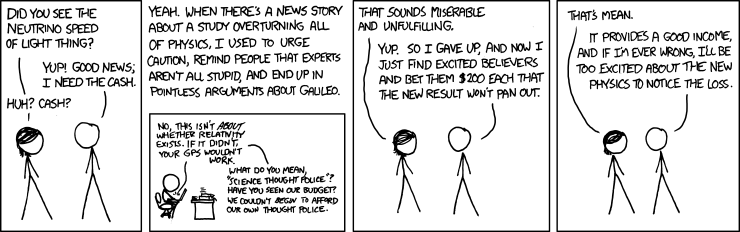
Both of these prizes, I should point out, both show how the scientific method eventually corrects misperceptions and that we need to be much more humble about what science tells us. Within 20-30 years we may believe things that are completely different from what we believe now. Science is not exact. It is a process of falsification and the things we believe today are merely those we have not yet falsified. Be more humble when you place your faith in science. (Although, do remember to also be sceptical of new studies too:)


Monday, May 9, 2011

Five Second: Fukuyama

A wonderful article on Fukuyama’s book on the history of the state. This excerpt on where the rule of law comes from was particularly interesting to me:
WHY did the Catholic church’s insistence on priestly celibacy in the late 11th century give Europeans an early advantage over other societies in establishing the rule of law? The answer in Francis Fukuyama’s stimulating new book is that celibacy was one of several important reforms, instituted by Pope Gregory VII, which resulted in the development of canon law and the notion that even kings were subject to it. Gregory won everlasting fame by bending Henry IV, the Holy Roman Emperor, to his will, forcing the most powerful man in Europe to do penance before him at Canossa. 

Celibacy was vital in the battle against corruption and rent-seeking within the church, both of which were the typical consequences of patrimony. The reforms gave the church the moral stature to evolve into what Mr Fukuyama describes as “a modern, hierarchical, bureaucratic and law-governed institution” that established its authority for spiritual affairs—and by so doing set the ground rules for the subsequent rise of the secular state.
Fukuyama views the three main pillars of a strong modern state to be a strong state (monopolization of violence), the rule of law, and accountability. He credits China with the creating the first state

However, he did a much worse job in discussing Hayek, whom he claims had a knee-jerk certainty that governments are always wrong. It is the word certainty on which most of the responses have fixated. Easterly puts the case rather better:
Hayek’s view of knowledge was that it was partial and dispersed among many. The market gave individuals the incentives to apply this knowledge, and coordinated the uses of this local knowledge in a way that rewards each of us who knows best about any particular narrow area. ... Government usually lacks both the incentives and the coordination mechanism. In government we don’t know who knows best, so which knowledge wins the argument could often be wrong. …
[Even though democracies will have better incentives and mechanisms] the political feedback mechanisms even under liberty (like majority voting, protesting, freedom of speech, or lobbying) are much cruder and less likely to align individual and social payoffs than the market feedback mechanisms, so one should be cautious about the scope of activities in which government programs will be effective.  …
To sum up,  Hayek’s skepticism about government was NOT based on his certainty, as Fukuyama would have it,  but on his awareness of his ignorance. (and everyone else’s)

Friday, May 6, 2011

Five Second ... Friedman Quotations

On Free Markets and Government
The case for free enterprise, for competition, is that it's the only system that will keep the capitalists from having too much power. ... The virtue of free enterprise capitalism is that it sets one businessman against another and it's a most effective device for control.

I start ... from a belief in individual freedom and that derives fundamentally from a belief in the limitations of our knowledge, from a belief ... that nobody can be sure that what he believes is right, is really right.... I'm an imperfect human being who cannot be certain of anything....

It is fortunate that the capitalist society is more productive, because if it were not it would never be tolerated. The bias against it is so great that ... it's got to have a five-to-one advantage in order to survive.

Every intellectual believes in freedom for himself, but he's opposed to freedom for others. ... He thinks ... there ought to be a central planning board that will establish social priorities.... The businessmen are just the opposite -- every businessman is in favor of freedom for everybody else, but when it comes to himself that's a different question. He's always a the special case. He ought to get special privileges from the government, a tariff, this, that, and the other thing.

We talk about ourselves as a free enterprise society. Yet in terms of the fundamental question of who owns the means of production in the corporate sector we are 48 percent scholastic because the corporate tax is 48 percent.

Part of freedom ... is the freedom to be a fool.

Many people complain about government waste, but I welcome it ... for two reasons. In the first place, efficiency is not a desirable thing  if somebody is doing a bad thing. ... In the second place, waste brings home to the public at large the fact that government is not an efficient instrument for achieving its objectives. One of the great causes for hope is a growing disillusionment... with the idea that government is the all-wise, all-powerful big brother who can solve every problem that comes along.

On Monetary Policy

Thursday, April 28, 2011

Keynes vs. Hayek Rap 2.0


The first rap in my opinion did a better job in presenting very clear cut answers and a much stronger Hayek case. In the second, though there are some good rejoinders, the absolute refusal to rely on empirics and some double-talking leaves a lot of questions wide open.

The big question: is the economy an engine or is it organic?

Hayek's best line: "Jobs are the means, not the ends in themselves. People work to live better, to put food on the shelves."

His least effective line was that he doesn't want "nothing" done, he just wants individuals to do things rather than government. That (still) doesn't answer several of the fundamental questions and doesn't really respond to the question being asked.

Update: Voorhies puts it better: "Better production values, but its also a more ideological piece than the first one. It sounds less like the rap version of a conversation between a Keynesian and Austrian, and more like a conversation between an Austrian and what an Austrian thinks a Keynesian might say, which are two separate things."

HT:Mankiw

Tuesday, April 19, 2011

Big Bag of Silly

Bayes’ Theorum meets the Congressional Muslim
Terrorism Hearings. The result? Hilarity and a picture! 

If you want to lower sales of a product you hate, don’t just give it a bad review. Give a bad review with spelling and grammatical mistakes.
Hernando de Soto said the only thing that mattered was property rights. He called for secure titles to his team’s land. This team defended its own half-court successfully, but they were forced to recognize the other team’s rights also. There was not a lot of scoring….
(From the comments) Amartya Sen said his team has never had a shortage of points, they were just poorly distributed among the games.
Republicans throw support behind a man who doesn’t want to be President (video below the fold):

Friday, December 31, 2010

100 Years of Coase

Yesterday was Nobel Economist Coase's 100th birthday. A Boudreaux (2007) article celebrates one of his less-known articles on a fallacy of relying solely on marginal cost to determine value.

To celebrate, here are a few links that serve to either reduce our research transaction costs or to correct other economics fallacies:

IFPRI has released a new weekly food price series going back to 1998 with daily data for futures back to 2001. It includes hard wheat, soft wheat, soybeans, maize, and rice.

Nick Rowe demonstrates that there are no income effects. Well, not from price changes anyway.

Yes, thing are bad in Haiti one year after the earthquake. This is par for the course after disasters everywhere.

Is government growing or shrinking? Yglesias repeatedly shows that total government employment is down slightly as state and local governments are shedding workers. The federal government, however, has been growing its workforce: a little in 2002 and a lot since the recession started. It's not just the retired census workers. Oddly enough, it's Krugman showing us the graph that demonstrates it, though we need to turn to Murphy for the pointer and a response to Yglesias:
But I bet if a had a bullhorn I could get a Tea Party crowd pretty worked up by saying, "Can you patriots believe this? The federal government is growing, while state and local governments have to lay off teachers and firefighters! So grab your pitchforks and let's go give Obama a lesson in federalism he'll never forget!"

Wednesday, November 3, 2010

Food prices and inflation

A couple weeks ago, Armstrong at the Mises Institute put out a tirade against "Helicopter Ben running his printing presses at full speed" causing 0.4% inflation. He then explained that people were not more concerned about this terrible inflation rate because "core" inflation -- everything but food and fuel -- had only gone up 0.1%. That's less than 2% a year, hardly massive inflation. Food and fuel had gone up by a little more than 0.5%.

Armstrong then made a point that was simultaneously off-base and insightful in another context. First, the off-base part. Inflation is not changes in relative prices. When the price of one group of commodities (like food) goes up relative to other prices, that isn't inflation. When the rise in food prices leads to a rise in wage prices and a rise in the price of everything, that is inflation, but it's still a one-time event. It's not ongoing, monetary inflation of the sort that would be caused by the Fed. If I have a pain in my chest, it could be a heart attack or it could be that someone punched me and as a doctor you have to look at the other symptoms to know which is the case. This is not inflation caused by the monetary authority.

The other point is exceptionally well made, however. Where people spend large amount of their income on food -- particularly poor people -- the rise in food and fuel prices matter a lot more to their well-being than core inflation. When food prices spiked in 07/08, what mattered for the world's poor was the rapid erosion of their purchasing power. The current, small spikes are not caused by Bernanke, but by Russian wildfires and predicted low US maize harvests. FAO is rather concerned about it.

The reason we separate inflation into food, fuel, and "core" is so we can look at the part that matters. If you're trying to judge whether Fed policy is excessively loose, core inflation is what you ought to look at and it says that inflation is below what the Fed is unofficially targeting. If you want to identify changes in welfare for the "average" person, you need to look at the total picture including food and fuel. For different income groups, you really ought to look at different commodity baskets that include the other resources available to the group. If the price of organic, farmers' market foods goes up, well-to-do Ithacans may spend less on food in total by buying more from WalMart (while wearing a bag over their heads... can't let my neighbors find out.) When the prices of food at WalMart go up, the less well off have few other alternatives.

This, incidentally, is one of the reasons that it is important to continue investments to help small farmers become more productive, as discussed by this year's World Food Prize winner Beckmann and Aid Thoughts' Dissanayake. A paper reassessing our success in raising smallholder, Sub-Saharan Africa agricultural productivity is here, recent FAO efforts are highlighted in Nicaragua and in Pakistan, India is considering replacing coconut harvesters with machines, and a discussion of Malawi beekeeping all make interesting case studies of the efforts underway.

Friday, October 8, 2010

Big Bag o Latin American Links

The Millennium Challenge Corporation celebrated a completed contract with Honduras
“on-time, on-budget, and with all targets met” despite a political crisis and three different governments during the duration of the compact.  With numerous infrastructure projects completed and over 6000 farmers trained, the compact targeted development in rural areas and worked as a transformational tool to put in place systems that will continue to benefit the Honduran poor after the close of the compact.
 The application of the Coase theory to water management in Ecuador.Rights have been awarded the upstream water users with downstream users paying them to keep it clean and preserve forestry along the water's edge.

Growing tension in Haiti over land rights - tent dwellers have been in tents for quite some time now and the generous folks giving them the land for it are getting tired. They'd like people to move on so they can make sure their land stays theirs. But where do the displaced people then go? Higher education is similarly suffering a heavy burden from the earthquake, and it's pretty low on most donors' lists. And, by the by, here is a picture of the Haiti/DR border demonstrating (once again) the lack of trees. Most were cut down during the 1991-94 military dictatorship/embargo/inflation/everything else that could go wrong.

I have continued my tradition of picking up one of the works of the year's latest literature Nobel winner, which this time around is Mario Vargas Llosa, a Peruvian politician and libertarian. The War of the End of the World sounds like it should be quite engaging - inequality and poverty, development, state vs. individual, and it opens with a mysterious religious man with fire in his eyes.

Friday, October 1, 2010

The Lighter Side: Economists

From the 2010 AEA meetings, it's Bauman, the stand-up economist, featuring

How to make eggs with economists
Nobel Prize winners reactions to the news
Nobel contributions summarized and simplified

(below the fold)

Monday, August 16, 2010

Coase theorem at work: green energy and litigation avoidance

From MR comes a link to a fascinating piece. Coase got his Nobel in part for showing that it doesn't matter whether you assign property rights to polluters or non-polluters so long as they can costlessly* pay each other for good behavior. Wind power is not usually seen as a polluter, but there is a law in Oregon against noise pollution. "In a region where people often have to holler to be heard over the roar of the wind across the barren hills, they say it is the windmills that make too much noise."

In response,
Patricia Pilz of Caithness Energy, ...  is making a tempting offer: sign a waiver saying you will not complain about excessive noise from the turning turbines ... and she will cut you a check for $5,000.
“Shall we call it hush money?” said one longtime farmer, George Griffith, 84. “It was about as easy as easy money can get.” Mr. Griffith happily accepted the check, but not everyone is taking the money.


* - Costlessly is the big assumption. Much of the rest of his Nobel came from showing the importance of transaction costs and that it is NOT costless to do this kind of arrangement.

Thursday, July 8, 2010

World Food Prize 2010

David Beckman (Bread for the World) and Jo Luck (Heifer International) are the recipients of this year's World Food Prize, largely in honor of the role that NGOs play in improving food security.

Beckman's work to nearly double membership in Bread for the World advocate for US policy changes are credited with lifting "hundreds of millions of people" out of poverty and hunger. Centrally highlighted are the US government's increases in aid, particularly to Africa and for agricultural development. "While these positive strides have many causes, they would not have happened without Beckmann and Bread for the World leading millions of citizen advocates across the country to press for change, nor without Beckmann's personal commitment to founding and strengthening other organizations working in concert to improve the lives of the poor." Beckman is a minister and an economist.


Heifer International has been involved in getting livestock to poor families as an additional source of income and food production. Luck expanded membership in the organization 20 fold since 1992 and is credited with expanding HI's outreach to enable 12 million families to feed themselves. Part of the program involves recipient families passing on one of the livestock's offspring to another needy family so that more families can be reached and recipients become givers in turn.

Friday, February 5, 2010

Five Second ... Capitalism and Freedom

One of the parts that has stayed with me the most since I read Milton Friedman's Capitalism and Freedom (1962) this last year was his first argument from the introduction. I caught myself rehearsing it just this week, in fact, without remembering who made it until I reread it today:
In a much quoted passage in his inaugural address, President Kennedy said, "Ask not what your country can do for you - ask what you can do for your country." ... Neither half of the statement expresses a relation between the citizen and his government that is worthy of the ideals of free men in a free society. The paternalistic "what your country can do for you" ... is at odds with the free man's belief in his own responsibility for his own destiny. The organismic, "what you can do for your countrry" implies that government is the master or the deity... . To the free man, the country is the collection of individuals who compose it, not something over and above them. He is proud of a common heritage and loyal to common traditions. But he regards government as a means, an instrumentality, neither a grantor of favors and gifts, nor a master or god to be blindly worshipped and served. ...

The free man will ask ... rather "What can I and my compatriots do through government" to help us discharge our individual responsibilities, to achieve our several goals and purposes, and above all, to protect our freedom? And he will accompany this question with another: How can we keep that government we create from becoming a Frankenstein that will destroy the freedom we establish it to protect? Freedom is a rare and delicate plant. Our minds tell us and history confirms, that the great threat to freedom is the concentration of power.
The two questions form the crux of the book's discussion.

Friday, January 8, 2010

Five Second Nobel ... Frisch 2

In the second half of his Nobel lecture, Ragnar Frisch turns to the subject of econometric planning and lays out what I think is a rather unique vision of how economists could improve the policy process. I make some comments at the end about why we don't see this system in practice and a danger I would see if we did.
My purpose is to make economic planning at a high aspiration level one of the pillars of a living democracy ... living in the sense of actually engaging as many as possible of the citizens to take an active part in the affairs of the small community where they are living, and ... the nation as a whole.
I should note that I see nothing in the remainder of his talk that would actually promote this ideal, but this is his ideal.

The first step in his proposed process involves the economist sitting in his [or her] office formulating the complex system of dynamic equations that describe the macroeconomy and its behavior and making "a tentative opinion" about the preferences of the major political parties/actors.

Then the economist is to interview the primary decision makers. The purpose is to get at the decision makers' indifference curve over outcomes, and he stresses that this is not a social welfare function in any sense of the word. He provides as an example identifying the politician's preferences over the Philips curve trade off between inflation and unemployment.

He has some interesting things to say about the interview process itself:

Wednesday, January 6, 2010

Five Second Nobel ... Frisch 1

Ragnar Frisch shared in the first award of the Nobel prize in Economics. He not only helped found the first econometric society and its top journal, Econometrica, but even gave us the term econometrics. Following are excerpts and summaries from the first half of his Nobel address where he identifies why economics moved to quantitative analysis in a manner that has a great deal of application to today and warns about not trusting our computers and minds too thoroughly:

"FROM UTOPIAN THEORY TO PRACTICAL APPLICATIONS: THE CASE OF ECONOMETRICS"
Deep in the human nature there is an almost irresistible tendency to concentrate physical and mental energy on attempts at solving problems that seem to be unsolvable. [As examples, he points to mountain climbers, physicists, and astronauts.] scientists who are absorbed in the study of “unsolvable” problems ... pass through ups and downs. Sometimes hopeful and optimistic. And sometimes in deep pessimism. ...

[He demonstrates with a simple linear algebra example that we can produce as strong a correlation as we wish on chaotically unrelated variables.]

It is quite clear that the chances of survival of man will be all the greater the more man finds regularities in what seems to him to be the “outer world”. The survival of the fittest will simply eliminate that kind of man that does not live in a world of regularities. This development over time would work partly unconsciously through the biological evolution of the sense organs, but it would also work consciously through the development of our experimental techniques. The latter is only an extension of the former. In principle there is no difference between the two. Science considers it a triumph whenever it has been able by some partial transformation here or there, to discover new and stronger regularities. If such partial transformations are piled one upon the other, science will help the biological evolution towards the survival of that kind of man that in the course of the millenniums is more successful in producing regularities. If “the ultimate reality” is chaotic, the sum total of the evolution over time - biological and scientific - would tend in the direction of producing a mammoth singular transformation which would in the end place man in a world of regularities. How can we possibly on a scientific basis exclude the possibility that this is really what has happened ? This is a crucial question that confronts us when we speak about an “ultimate reality”. Have we created the laws of nature, instead of discovering them? ...

Understanding is not enough, you must have compassion. This search for regularities may well be thought of as the essence of what we traditionally mean by the word “understanding”. This “understanding” is one aspect of man’s activity. Another - and equally important - is a vision of the purpose of the understanding. Is the purpose just to produce an intellectually entertaining game for those relatively few who have been fortunate enough through intrinsic abilities and an opportunity of top education to be able to follow this game? I, for one, would be definitely opposed to such a view. I cannot be happy if I can’t believe that in the end the results of our endevaours may be utilized in some way for the betterment of the little man’s fate. ...

As long as economic theory still works on a purely qualitative basis without attempting to measure the numerical importance of the various factors, practically any “conclusion” can be drawn and defended. For instance in a depression some may say: A wage reduction is needed because that will increase the profits of the enterprises and thus stimulate the activity. Others will say: A wage increase is needed because that will stimulate the demand of the consumers and thus stimulate activity. Some may say: A reduction of the interest rate is needed because this will stimulate the creation of new enterprises. Others may say: An increase of the interest rate is needed because that will increase the deposits in the banks and thus give the banks increased
capacity of lending money. Taken separately each of these advocated measures contains some particle of truth, taken in a very partial sense when we only consider some of the obvious direct effects, without bothering about indirect effects and without comparing the relative strengths of the various effects and countereffects. ... This perhaps is the most general and most salient formulation of the need for econometrics. ...

It goes without saying that econometrics as thus conceived does not exhaust all the contents of economics. We still need - and shall always need - also broad philosophical discussions, intuitive suggestions of fruitful directions of research, and so on. But this is another story with which I will not be concerned here. Let me only say that what econometrics - aided by electronic computers - can do, is only to push forward by leaps and bounds the line of demarcation from where we have to rely on our intuition and sense of smell. ...