Showing posts with label Trade. Show all posts

Friday, February 10, 2017

Is a strong exchange rate good or bad?

So apparently Pres. Trump has asked his national security adviser if it was a strong dollar or a weak dollar was good or bad.

I ask this on my tests regularly ... almost every class I teach has it in one form or another, actually. And since the article doesn't answer it for you, here are the correct answers depending on the class:

Correct answer a) in every class - There is no such thing as "strong" or "weak". It's all relative. So then I ask whether "stronger" or "weaker" is better. [PS - This is the kind of pedantic right answer that is useful for students and should not be given to the President of the United States, just in case you are in that position.]

Correct answer for intro students - It depends on who you are. Exporters, the tourist industry, and firms competing with imports prefer weaker while importers, consumers, and tourists prefer stronger. So if you produce shirts, you like a weaker dollar at the office and a stronger dollar at home.

Correct answer for intermediate macro students: It depends on WHY the dollar changed. NEVER REASON FROM A PRICE CHANGE. I can tell you an example where a stronger dollar is good for just about everyone in the US and I can tell you an example where a stronger dollar is worse for just about everyone. The relative strength or weakness of the dollar by itself doesn't matter. WHY did it change?

Correct answer for international (trade) students: What matters for investors is what direction it might move in the future. If you are planning to invest abroad, you want the dollar to get weaker over time. If you want to attract foreign investment, you want them to believe the dollar will get stronger. Unless of course the WHY is something bad for your firm (Why still matters)

Correct answer for development economics students: One theory claims you can boost economic growth by weakening your currency so you export more. The problem with that theory is that the way you weaken your currency is via inflation or taxing your people so you can buy up a lot of foreign currency, either of which will have negative effects on your economy too.

Given that very long answer, I'm not surprised Trump didn't ask an economist.

Monday, November 26, 2012

ECO 303: Clarification on our need for imports

I have a suspicion my example in Development today was less than crystal clear, so please let me try again.

I posed the question why it was a mistake to think that shutting off all imports was a key to growth based on the claim that Y=C+I+G+EX-IM, so *obviously* lowering imports is good.

If you missed the quiz, take a moment to think about the answer before looking below the fold.

Tuesday, November 13, 2012

ECO 302: Big Bag of Market Monetarism

We're doing market monetarism in my intermediate macro class tomorrow morning. Here are the handout notes, minus some explanatory material. These are just a few of the things written in the last 45 days on the subject - making the class CURRENT, baby! - without themselves being an attempt to define and explain everything about market monetarism. The main topic is why current inflation rate and interest rate targeting is ineffective, supporting the MM view that we should target the forecast of nGDP growth.

Friday, February 17, 2012

Lit in Review: Ghanaian Agriculture

Egyir, Adu-Nyako, and Okafor examine how the "Made in USA" poultry label affects consumer choice in Ghana. Among the statistics they offer, domestic production accounts for 10% of the poultry market. In 2010, the local price was just under $4/lb while imports cost under $1.10/lb Costs could be brought down with better management and vaccine delivery. Two decades ago, fish provided 60% of the animal protein they consumed, but poultry has been growing in importance. Most of the chickens (60%) are bought directly from the farm, with supermarkets only serving the high income group. The poultry packing industry is in its extreme infancy.

500 consumers were surveyed about their attitudes on how likely they were to purchase domestic chicken, versus Tyson (US), Brazilian, European, or Asian chicken. 56% were likely to buy Made in the USA, and 72% to buy Ghanaian. Asian chicken did not score very highly. More than 80% recognized COOL chicken. (That's Country of Origin Labeling, not the fellow on the right.)

Here is Kris Klokkenga's description of the differences between trying to farm in Illinois and in Ghana:

Tuesday, January 17, 2012

Best of 2011

Time for some intense naval-gazing. I wasn't going to do one of these, but then I enjoyed others' so much for the posts I missed that it seemed much more interesting.

Top Ten Posts of 2011
1. Google's statement on AUN's amazing internet usage, got a lot of doubting comments and a few  defending and very plausible explanations.
2. Nutrition Labeling, describing the new requirement that meat include information on calories from fat.
3. Unemployment: Leads and Lags - Breaking unemployment into separate decisions to hire or fire will give us a better indicator of where the economy is going (has been) than total unemployment.
4. AEA session on agricultural export bans during the 07/08 food price crisis.
5. Microinsurance in Kenya via cellphone
6. My first visit to AUN. Classes will resume Thursday the 24th
7. Low saturated fat diet vs. low simple carbohydrate diet
8. QE2 and food prices - debunking the idea that the Fed is causing global food price inflation
9. Food safety, food movements, and paternalism
10. Lit in Review: Food Demand -- Ethiopia and Speculators
Honorable Mention (because I thought it was fun): The socially acceptable price of fried chicken, also known as the political economy of fast food markets in South Korea.

Top Ten Posts of 2010 (in 2011)

1. My pictures of the Thorvaldsen's Christus and apostles statues, mentioned in a Church lesson this year.
2. Lit in Review: Grossman and Helpman, there has been steady interest in summaries and other papers that make use of the "Pay to Play" model of lobbyists.
3. Food in Africa: Too much and too little discussing the problem of getting food from food-surplus states to food-deficit states. There was never a large spike, but a steady stream of interest throughout the year.
4. High Hopes for Rwandan Agricultural Development
5. Food Security in Nepal which has been of increasing interest lately
6. Cutting Costs Through ... Fonts?? Some fonts go easier on the printer's ink
7. Population Health vs. Individual Health - commentary on macro vs. micro in economics and health
8. Ethiopian Monetary Policy - combines monetary policy, food prices, Ethiopia's development goals (food self-sufficiency), and growth prospects
8. Five from vacation: education, hyperinflation, and Chinese food safety.
10. Fed governor: if we could guarantee 5% NGDP growth, it would be great - I'm glad this made the list because I think it was my most significant post, interviewing Governor Dudley about what they are targeting and Sumner's policy.

Where did my visitors come from in 2011?

Wednesday, January 11, 2012

General Equilibrium: Fuel Subsidies and Cocoa

What other effects does the removal of a fuel subsidy have? Well, it increases the price of cocoa, for one. Removing the fuel subsidy led to strikes, and strikes led to this:

The ongoing labour strike in Nigeria has contributed to drive the price of Cocoa to highs not seen in 11 years. Government processing offices that usually grade Cocoa before export are closed as a result of the strike. Also virtually all export terminals have been closed as a result of the strike. Cocoa beans are first certified/graded before being bagged and shipped for exports.
The price of Cocoa had fallen over 30% in 2011, however the strike has seen prices rebound and gain 15% in just two days.

Friday, December 30, 2011

Economics in Unusual Places

1 - Using game theory at a buffet with limited food options to figure out what foods you should choose first (HT: MR). Basically, instead of just grabbing your favorites first, you should think about what other people will grab first (and as importantly, last). If your favorite food is hated by your fellow diners, leave it alone - it will still be there later - and pick up something else that might disappear if you don't grab it now. The article also has insights about the kinds of social norms that make everyone better off, how to pile the most on your plate, and some Wansinkian insights how much women's food choices are influenced by their neighbors.

2 - Some more game theory on why Iran has told the US just how it captured the Sentinal drone: by ensuring that it will only have one to sell, it makes other countries much more willing to pay for that one than they would be if they thought 2-3 more might appear in the next few years. Iran is sending a signal or using a commitment device about its future behavior to impact the actions of its fellow players today.

3 - I reported earlier on how G.I. Joe action figures are not classified as "action figures", but are "dolls" so they can get a lower tariff. The X-Men apparently are marketed by Toy Biz as not being human at all so they can avoid being tariffed at the doll rate altogether and instead get classified as "toys." Little did the X-Men realize their own marketing agents were plotting against their basic humanity, and all in the name of economics!

4 - Are we on our way to a Kuznets Gender Curve? Very poor countries and households can't afford to select children based on gender. As income rises (to the level of India and China, say) there is more and more discrimination favoring boys - medicine can tell families whether the fetus is a boy or a girl and they can react as they wish. However, new evidence is showing that upper-middle class Indian families ($3200/yr and up) are reversing the trend. The Economist praises bourgeouise values for saving the girls.

5 - Cowen pushes back hard on the idea that wealth is power, whether in politics, charity, or the market:
Second, the wealthy in groups do not always coordinate very effectively, to say the least.  ...  Third, many of the very wealthy choose to consume ego rents rather than effectiveness.  Fourth, “democracy” and “the market” control large chunks of modern life, and it is hard for outsiders to commandeer those processes.... the ability of the rich at the margin to control policy through intentional acts, either individually or in groups is much overrated.
Wealth does protect you from the depredations of others, such as being treated very badly by the police or legal system.  In this defensive sense wealth can give you a good deal of power.

Friday, November 11, 2011

Mixed Bag: good and bad in African agriculture

In the most distressing news I've heard recently put in a positive light, 20 Tanzanian farmers were invited to Uganda to learn more about using human feces as fertilizer. They would like to convince us that this is a good thing because fertilizer use is so low, but it's also a great way for spreading diseases. Their numbers are 20 years old, but show that a lot more fertilizer is supposedly distributed than was ever spread on crops. That doesn't suggest the problem was lack of fertilizer availability.

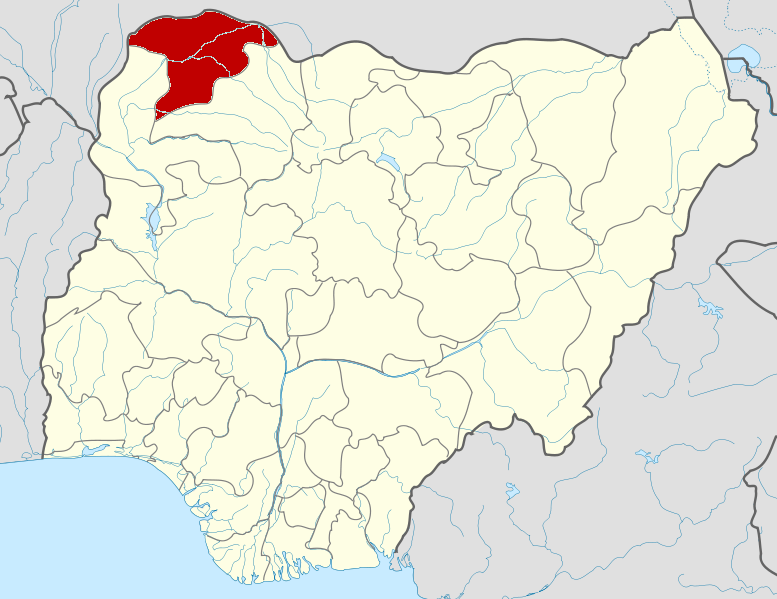
Flooding in northwestern Nigeria (Sokoto state, pictured) destroyed 1 billion Naira worth of crops ($6.7 million).

In much happier news, ICRISAT has been providing some Mali farmers with groundnut (peanut) seeds that take only 3 months to harvest instead of 4. As rain patterns have shifted, assumedly due to climate change, the rainy season has been getting shorter and shorter. If I understand the report correctly, it claims that groundnut production has also increased 10-fold.

They also established a cooperative (starting at 20 members, now 65) to coordinate storage. Each member of the cooperative contributes 20 kg of groundnuts for storage. 10 of them they get back later in the year (as a form of forced storage for behavioral economics reasons) and the other 10 are sold (for about $320) to give the cooperative a source of loanable capital.

Ugandan rice production is up significantly - 66% during the last decade. Instead of importing rice, they now export to South Sudan, Kenya, and DRC. The article credits Nerica (New Rice for Africa) with much of the growth. I take the article to be saying that a new survey by the Ministry of Agriculture claims that rice exports are now valued more than any other traditional food export.

Zimbabwe is going to start handing out agricultural input vouchers to vulnerable farmers this week, entitling them to "10 kilograms of maize seed, one 50-kilogram bag of compound D and one 50 kilogram bag of ammonium nitrate fertilizer."


Wednesday, November 9, 2011

Lit in Review: SSA Development

Wantchekon, Leonard, "Deliberative Electoral Campaigns and Transition from Clientelism: Evidence from a Field Experiment in Benin." Wantchekon got permission from the major presidential political candidates in Benin to run an experiment on their campaigns. The randomly selected treatment villages had two town hall-style discussions about important political topics while control villages had the standard rallies. Among the interesting conclusions from his research, rallies cost $15/person to hold but town hall meetings only $2/person; turnout is 5% higher after town halls; and average spending (cash and gifts) to voters was not statistically different between treatment and control groups so that's not what's driving it. It seems that town hall meetings may be the more efficient way to go in national elections.

Aye and Gupta, "The Effects of Monetary Policy on Real Farm Prices in South Africa." They find using a VAR model that both anticipated and unanticipated monetary policy impacts farm prices in the way we would expect (more money supply --> higher prices, big surprise; but lower money supply does not lower prices) but while statistically significant they don't explain much of the variation in what is happening from 1970 to 2010. I wonder if they would have gotten much different results if they looked at  1975-2005 instead and took out the two major episodes of international food price volatility. How much are they driving the small impacts? They also do not attempt to explain how anticipated monetary shocks could have a significant impact or why negative money shocks don't have price impacts. I would hypothesize at least for the latter that it is because of an inflationary shock to supply that the monetary authority chose lower money supply growth, so we wouldn't see a change that direction because of endogeneity problems.

Clemens and Demombynes' latest salvo in the Millennium Villages conflict: the MVP released a paper for the first time comparing progress in the villages to progress in the rest of SSA. Unfortunately, they still do this improperly. What would they have found doing it more properly?
In rural areas of the Ashanti region where the MVP site is located, stunting has been falling just as much as at the project site. The Millennium Village contains less than 1% of Ashanti Region’s population, so even allowing for a generous “spillover” effect of MVP programs to neighboring areas, it is implausible that the village is driving the trend across Ashanti. Comparing the project site to the national trend is likely to overstate the impact of the project.
Blattman reports on the results of an experiment in Kenya by Friedman, KIremer, Miguel, and Thornton, giving education grants to girls in secondary school. In addition to improved test scores and later marriage years, they find improved knowledge of politics and therefore ... more legitimacy for political violence as a way of solving political problems. Ooh. Blattman notes that his own work is starting to find a similar trend in Ugandan women.

Nicita, Olarreaga, and Porto examine "Pro-poor trade policy in Sub-Saharan Africa." They find that the average (of 6) country's trade policies are biased in favor of poorer households, but that developed countries' barriers are biased in favor of richer African households. This suggests, potentially, that reducing average trade barriers in Africa may harm the poor

Tuesday, November 8, 2011

Big Bag of Development: Signalling commitment and WWGD

How do you signal your commitment? This is one of the big questions in my own research, and there are two interesting recent answers:

1. Pakistan has begun to normalize trade relations with India. India had granted most favored nation (MFN) status to Pakistan in the mid-90s. In addition to the real effects from open trade, this is a costly signal of, I hope, better things in the future.

2. The Center for Global Development has an index measuring developed countries' commitment to development. I had heard of the index before, but it is now apparently more interactive, allowing you to see at a glance why countries scored what they did, comparing where each is strong and weak. Factors that go into it include amount and quality of foreign assistance (aid), trade, allowing in migrants, not selling weapons to unstable states, and others. Also handily, you can break the index down not only by component, but by region: how committed is this country or that to development in Africa vs. in Southeast Asia?  Barder and Roodman discuss.

A glorious World Bank paper that is almost certain to make its way into my intermediate microeconomics final this year (if you're a student reading this, you're welcome and thanks for reading) uses the language of income and substitution effects to demonstrate the different impacts that conditional cash transfers have vs. if they were only unconditional cash transfers. That is, how much more do we get for our conditions? By their argument, the cash transfer is an income effect and the conditionality is a substitution effect. Part one of a two part series by the authors of the paper.

Barder also shares some thoughts on an interesting development question: What Would Google Do? Specifically, how would Google run aid coordination/collaboration/correlation efforts? The answer is remarkably obvious when framed that way: set up one repository like a Google document or map to which every aid agency contributes. Instead of trying to hound down every possible aid agency that might or might not be working in your area before you deploy, you go to the one website and see if your planned measles vaccination project has already been done or is being planned by another group. More resources go where they are more needed and there is greater accountability.

Friday, September 16, 2011

Best Typo of the Day: Chinese development

"Factors that contributed to China's post WWII growth include ... export-lead development opportunities." 
     -- Source


I had no idea the 2007 toy recall for lead paint was that successful!

Monday, September 12, 2011

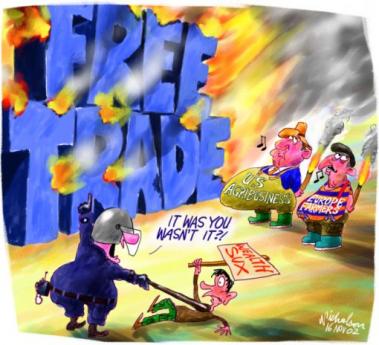
How can anyone not support free trade?

My cousin asked me that today, by happy coincidence the very day I prepare to lay the foundation so my micro principles students can understand why the vast majority of economists do support free trade. I responded to him, in part (and from a US-centric standpoint): 


But you ask me why other people don't think the way we do, so this is my attempt to give them a fair shake. I actually had to write a paper once on why some people don't support free trade. The short answers are:

  • They don't understand free trade. (#1 reason)
  • If they understand free trade is good in general, they may not understand what is really meant by "strong" and "weak" currencies or where trade deficits come from. Those we aren't going to cover in micro principles, but they are important parts of understanding free trade.
  • They understand that free trade maximizes total utility, but they are concerned about the distribution of the gains and losses. The ethics behind free trade says that the winners could compensate the losers of a change to free trade, but in general they don't - no more than the winners of protection compensate the losers. If you think most of the losses will hit poor people, there is a reasonable ethical ground for wanting to discourage some trade. Now, we could do things better by still allowing trade and doing something else for poor people, but I can understand the argument anyway. This analysis also usually forgets the much poorer people in another country who gain a job that allows them to survive.
  • As a rich country, the US can afford little luxuries like high labor and environmental standards that other countries may not. If you are categorically opposed to child labor in sweatshops or unsustainable fishing and air pollution, you might be concerned about more production moving to areas that don't regulate those items as much. There are arguments that go the other way, but again I can understand why someone who places a high value on the environment might not want production to move away from where we can regulate it.
  • If there are any externalities (like air pollution) you can also make the argument that the market price does not reflect the true costs and benefits, so markets will oversupply goods. Moving to somewhere that has a larger disparity between private and social costs (either because the firm will be more polluting there and increase the social costs, or different regulations lower private costs, or whatnot) will tend to exacerbate that problem.
  • It's a colonialist/egalitarian thing. If the rules of free trade agreements favor countries that are already wealthy (and they do), it is possible for a government to harm its citizens by opening to freer trade. The rules of accession to the WTO, for instance, allow current members to exact concessions from new members that either nullify WTO rules (WTO-) or require higher standards for entry (WTO+) so that the "rules-based" system becomes a power-based system. For egalitarian reasons, someone might not like that arrangement even if they like free trade per se. 
Now these aren't actually the arguments most people make. But if they had more sophisticated economic reasoning, these are the types of arguments they would make and they are the points brought up by the 2% of economists who don't care as much for free trade (e.g. Stiglitz). This is also ignoring the infant industries argument (favored by Rodrik), the national defence argument, or most arguments that point out that we may have more goals than efficiency and freedom (like food self-sufficiency). I'm also missing the anti-corporatist element and the more blatant self-serving protectionist arguments [made in particular by the corporatist element, right].

Thursday, August 11, 2011

The unintended consequences of hyphens

The political economy of the Dodd-Frank bill (against conflict minerals, but actually destroying livelihoods and preventing good local governance):
What's even more frustrating is that members of Congress like Jim McDermott and their staffs seem to have taken Enough's word at face value, going so far as to let the advocacy organization choose most of the witnesses at hearings on the Dodd-Frank measure, which meant that any dissenting voices - Congolese or American - went mostly unheard. 
That's a terrible way to develop legislation. I realize that members of Congressional staffs are extremely busy dealing with hundreds of issues every day and that it saves time to let an advocacy organization plan most of the details of a hearing on one obscure topic, but there need to be a wider variety of voices on questions involving Africa - or any topic, for that matter. At the very least, I think it's reasonable to expect that people testifying before Congress on DRC actually speak French and spend regular, extended periods of time there. 
It is beyond frustrating to have watched this completely avoidable catastrophe unfold when it was so evident that Enough has misread the situation in DRC and that the legislators who listened to them were going to unintentionally create the disaster Aronson describes. 
Modigliani-Miller as done in the Ukraine:
people who import cars to Ukraine sometimes cut the car in two separate pieces and carry it through the customs this way. By doing this, they save a fortune on import tax. A car carried in two pieces is seen as spare parts and therefore is taxed at a much lower rate than a normal car.

Tuesday, June 14, 2011

Arbitrage in Action

You say smuggler, I say arbitrager (HT:Poverty News Blog):
Social Solidarity Minister Gouda Abdel Khaliq cited smuggling to Libya and Gaza as a reason for [gas] cylinder scarcity in Egypt… . "Smugglers benefit from the difference in the price of the cylinders in Egypt," said Hossam Arafat, chairman of the petroleum section at the Federation of Commerce Chambers. "What makes this possible is that the government subsidizes the cylinders to the tune of 90 percent here."
Arbitrage in … used t-shirts?
Now along comes the notion of Project Repat that wants to exploit hipster demand for the double-irony of used t-shirts from Africa by buying these shirts at developing world markets, shipping them back to the United States, and using the profits to finance charitable activities.
Arbitrage in … investment opportunities
The arrival of large numbers of Chinese over the past few years is not something that Africans are so worried about (compared to the fixation in the western press). A Minister in Angola looked at us incredulously asking why we were so obsessed with the Chinese. He said they were only one amongst a range of new investors, and his country was open for business to all of them. …
A Chinese businessman in Accra told us “I don’t think I will be able to make more money in China than I can do here. The conditions in China are getting quite bad, and will be worse with this world crisis”. Commonly businessmen talked about earning anything up to three times what they could make in China for the same investment.
You say “misuse of scarce development funds,” Moss says “development” (emphasis added):
The project will also turn a disused old hotel site into an active hive of economic activity.  If that’s not development, then what is?  … When President Bill Clinton visited Ghana in 1998 he couldn’t spend even one night in Accra because of a shortage of suitable hotels.  Today, Ghana has several world-class business hotels, but if the country is going to live up to its ambition to become a regional business hub, then it needs places for business elites and tourists to sleep, eat, and meet.  Even if this is somehow distasteful to critics who may imagine that poverty-reduction is only about romantic notions of selfless activists helping peasants, development is really about building a vibrant business sector
While staying at one of these more luxurious estates for a development conference for the first time, I proposed a research agenda to my advisor: measure the importance and attention of development institutions in a country based on the presence or absence of luxury hotels. It seems there is some interest in coming to more of an answer of that question. Now if only I can get a grant to stay at a few more of them so I can do some data collection....

Friday, May 20, 2011

Interesting Sentences

The Economist: The world could be on the verge of a great management revolution: making robots behave like humans rather than the 20th century’s preferred option, making humans behave like robots.

HT: Grandiloquent Bloviator: “If you’re not the consumer, you’re the product.” Also known as: there is no such thing as a free lunch on the internet. If you can’t tell what the website is trying to sell you, they are either selling your eyes to advertisers or your information. 
Beckworth: “money is special: it is the only asset on every other market (i.e. it is the medium of exchange) and thus is the only one that can affect every other market.  Money, therefore, is what makes it possible to have economy-wide recessions.
Marron: Sometimes, it’s more than $100 lying on the sidewalk: “You can sell 9,999 shares of The Donald …  at $0.52 a piece [on Intrade]. In just that one trade, you can pocket almost $5,200 of free money.” The only question is whether the government decides this is an illegal activity for influencing voting and elections. “For the latest Trump action, click here.”
The Economist: “The [United Arab Emerites] government aims to reduce the rising number of single local women by offering prizes of up to $19,000 to men who marry them.”
 
The history of political cartooning in South Africa: “I tried to define when South African cartooning started … all the way back to a cartoon which was published in 1819 by George Cruikshank who was a leading London caricaturist of the day. I called it the Cruikshank’s cannibal cartoon. It shows the white settlers being devoured by these cannibal figures – these huge, hulking monstrous figures. … For me that became an iconic cartoon, a prototypical South African cartoon.”
 
Yglesias on Chomsky’s denunciation of Osama’s death as an illegal assassination: “International law is made by states, powerful states have a disproportionate role in shaping it, and powerful states have obvious reasons to not be super-interested in the due process of suspected international terrorists or the sensibilities of mid-sized countries. Many people are pacifists and/or strong critics of western military power, and that’s fine. But it’s simply not the case that international law is identical with these policy preferences. On the contrary, one of the main functions of the international institutional order is precisely to legitimate the use of deadly military force by western powers."

Calzadilla, Rehdanz, and Tol: “Trade liberalization tends to reduce water use in water scarce regions, and increase water use in water abundant regions, even though water markets do not exist in most countries “

Easterly and Freschi: “Belief in Hell raised … economic growth potential. … A different twist than the Protestant Ethic: Scared Rich?

Friday, February 4, 2011

Economics in Literature: Princess Academy and Traders

The Lovely and Gracious enjoys reading young adult and childrens books and she got me to read The Princess Academy by Shannon Hale, targeted at grades 5-9. A short read, it tells the story of group of girls from a poor village, one of whom will be selected to marry the prince. It also includes a small piece of economics that was running through my head today as I pondered people's reactions during the food price crisis to speculators, traders, middlemen, and other pariahs.

In the story, the villagers live on a mountain and most of them are involved in quarrying rock. Their only contact with the outside world is a group of traders who arrive, bargain for the lowest price they can get for the stone, and leave. During the course of the girls' education to make them worthy of marrying the prince, however, the lead character discovers that their village is the only one that produces this special kind of rock that is highly valued because it is rare. She returns home and convinces her village to threaten to not sell to the traders and take up trading themselves if they don't get a better price. The traders cave and everyone gets to eat that winter ... and live happily ever after.

It seems that I've heard this story repeated often in discussing agricultural development. Allow me to mix smallholder farmers and stone quarriers for a moment:

Scenario 1 (from the book): Producers' cooperatives give producers (more) market power compared to traders, so we want to encourage them. Fight monopoly power with another monopoly. Or at the least with a public education system that teaches kids how to form their own monopoly/cartel.

Scenario 2: What economists have tried to convince people of -- and we can see how little success we've had thanks to the pitchforks that came out at the mention of speculators rigging food markets -- is that traders are good for reducing price volatility and provide essential market services. Yes, it looks like they buy low and sell high, but if they didn't the low would be lower and the high would be higher. In this view, the problem really is too little competition in the trading sector. If the traders really are a monopoly, break them up; if not, encourage the growth of middlemen to reduce their market power (e.g. subsidies, infrastructure to lower costs, spread of market information, the usual). Mr. Government, tear down this monopoly.

Scenario 3 (the 1980s parastatal boards?): If the profits from selling rocks/grain are high enough compared to transaction costs, the only way a monopoly can exist for extended periods of time is with government collusion preventing the growth of the trading industry. What's important could be the political economy of the trading industry. This is a marginalized town with no representation in government, whose citizens are in fact despised by most of the nobility. Since in the story the stone is primarily valuable to the crown and the nobility, it would not be hard to imagine that the traders are in fact or implicitly bankrolled and supported by the government. It is conceivable that in the next book we discover the traders coming into town with a little military might to encourage a more favorable pricing. Let's hope the prince can come to the rescue then because in the last 30 years of governance research we haven't quite figured out how to solve this problem ideally...

Friday, January 28, 2011

Big Bag of Africa

One of my better-visited posts dealt with Ethiopian monetary policy. The question is: what is the chance of another Birr devaluation? One vote for pretty good based on pretty simple trends. The currency stays relatively stable against the dollar for 5-6 months, then is devalued. The hope with the last one, though, was that it would be large enough to stave off another such episode for a longer period of time. Blattman ponders:
The under-qualified macroeconomist in me expected Ethiopia’s recent devaluation to actually spur rather than slow the manufacturing sector. In time that may be so. But in a place where inputs and machinery are imported, a devaluation is a mixed blessing. Existing firms must be adding real value to production to succeed. The agricultural export sector, where few foreign inputs are needed, seems to have a brighter future.
South Africa is starting its own development agency. "development assistance for the year 2006 is estimated between $363 – $475 million.  This is 0.18% of South Africa’s GDP from 2006 – which matches the figures for US development assistance as a share of the economy."

People seem to enjoy ranking Africa's leaders. Here is the latest (Hat tip: Africa is a Country)

The Economist does Nollywood (Nigerian Hollywood).

How helpful is fairtrade chocolate? One journalist's opinion is here
World cocoa prices easily exceed the Fairtrade minimum. Kuapa has built schools and clinics but competition for beans is fierce and many other buyers offer farmers incentives, such as loans or machetes or insecticides.  Some farmers are loyal to Fairtrade but many have good reasons to sell their beans elsewhere.
Farmers are an important lobby in Ghana, which has seen two government changes in the last five elections, and hence
Ghana has fixed a minimum farm gate price of 3200 cedis, or $2165, roughly two thirds of the world market price.  It is unusual for farmers to be this well rewarded.  During the late 1970s, producers received just 10 per cent of the world market price.
This means fair trade matters less in Ghana than it used to now that the alternative is not as bad.  Here is another good article on the subject.

Speaking of chocolate exporters, there's a new article on Cote d'Ivoire which "traces the civil war to the politicization of citizenship and ethnicity during the democratization process."

Friday, January 14, 2011

Food Prices are Now at 2008 Peak

The big news is that FAO's measure of  general food prices in December reached the peak we had in 2008, a little more than twice as high as prices were in 2002-2004. Evans and GDN are quick to point out the difference between this time and last:
  • Most of the increase is in meat, sugar, and vegetable oils rather than cereals. Poor consumers can substitute away from those products and buy more staples, so they should be hit less hard than last time.
  • Of staple cereals (left) rice has seen very little movement - still at half of its old peak - and wheat is still well below its peak. This is important because the most harmful and wide-reaching policy actions last time happened in countries where rice is the most important staple. If rice prices stay where they were in 2009, we might avoid a repeat of 2008's policy reactions.
  • Only maize, the cheapest of the three, has reached its 2008 peak. This is another contributing factor in why meat prices are high.
  • Many African countries have done a good job responding to the last food crisis by investing more in their agriculture. As a result, African and Asian countries have had bumper crops - so much so that while world maize increased 45%, they are down 10% in some parts of Africa.
  • Oil prices are still $50/barrel lower than their peak in 2008, another boon to farmers.
GDN argues that among the implications of these is that US policy can have a large impact by suspending biofuel mandates and improving food aid policies when the farm bill comes up for debate again in 2012.

One thing neither report mentions is possible psychology factors. The 2008 food crisis had a very high percentage change in food prices, while absolute price changes were relatively small and remained lower than they were in the mid 1980s for the most part. This time we are at a higher base, so there is a smaller percentage increase in prices. If it is less the absolute price level that matters to consumers' perceptions and chance of rioting, and more the rapid change in percentage that matters, that would help explain why we see so little unrest right now as well.


Nelson at IFPRI points out that the relative threats to the global food system change over time. Right now, population and income growth matter most, making random weather shocks more potent than they would have been ten years ago. Over the next 40 years, however, population growth is expected to slow so it will be less important and climate change and supply side factors will become more important. He predicts that the next 40 years will see a doubling of maize prices and roughly a 50 percent increase in rice and wheat prices. If agricultural research can increase productivity 40 percent beyond the baseline scenario, however, those increases can be cut in half.

IFPRI has just released a new set of international wheat market tools to help people track prices and other information. Further tools are expected soon for maize and rice. Worldwatch Institute is also releasing its new report on 15 innovations that are already happening in parts of Africa to increase production on small farms and reduce hunger. I will return to that report in a future post.

Zamiba's Food Reserve Agency is exporting nearly 300 thousand tonnes of maize to nearby Namibia, DRC, and Zimbabwe. High export costs and a lack of trucks have been slowing the process.

Update: "so little unrest" is a bit more than I thought:
And just as they were posting, riots flared up in Algeria, with two killed and hundreds injured in the protests against soaring food prices. Across the border in Tunisia 14 were killed in clashes with the police. As the unrest spreads across northern Africa, Egypt is nervously trying to put measures in place to prevent any comparable violence, with extra supplies of meat being flown in from Kenya. An occupational hazard of blogging; no sooner have you posted, than somewhere in the world you have been outstripped by events.

Thursday, January 13, 2011

Climate change comments

I was chatting with Per this week about weekly food price volatility, which has been up significantly since the food price spikes. We've been analyzing the trends in food price volatility for the time period during which we have weekly data. For some commodities (e.g. wheat and maize) price variation has been increasingly fairly steadily since the mid-90s. For other commodities (e.g. rice) price variation was lower between the mid-90s and the food price spike. He opined (reasonably) that rice is more often irrigated than wheat and maize, so their price volatility is more dependent on weather fluctuations. Makes sense.

What surprised him was I don't think climate change has much to do with post-spike volatility. So let me put my thoughts out here and feel free to improve my understanding.

Climate change is fundamentally a gradualist story. Even the most apocalyptic scenarios involve a change of 1 degree Fahrenheit per decade. This decade has seen an increase of half a degree Fahrenheit and last decade saw less. ANY story that blames climate change for a difference from one year to the next has to involve a severe threshold effect: global temperatures rise by 0.1 degrees Fahrenheit and massive crop failures ensue. Something like that. I was shocked this year to hear a local plant scientist arguing on NPR that climate change had, from one year to the next, caused massive growth in poison ivy, oak, etc. growth and pain. Ivy is just not that sensitive a plant. So while I freely acknowledge the role of climate change in increasing food production volatility from 1980-2010 (increasing temperatures, rainfall variation, extreme weather events, etc.) I strongly doubt that it makes much difference between 2006 and 2008.

Climate change does not happen smoothly. There are regular downs even while the gradual trend is up. If you like numbers, here are some that show that even though 2001-2010 were warmer than 1991-2000, the coldest year in this decade was 2008 with 2005 and 2010 tie-ing for warmest. Since 2005 was warmer than 2006-2009, the food price spike would have happened several years earlier if that were the prime culprit. The three warmest months in the last decade were March of 2002 and 2010 and January of 2007 (yes, Virginia, there is a southern hemisphere) and there was no panic in 2002. Yes, this is not a formal analysis, but this also isn't a formal publication venue. Suffice it to say, the initial data do not look good for a climate change story.

Where I do place the blame is persistence of memory. Food prices were recently high, so speculators who wouldn't normally be interested in food commodities are paying attention; commodities in general are getting much more financial game thanks to the recession; governments are still adjusting their food policies in response to the last food crisis and that uncertainty increases volatility; Russia declares an export ban on wheat and so people start buying wheat in anticipation of the next spike even though the export ban is meaningless since Russia is now importing wheat. I imagine - we don't have data on this, sadly - that food price volatility was fairly high for several years following the 1973-74 food price crisis despite the onset of the long downward trend we enjoyed after. It takes time for volatile markets to calm down. The increase in weekly wheat price volatility happened just after the 1996 food price spike, after all.

Thankfully we aren't seeing the panicked responses from governments that have a lot of influence in food markets like we did a few years ago. I'll be putting up another post either today or tomorrow about the current high food prices, some of which are quite high. It was largely government reactions that turned rising food prices into a panic, and as long as governments avoid the same round of export bans and other policy reactions we saw last time, we should be okay. But more on that next time.

Saturday, January 8, 2011

AEA Session: Agricultural Export Bans

The final AAEA session at the AEA meetings in Denver discussed the agricultural export bans put in place in eight countries (plus export tariffs in many more) during the food price crisis a couple years ago. The major contribution was to consider the political economy explicitly and its impact on food prices. My major complaint about previous studies trying to measure the effect of biofuel prices on the food price spikes ignored this essential factor, and then claimed biofuels did most of the work.

The bottom line: the export bans and import tariff drops alone caused at least 40% of of the price change, and likely a lot more.

Government actions were responsible for more if you include growing stockpiles, offers to buy up a lot more than usual at prices above already inflated prices, and account for large-country effects. On that last point, rice export bans in Brazil don't matter much because they don't export much rice. The ban in India makes a much larger difference. Similarly, Russia's current export ban doesn't matter: they've moved to being an importer of wheat this year so the official ban is just a nice photo-op (or as Martin put it, a chance for Mr. Putin to show off his hairy chest).

The papers will be coming out next January. Until then, my notes are below the fold