Showing posts with label Food Prices. Show all posts
Showing posts with label Food Prices. Show all posts
Thursday, February 16, 2012
Proving I'm Alive: Big Bag of Blogs
Bellemare on Swinnen's paper on who wins and loses from high food prices and on the benefits to rural smallholders of joining marketing chains.
Tabarrok showing me why I should be very, very afraid: Kucinich and co. try a real life enactment of Atlas Shrugged.
Sumner discovers a second career as Bernanke's shrink, showing how his psychology helps determine the fate of this recession. (If you wanted to be more sensational about it, you could talk about the discovery of the sinister figure in the shadows: Vincent Reinhart. That would be overdoing it a touch.)
The early impacts of AGRA's investment in Ghana, combining fertilizer subsidies, market access, and variable loan structure depending on outcome (essentially removing downside risk).
I was getting ready to run some proper experiments out here, only to learn that my very presence might bias the games. Of course, now this proposes that I need to replicate this (preliminary) finding itself. How general is the result? (HT: Aid Thoughts and Roving Bandit)
Urbanization in Africa is mostly about population growth rather than migration.


Tuesday, January 17, 2012
Best of 2011
Time for some intense naval-gazing. I wasn't going to do one of these, but then I enjoyed others' so much for the posts I missed that it seemed much more interesting.
Top Ten Posts of 2011
1. Google's statement on AUN's amazing internet usage, got a lot of doubting comments and a few defending and very plausible explanations.
2. Nutrition Labeling, describing the new requirement that meat include information on calories from fat.
3. Unemployment: Leads and Lags - Breaking unemployment into separate decisions to hire or fire will give us a better indicator of where the economy is going (has been) than total unemployment.
4. AEA session on agricultural export bans during the 07/08 food price crisis.
5. Microinsurance in Kenya via cellphone
6. My first visit to AUN. Classes will resume Thursday the 24th
7. Low saturated fat diet vs. low simple carbohydrate diet
8. QE2 and food prices - debunking the idea that the Fed is causing global food price inflation
9. Food safety, food movements, and paternalism
10. Lit in Review: Food Demand -- Ethiopia and Speculators
Honorable Mention (because I thought it was fun): The socially acceptable price of fried chicken, also known as the political economy of fast food markets in South Korea.
Top Ten Posts of 2010 (in 2011)
1. My pictures of the Thorvaldsen's Christus and apostles statues, mentioned in a Church lesson this year.
2. Lit in Review: Grossman and Helpman, there has been steady interest in summaries and other papers that make use of the "Pay to Play" model of lobbyists.
3. Food in Africa: Too much and too little discussing the problem of getting food from food-surplus states to food-deficit states. There was never a large spike, but a steady stream of interest throughout the year.
4. High Hopes for Rwandan Agricultural Development
5. Food Security in Nepal which has been of increasing interest lately
6. Cutting Costs Through ... Fonts?? Some fonts go easier on the printer's ink
7. Population Health vs. Individual Health - commentary on macro vs. micro in economics and health
8. Ethiopian Monetary Policy - combines monetary policy, food prices, Ethiopia's development goals (food self-sufficiency), and growth prospects
8. Five from vacation: education, hyperinflation, and Chinese food safety.
10. Fed governor: if we could guarantee 5% NGDP growth, it would be great - I'm glad this made the list because I think it was my most significant post, interviewing Governor Dudley about what they are targeting and Sumner's policy.
Where did my visitors come from in 2011?
Top Ten Posts of 2011
1. Google's statement on AUN's amazing internet usage, got a lot of doubting comments and a few defending and very plausible explanations.
2. Nutrition Labeling, describing the new requirement that meat include information on calories from fat.
3. Unemployment: Leads and Lags - Breaking unemployment into separate decisions to hire or fire will give us a better indicator of where the economy is going (has been) than total unemployment.
4. AEA session on agricultural export bans during the 07/08 food price crisis.
5. Microinsurance in Kenya via cellphone
6. My first visit to AUN. Classes will resume Thursday the 24th
7. Low saturated fat diet vs. low simple carbohydrate diet
8. QE2 and food prices - debunking the idea that the Fed is causing global food price inflation
9. Food safety, food movements, and paternalism
10. Lit in Review: Food Demand -- Ethiopia and Speculators
Honorable Mention (because I thought it was fun): The socially acceptable price of fried chicken, also known as the political economy of fast food markets in South Korea.
Top Ten Posts of 2010 (in 2011)
1. My pictures of the Thorvaldsen's Christus and apostles statues, mentioned in a Church lesson this year.
2. Lit in Review: Grossman and Helpman, there has been steady interest in summaries and other papers that make use of the "Pay to Play" model of lobbyists.
3. Food in Africa: Too much and too little discussing the problem of getting food from food-surplus states to food-deficit states. There was never a large spike, but a steady stream of interest throughout the year.
4. High Hopes for Rwandan Agricultural Development
5. Food Security in Nepal which has been of increasing interest lately
6. Cutting Costs Through ... Fonts?? Some fonts go easier on the printer's ink
7. Population Health vs. Individual Health - commentary on macro vs. micro in economics and health
8. Ethiopian Monetary Policy - combines monetary policy, food prices, Ethiopia's development goals (food self-sufficiency), and growth prospects
8. Five from vacation: education, hyperinflation, and Chinese food safety.
10. Fed governor: if we could guarantee 5% NGDP growth, it would be great - I'm glad this made the list because I think it was my most significant post, interviewing Governor Dudley about what they are targeting and Sumner's policy.
Where did my visitors come from in 2011?
Friday, January 13, 2012
One week later in Jimeta
One week after the shooting in Yola and on the 4th day of the fuel subsidy strike, the Yola-Jimeta area is remarkably quiet. My family went shopping and saw that there were far fewer vehicles on the road, many shops were closed - in some cases whole streets of shops gated and locked up - and the main market itself was quieter than usual, though there still a decent amount of traffic around the stalls. It was very strange to see so little activity.
I carefully wrote down the prices of everything we bought and noted that nothing had gone up significantly. The small pouch of water that in other cities had doubled or trebled in price was still the same N5 as ever. Our huge block of mozzarella cheese was even down N500 since last time.
There were two big differences. Faro Water, the local bottling plant owned by AUN Founder Atiku Abubakar, has joined the strike, so there were no refill water jugs. One shop did still have cartons of water bottles we could buy.
Second, a couple key intersections now sport dedicated police searching every car. Each motorcyclist had to stop, dismount, and walk their bike through. Pedestrians passed with their hands in the air. Each car had to show what was in the trunk and sometimes answer questions. I may post some of it later. Most of the travellers, and our driver, laughed at most of it.
The road to the church where the shooting took place is blocked to all traffic.
I carefully wrote down the prices of everything we bought and noted that nothing had gone up significantly. The small pouch of water that in other cities had doubled or trebled in price was still the same N5 as ever. Our huge block of mozzarella cheese was even down N500 since last time.
There were two big differences. Faro Water, the local bottling plant owned by AUN Founder Atiku Abubakar, has joined the strike, so there were no refill water jugs. One shop did still have cartons of water bottles we could buy.
Second, a couple key intersections now sport dedicated police searching every car. Each motorcyclist had to stop, dismount, and walk their bike through. Pedestrians passed with their hands in the air. Each car had to show what was in the trunk and sometimes answer questions. I may post some of it later. Most of the travellers, and our driver, laughed at most of it.
The road to the church where the shooting took place is blocked to all traffic.
Thursday, January 12, 2012
Random Links: food governance, being LDS, behavioral economics
C. Juma on how to improve Africa's research infrastructure - basically, make research institutions more like teaching institutions and teaching institutions more research oriented.
A fascinating Kenyan website called I paid a bribe. The tagline is: uncover the market price of corruption.
Bellemare on how to do well in an economics class.
A fascinating Kenyan website called I paid a bribe. The tagline is: uncover the market price of corruption.
The price of orange juice at a 34-year high.
Price transmission in NYC from subway to pizza.
Why are Americans eating less meat? Partly higher relative prices, partly recession, party "Flexitarianism."
WalMart pays Nicaraguan farmers less than other retail outlets, but offers much less price variance in compensation. Since food price variance has increased, this might be a better deal than it used to be.
Why are Americans eating less meat? Partly higher relative prices, partly recession, party "Flexitarianism."
WalMart pays Nicaraguan farmers less than other retail outlets, but offers much less price variance in compensation. Since food price variance has increased, this might be a better deal than it used to be.
"What is essential to being a good Mormon? According to the [Pew] survey [of pretty active American members of the Church of Jesus Christ of Latter-day Saints], 80 percent said "believing Joseph Smith saw God the Father and Jesus Christ" is essential to being a good Mormon, 73 percent said "working to help the poor,"" Other interesting sound bites:
- The Latter-day Saints surveyed had a more favorable opinion of Pres. Obama than LDS Senate Majority Leader Reid (25 to 22)
- 97% of us identify as being Christians, believe in Jesus' resurrection, and use the word "Christian" as the single word that best describes us, while 49% of non-Mormons do not think we're Christian
- Most of us rank being a good parent as more important than career or religious activities
- 60% of converts cited church beliefs as why they joined. 60% of converts joined between 18 and 35 years old.
- 82% say they have a food storage, and almost half have 3 months stored up. When Pres. Ensign came to check on us and assess our needs, we were happy to report that we had 1-2 weeks of food stored up and enough cash to satisfy our needs. Water was another story, but we could boil the tap water to make more as needed and had already refilled a 5 gallon (20 liter) drum with boiled water.
- Even though most identified as conservative, we are much more positive about immigrants and immigration than the average conservative.
Bellemare on how to do well in an economics class.
How to prolong lithium battery life.
Lunch for Jonathan and Obama
They do things differently in the US and UK from Nigeria, and yet it's not so very different after all.
There is a delightful BBC show (Lady Thatcher's favorite during her term) called "Yes, Prime Minister." Elegant. Witty. And it introduced the world to public choice. In the very first episode's side story, the PM is cranky because no one is there to make him lunch. The staff explain that the cafeteria is only for staff, not the PM. Because the staff is doing government work, the government pays; but the PM is political, so the government can't pay for his lunch. However, meeting with ambassadors is government work, so he announces he will have lunch with a different ambassador every day so that the government will make his lunch. It goes back and forth quite entertainingly and later fits in to how defence budgets are created. Remarkable stuff.
I also have in my collection an old radio bit called The First Family, a series of comedy sketches around the Kennedy family. There's one where during a meeting of heads of government, Pres. Kennedy tells them he has been taking some criticism for the expense of all the fancy state dinners, and economy starts at home, so today they will be having a typical American businessman's lunch. Hilarity ensures as Castro orders a chicken sandwich with a live chicken, Kruschev wants the eastern half of Adenauer's "Western sandwich", and Abdul Nasser and Ben Gurion find peace over pastrami. At the end of the sketch, the President then asks each of them to pay for their sandwich.
Over here, the removal of the fuel subsidies has brought to light just how much is budgeted to feed the President and Vice-President: 1 billion Naira. That would be US$6.5 million by exchange rates. The one data point I have tells me it costs twice as much to feed our family in Nigeria as it did in the States, so a not-quite Purchasing Power Parity exchange rate would put it at closer to $3 million. Still a hefty sum.
The breakdown:
N477million for meals and catering for the office itself; -- note we're not just buying food, but hiring labor too
N293 mil for Pres Jonathan's meals at home and office;
N104 mil for Vice-Pres Sambo's office.
N90 mil for kitchen supplies - similar to last year - half for the state house, half for the President's home
Among the things I would like to know, based on the humor I've already consumed, is how much of that is for feeding official guests. As my colleague Alvin Lim put it when I asked him that question, "I guess the President can't serve his important guests meat pies."
Over here, they have been touting British and American austerity, expounding on the great poverty of our millionaire leaders. On the other hand, it appears Pres. Obama's $4 million vacation to Hawaii this Christmas was also paid by taxpayers, mostly because it costs $3.3 million just to fly Air Force One there and back again. Another quarter million goes to paying for security's hotel and per diem. FactCheck tells me that Pres. Obama has used Air Force One less than Dubya did in his first two years.
So for which would you rather be taxed? $3mil to feed your leader for a year or $3mil to fly him across country for a one-week vacation?
There is a delightful BBC show (Lady Thatcher's favorite during her term) called "Yes, Prime Minister." Elegant. Witty. And it introduced the world to public choice. In the very first episode's side story, the PM is cranky because no one is there to make him lunch. The staff explain that the cafeteria is only for staff, not the PM. Because the staff is doing government work, the government pays; but the PM is political, so the government can't pay for his lunch. However, meeting with ambassadors is government work, so he announces he will have lunch with a different ambassador every day so that the government will make his lunch. It goes back and forth quite entertainingly and later fits in to how defence budgets are created. Remarkable stuff.
I also have in my collection an old radio bit called The First Family, a series of comedy sketches around the Kennedy family. There's one where during a meeting of heads of government, Pres. Kennedy tells them he has been taking some criticism for the expense of all the fancy state dinners, and economy starts at home, so today they will be having a typical American businessman's lunch. Hilarity ensures as Castro orders a chicken sandwich with a live chicken, Kruschev wants the eastern half of Adenauer's "Western sandwich", and Abdul Nasser and Ben Gurion find peace over pastrami. At the end of the sketch, the President then asks each of them to pay for their sandwich.
 |
| Pres. Jonathan, encouraging us to eat cassava bread to reduce wheat imports. |
The breakdown:
N477million for meals and catering for the office itself; -- note we're not just buying food, but hiring labor too
N293 mil for Pres Jonathan's meals at home and office;
N104 mil for Vice-Pres Sambo's office.
N90 mil for kitchen supplies - similar to last year - half for the state house, half for the President's home
Among the things I would like to know, based on the humor I've already consumed, is how much of that is for feeding official guests. As my colleague Alvin Lim put it when I asked him that question, "I guess the President can't serve his important guests meat pies."
Over here, they have been touting British and American austerity, expounding on the great poverty of our millionaire leaders. On the other hand, it appears Pres. Obama's $4 million vacation to Hawaii this Christmas was also paid by taxpayers, mostly because it costs $3.3 million just to fly Air Force One there and back again. Another quarter million goes to paying for security's hotel and per diem. FactCheck tells me that Pres. Obama has used Air Force One less than Dubya did in his first two years.
So for which would you rather be taxed? $3mil to feed your leader for a year or $3mil to fly him across country for a one-week vacation?
Wednesday, January 11, 2012
General Equilibrium: Fuel Subsidies and Cocoa
What other effects does the removal of a fuel subsidy have? Well, it increases the price of cocoa, for one. Removing the fuel subsidy led to strikes, and strikes led to this:
The ongoing labour strike in Nigeria has contributed to drive the price of Cocoa to highs not seen in 11 years. Government processing offices that usually grade Cocoa before export are closed as a result of the strike. Also virtually all export terminals have been closed as a result of the strike. Cocoa beans are first certified/graded before being bagged and shipped for exports.
The price of Cocoa had fallen over 30% in 2011, however the strike has seen prices rebound and gain 15% in just two days.
Tuesday, January 10, 2012
Food demand and price volatility
In Mankiw's Principles of Microeconomics textbook, he poses students the following paraphrased question: Your friend notes that food has a very high demand elasticity and comments that it would be a good source of tax revenue. In what sense is your friend right about it being a "good" tax and in what sense is the tax "not good"?
Most students successfully answered that it was "good" in the sense that it would generate a lot of tax revenue, (missed the part of it being "good" in the sense that there would be very little deadweight loss), and that it is "not good" in the sense that it will hurt the poor who may not have enough to eat more than the wealthy.
 FAO in its new High Level Panel of Experts report on food price volatility takes that excellent point one step further in rigor. As societies and individuals become wealthier, their demand for food becomes less sensitive to price (less elastic). This means when any price change occurs, it is the poorer consumers who will change their consumption pattern most. When all food prices increase and it isn't because of an increase in demand*, the poor have less to eat while the non-poor are still able to have enough food.
Food price volatility increases the inequality of food consumption. They also show that biofuel policies increase the inequality of food consumption even further, shaping a food system designed to hurt the poor more when food prices rise.
Most students successfully answered that it was "good" in the sense that it would generate a lot of tax revenue, (missed the part of it being "good" in the sense that there would be very little deadweight loss), and that it is "not good" in the sense that it will hurt the poor who may not have enough to eat more than the wealthy.
 FAO in its new High Level Panel of Experts report on food price volatility takes that excellent point one step further in rigor. As societies and individuals become wealthier, their demand for food becomes less sensitive to price (less elastic). This means when any price change occurs, it is the poorer consumers who will change their consumption pattern most. When all food prices increase and it isn't because of an increase in demand*, the poor have less to eat while the non-poor are still able to have enough food.
Food price volatility increases the inequality of food consumption. They also show that biofuel policies increase the inequality of food consumption even further, shaping a food system designed to hurt the poor more when food prices rise.
Wednesday, January 4, 2012
The government's side on the fuel subsidy
The BBC had a brief interview with Ahmed Ali Gulak, Special Adviser to the President on political matters. Among the more interesting talking points, the government claims that prices and protests will have calmed down within 3-4 weeks. Here's hoping it's calmed down by the time classes start!
UPDATE: BBC's interview with the central banker, Senusi, who argues that subsidies should be for production, not consumption; that they should be paid for with savings not debt (our children are paying for our consumption); and that much of Nigeria's subsidies are re-exported to other West African countries. He admits the cost of living to go up and that other prices will rise. It was not unexpected. The crash in Europe and other countries requires greater fiscal responsibility. Improvements may not be seen for 6 months-3 years.
UPDATE: BBC's interview with the central banker, Senusi, who argues that subsidies should be for production, not consumption; that they should be paid for with savings not debt (our children are paying for our consumption); and that much of Nigeria's subsidies are re-exported to other West African countries. He admits the cost of living to go up and that other prices will rise. It was not unexpected. The crash in Europe and other countries requires greater fiscal responsibility. Improvements may not be seen for 6 months-3 years.
Price transmission in Nigeria
With the fuel subsidy's disappearance, the price of gasoline increased from N65 ($0.40) to N140-N150 (just under $1). What other prices go up and how quickly? I'll be updating this post from time to time with new prices as I learned them:
Small plastic bag with water: N5 up to N10; larger bag in Lagos from N60 to N150 Jan 4 (reported through Twitter from numerous sources)
Jan 5 from our shopping - taxi service price up from N1000/hour to N2000/hr; water jug refills unavailable; most food sold at the same price; lower selection of bread than usual;
Jan 5 NigeriaNewsDesk Twitter report: Many filling stations outside Calabar, the Cross River State capital, are selling premium motor spirit, popularly known as petrol, for N250
Fourth-hand Twitter report: Packet of St Louis Sugar was N100. Post subsidy N250
A student reports: A bowl of raw foreign rice has gone from N250 to N270 in Kaduna while a similar bowl of black eyed peas has gone from N120 to N180.
Jan 9 - water jug refill up from N350 to N375. Tailoring services and fabric same price as before.
Small plastic bag with water: N5 up to N10; larger bag in Lagos from N60 to N150 Jan 4 (reported through Twitter from numerous sources)
Jan 5 from our shopping - taxi service price up from N1000/hour to N2000/hr; water jug refills unavailable; most food sold at the same price; lower selection of bread than usual;
Jan 5 NigeriaNewsDesk Twitter report: Many filling stations outside Calabar, the Cross River State capital, are selling premium motor spirit, popularly known as petrol, for N250
Fourth-hand Twitter report: Packet of St Louis Sugar was N100. Post subsidy N250
A student reports: A bowl of raw foreign rice has gone from N250 to N270 in Kaduna while a similar bowl of black eyed peas has gone from N120 to N180.
Jan 9 - water jug refill up from N350 to N375. Tailoring services and fabric same price as before.
Thursday, December 22, 2011
Test Questions I Have Used: The price of everything
In the final for my introductory microeconomics students, I posed a question based on a post on Wronging Rights. It involved an NGO buying up AK-47s in Africa to scrap and sell as jewelry in the West as a means of "doing something" about conflict. The question was to identify why this was a terrible idea, thinking about the incentives increased demand has on the supply side. WR subsequently put up a correction based on an email to the NGO. They do not go around buying guns from dealers, but they buy guns that have been confiscated by the government of the Democratic Republic of Congo and the UN. If anything, this encourages the government to confiscate more guns, which should do good things for reducing demand and supply.

In class we also debated the ethics of kidney donations just in time for a slough of posts to go up around the blogsosphere about them.
Perfectly Competitive Markets get kinda boring
This semester has been hectic enough that I haven't been able to spend much time exploring the Jimeta Modern Market, where "modern" means that it's the newer location for the bazaar. So for fun and Christmas preparation, Econolad and I took a few hours yesterday to wander the stalls, find a few more gifts, and soak up some not-on-campus life.
I was very surprised to discover that the wonderful variegated kaleidoscope of humanity at the bazaar gets rather repetitive after only a short while. The market consists of several dozen virtually identical copies of the same atomistic sellers with virtually identical products. It's a perfectly competitive market. Haggling mechanism notwithstanding, I can get bananas or cloth or whatever at about the same price no matter what stall I go to, and often without haggling. One potato vendor offered me a basket for N1000 and I just walked on. His neighbor hailed me and offered N800. Had I haggled with the first vendor, I could have gotten the same price, but because we're in a nice competitive environment I didn't even have to go to that kind of effort. Price taking behavior indeed!
While great for economic theory, it made rather quickly for a very bland shopping experience. Stall after stall selling the same things they were selling on the next row over or even the next stall over gets boring. There are a small handful of unique shops - the Cake House with high quality baking goods, the Babies World with baby necessities, two of the mass of "gift shops" that actually have children's toys - and everyone else is a virtual copy of the others.
I was very surprised to discover that the wonderful variegated kaleidoscope of humanity at the bazaar gets rather repetitive after only a short while. The market consists of several dozen virtually identical copies of the same atomistic sellers with virtually identical products. It's a perfectly competitive market. Haggling mechanism notwithstanding, I can get bananas or cloth or whatever at about the same price no matter what stall I go to, and often without haggling. One potato vendor offered me a basket for N1000 and I just walked on. His neighbor hailed me and offered N800. Had I haggled with the first vendor, I could have gotten the same price, but because we're in a nice competitive environment I didn't even have to go to that kind of effort. Price taking behavior indeed!
While great for economic theory, it made rather quickly for a very bland shopping experience. Stall after stall selling the same things they were selling on the next row over or even the next stall over gets boring. There are a small handful of unique shops - the Cake House with high quality baking goods, the Babies World with baby necessities, two of the mass of "gift shops" that actually have children's toys - and everyone else is a virtual copy of the others.
Wednesday, November 9, 2011
Lit in Review: SSA Development
Wantchekon, Leonard, "Deliberative Electoral Campaigns and Transition from Clientelism: Evidence from a Field Experiment in Benin." Wantchekon got permission from the major presidential political candidates in Benin to run an experiment on their campaigns. The randomly selected treatment villages had two town hall-style discussions about important political topics while control villages had the standard rallies. Among the interesting conclusions from his research, rallies cost $15/person to hold but town hall meetings only $2/person; turnout is 5% higher after town halls; and average spending (cash and gifts) to voters was not statistically different between treatment and control groups so that's not what's driving it. It seems that town hall meetings may be the more efficient way to go in national elections.
Aye and Gupta, "The Effects of Monetary Policy on Real Farm Prices in South Africa." They find using a VAR model that both anticipated and unanticipated monetary policy impacts farm prices in the way we would expect (more money supply --> higher prices, big surprise; but lower money supply does not lower prices) but while statistically significant they don't explain much of the variation in what is happening from 1970 to 2010. I wonder if they would have gotten much different results if they looked at 1975-2005 instead and took out the two major episodes of international food price volatility. How much are they driving the small impacts? They also do not attempt to explain how anticipated monetary shocks could have a significant impact or why negative money shocks don't have price impacts. I would hypothesize at least for the latter that it is because of an inflationary shock to supply that the monetary authority chose lower money supply growth, so we wouldn't see a change that direction because of endogeneity problems.
Clemens and Demombynes' latest salvo in the Millennium Villages conflict: the MVP released a paper for the first time comparing progress in the villages to progress in the rest of SSA. Unfortunately, they still do this improperly. What would they have found doing it more properly?
Nicita, Olarreaga, and Porto examine "Pro-poor trade policy in Sub-Saharan Africa." They find that the average (of 6) country's trade policies are biased in favor of poorer households, but that developed countries' barriers are biased in favor of richer African households. This suggests, potentially, that reducing average trade barriers in Africa may harm the poor
Aye and Gupta, "The Effects of Monetary Policy on Real Farm Prices in South Africa." They find using a VAR model that both anticipated and unanticipated monetary policy impacts farm prices in the way we would expect (more money supply --> higher prices, big surprise; but lower money supply does not lower prices) but while statistically significant they don't explain much of the variation in what is happening from 1970 to 2010. I wonder if they would have gotten much different results if they looked at 1975-2005 instead and took out the two major episodes of international food price volatility. How much are they driving the small impacts? They also do not attempt to explain how anticipated monetary shocks could have a significant impact or why negative money shocks don't have price impacts. I would hypothesize at least for the latter that it is because of an inflationary shock to supply that the monetary authority chose lower money supply growth, so we wouldn't see a change that direction because of endogeneity problems.
Clemens and Demombynes' latest salvo in the Millennium Villages conflict: the MVP released a paper for the first time comparing progress in the villages to progress in the rest of SSA. Unfortunately, they still do this improperly. What would they have found doing it more properly?
In rural areas of the Ashanti region where the MVP site is located, stunting has been falling just as much as at the project site. The Millennium Village contains less than 1% of Ashanti Region’s population, so even allowing for a generous “spillover” effect of MVP programs to neighboring areas, it is implausible that the village is driving the trend across Ashanti. Comparing the project site to the national trend is likely to overstate the impact of the project.Blattman reports on the results of an experiment in Kenya by Friedman, KIremer, Miguel, and Thornton, giving education grants to girls in secondary school. In addition to improved test scores and later marriage years, they find improved knowledge of politics and therefore ... more legitimacy for political violence as a way of solving political problems. Ooh. Blattman notes that his own work is starting to find a similar trend in Ugandan women.
Nicita, Olarreaga, and Porto examine "Pro-poor trade policy in Sub-Saharan Africa." They find that the average (of 6) country's trade policies are biased in favor of poorer households, but that developed countries' barriers are biased in favor of richer African households. This suggests, potentially, that reducing average trade barriers in Africa may harm the poor
Monday, November 7, 2011
The price of seeds (and everything else) in Africa
Good news: the prices of cereals, edible oils, sugar, and dairy products were down sharply in October, bringing FAO's food price index down to its lowest point for the year. Not that it's all that low, but it's something. However, peanut butter prices are up 40% in the US, but not abroad (so American expat families everywhere can breathe a sigh of relief). Since the US government shields peanut growers from the world market, the weather in Georgia and Alabama matters for the US price, but not the international price.
Swaziland's government has retracted its usual agricultural input subsidies: no more discount or free seeds, no more discount tractors (government was charging $17.30/hr rental; private cost is $26.60). The article also discusses how the feudal land tenure system makes things more difficult. One farmer laments:
Swaziland's government has retracted its usual agricultural input subsidies: no more discount or free seeds, no more discount tractors (government was charging $17.30/hr rental; private cost is $26.60). The article also discusses how the feudal land tenure system makes things more difficult. One farmer laments:
“I live on the banks of a river [the Nkomati]. My maize crops could easily thrive if I had a simple pump and piping. What I harvest would pay for the loan, but I have no collateral because there is nothing to offer the bank" [because he does not own the land and so can't put that up as collateral.]Roving Bandit notices the South Sudan National Bureau of Statistics report: annual inflation in South Sudan is up to 60% from September 2010 to September 2011. For the year, the biggest contributor is food prices that went up 64%. The price of furniture and furnishings went up far more (108%) as did alcohol (95%), but food carries a much larger weight (71/100) in the basket of goods than anything else. Food price increases have been very small this month, thankfully.
Wednesday, October 12, 2011
Big Bag of Money and Macro
History a la Sumner: US monetary policy didn't change permanently in 1979 with Volcker's appointment. It happened two years later:
Friedman emphasized how monetary policy was not loose in Japan, despite low interest rates, and his arguments apply just as well here when it wasn't loose for the last 3-4 years (HT: Tabarrok):
Evidence that the stock market corrects prices from false information within 7 days.
The tight money of late 1979 was not really all that tight, and it lasted very briefly. By late-1980 monetary policy was highly expansionary, indeed perhaps the most expansionary in my lifetime. Only in mid-1981 did the Fed seriously commit to tight money.How highly expansionary? Well, nominal GDP grew by ... 19%. That's some pretty high inflation for you.
Friedman emphasized how monetary policy was not loose in Japan, despite low interest rates, and his arguments apply just as well here when it wasn't loose for the last 3-4 years (HT: Tabarrok):
it shows how unreliable interest rates can be as an indicator of appropriate monetary policy. The Japanese bank has supposedly had, until very recently, a zero interest rate policy. Yet that zero interest rate policy was evidence of an extremely tight monetary policy. Essentially, you had deflation. The real interest rate was positive; it was not negative. What you needed in Japan was more liquidity. ... They can buy long-term government securities, and they can keep buying them and providing high-powered money until the high powered money starts getting the economy in an expansion. What Japan needs is a more expansive domestic monetary policy.Fengler at the World Bank shows some sloppy thinking about food price inflation. Food prices are going up in Kenya, but that does mean it is inflation. Inflation includes increases in wages and other forms of income. If food prices go up 100% and wages go up 100%, how are people worse off? Instead, we see food prices going up 25% and other prices going up 10%. That suggests that there is really 10% inflation and real food prices are going up by another 15% on top of that. That isn't inflation. Inflation is a "tax" on savings, it's a "tax" on holding cash in the sense that your money doesn't buy as much as it used to, but it is a tax that can be imposed by the outside as in this case, unlike any other form of tax that exists.
Evidence that the stock market corrects prices from false information within 7 days.
The original story of what monetary policy looks like as a babysitting cooperative. I have a feeling this is going to make an appearance next semester in my intro macroeconomics course.
Friday, August 26, 2011
Some food prices in Yola
Right now, the official exchange rate between Naira (Neye-rah) and US Dollars is around 150, and that is the number I'm going to use to translate prices here. I have been mildly surprised to find remarkably steady prices (over a 3 week period, granted) when I buy things from different vendors who will haggle.
6-7 oranges is $1.33 in the modern market and outside of the expat stores and from some random vendor along the roadside.
A loaf of bread is $1.10 with anyone I've talked to. I forget what oranges cost in the US, but that's less than half the price of a loaf of bread, and it's really good bread. It holds up well, it's soft, it's sweet [my Lovely and Gracious does not always appreciate that sweetness], and often it's a bit larger than what they offer in the States.
Half a watermelon is $2.67. A rather small cabbage is $0.67; a more normal one is $1.00.
Then there are the items in the expat stores:
A small jar of peanut butter (Skippy) is $3.33, a touch expensive, but a large jar is a shocking $12.
Cans of peaches or pears are $2 each. These two foods are Econolad's staples at the moment, so we're very familiar with the price.
Given we're in an area with a high percentage of Muslims, pork products are not widely to be found. A tin of ham costs $4.67. You can also find Spam, but I don't remember the price off the top.
Tuna fish is either $1.33 or $2 depending on the can's brand.
Corned beef is $3.33 or $6 depending on the can's brand.
That, of course, is not counting the box of expired instant mashed potatoes for $8.
Thai rice (110 pound bag) at $0.50/pound
We were worried we would have no cheese, but the first day I found an enormous block of slightly sharp cheddar for a mere $56.
Tuesday, August 16, 2011
Food policy sausage
Where does Indian agricultural policy come from? IFPRI has a new report out on how the subsidy sausage gets made, and in particular what is keeping them from making better policy.
 Where did the idea of people consuming 2000 calories a day come from? M. Nestle answers from her forthcoming book: a survey + marketing. Reality is complex, with surveyed responses varying over 1400 calories per day just in what Americans admitted to eating, let alone what was actually consumed. 2000 is easy to remember, easy to divide, and less than they were recommending for most real people so as not to give an appearance of over-encouraging saturated fat and salt. But as to how many calories you personally should actually consume to be healthy and satisfied, even she gives little real help: if you're gaining weight, you're eating too much.
How is it that farmers' market food safety regulation comes out so differently from that for corporations? Tucker discovers there are (at least) two kinds of farmers' markets and points out the idiosyncracies and food safety problems in our governance of them. Attending the university-sponsored one on a whim, he found the upscale farmers market with prices to match. In another town, the market was "kept alive by the workers and peasants. The price were 1/3 to 1/2 as much as the local grocery. They have locally grown produce, and a fantastic cart full of virtually free produce that is about to spoil." He notes that neither one was easily a pure exercise in local food. At the second, he bought Vietnamese fish. At the first:
This study throws new light on the factors that have so far prevented a move toward more pro-poor and environmentally sustainable agricultural input policies in India. The authors show that electoral politics, institutional factors, and policy paradigms or belief systems all play an important role in blocking reform.

How is it that farmers' market food safety regulation comes out so differently from that for corporations? Tucker discovers there are (at least) two kinds of farmers' markets and points out the idiosyncracies and food safety problems in our governance of them. Attending the university-sponsored one on a whim, he found the upscale farmers market with prices to match. In another town, the market was "kept alive by the workers and peasants. The price were 1/3 to 1/2 as much as the local grocery. They have locally grown produce, and a fantastic cart full of virtually free produce that is about to spoil." He notes that neither one was easily a pure exercise in local food. At the second, he bought Vietnamese fish. At the first:
For example, the man with super-cool rabbit meat, lamb and goat sausage, and the like, had come 3.5 hours, and he does this every week, even though he doesn’t have a refrigerated truck. Every corporate giant faces a labyrinth of inspections and mandates comparable to the Soviet Gosplan, just to get meat to the market. And yet here is a guy with some animals on his land who slaughters, grinds, packs, and sells, and no one seems to be bothering him. No inspectors, no special tests, no mandates. Puzzling. Thrilling but puzzling.
Thursday, June 16, 2011
Lit in Review: Food Demand -- Ethiopia and Speculators
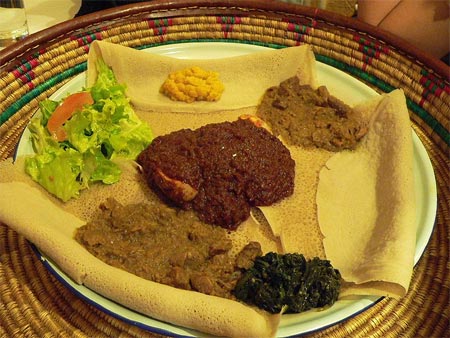 K. Tafere, Taffesse, and Tamiru, with N. Tefera and Paulos, (2010) “Food Demand Elasticities in Ethiopia: Estimates Using Household Income Consumption Expenditure (HICE) Survey Data), IFPRI and EDRI, ESSP2 Discsussion Paper 011.
One of the difficulties of working with Ethiopian food data is that there are four staple cereals: wheat, maize, teff, and sorghum. Another difficulty is that this means there are a lot of zeroes in the data: 28 percent consume no sorghum, 22 percent no teff, 16 percent no maize, 9 percent no wheat, and 2 percent no animal products.
They come up with a fairly large group of significant own-price and expenditure elasticities (90% of the 230 possible price effects are significant). Most commodities are own-price unitary elastic, though maize (-.75) and sorghum (-.66) are the furthest from -1 and wheat closest (-.98) of the major cereals. Cross-price elasticities are relatively small, with complementarity between teff-sorghum and maize-sorghum, but substitution between teff and wheat. Own-price elasticities appear to be the same in urban and rural areas, but there are different cross-price effects.
Hailu and Weersink, “Commodity Price Volatility: The Impact of Commodity Index Traders,” CATPRN Trade Policy Brief 2011-04
While both sides agree that there is a correlation between CIT (commodity index trader) activity and commodity futures prices, the direct of causation is the point of contention. The empirical evidence is mixed with very limited support for the view that higher commodity prices draws in investment activity by index funds. … There is more empirical support for the claim that CITs are associated with greater market volatility. Khara in a Brookings report argues it is unpredictable price volatility that is the real problem for producers, consumers and governments, not the level of prices. … Thus, an increase in commodity market volatility may lead to greater costs for managing risk: more costly insurance premiums, higher options premiums, and greater margins for hedging. … The research conducted to-date suggests commodity index traders had little to do in driving prices upward but are one of the reasons for the significant increase in market volatility over the last several years, but are not the sole cause.
Thursday, June 2, 2011
Lit in Review: Child health
An excellent natural experiment: the electricity was cut from Zanzibar for 4 weeks in May, 2008. Families who had just gotten pregnant and wouldn’t have known about it yet wouldn’t have done anything to change their behavior, but families who did know they had a pregnancy would adapt behavior to safeguard the mother’s and child’s health. As a result, women who knew they were pregnant delivered babies within the usual distribution for Zanzibar, while women who had not known were 11% more likely to give birth to children with low birthweight, according to a new paper by Burlando. Food prices hadn’t changed. Also interesting is that there was a increase in babies born 9 months after the blackout (also about 11%). Friedman particularly highlights the long-lasting effects of temporary shocks.
Vasilakis also has a new working paper on poverty and child malnutrition, using an overlapping generations framework to generate malnutrition-induced multiple equilibria and poverty traps. He models several different World Food Program policies. In his model, a school feeding program “locks” poor countries into a poverty trap by increasing fertility and lowering human capital, but the country could escape. A school feeding program increases efficiency and human capital accumulation in middle-income countries. WFP food price subsidies or investments in local agriculture and food industry allow poor families to increase human capital in their children and increase incomes, helping the country out of poverty. Clearly the body is buried in the adopted and adapted Becker model of fertility decisions (parents face a quantity/quality tradeoff). Since my read of the literature has made me skeptical of the fertility model, I end up skeptical of these results, but the rest of the set up (2 period OLG with poverty traps) is quite interesting.
 Glewwe, Park and Zhao (HT:MR) have a work in so much progress there are still notes from the authors to each other in the pdf:
 after one year, making eyeglasses available increased average test scores by 0.09 to 0.14 standard deviations (of the distribution of the test scores). For those students who accepted the glasses, average test scores increased by 0.12 to 0.22 standard deviations….
OXFAM Reactions

Matt at Aid Thoughts:
Of course, while Oxfam may believe this prediction now, they are trying to change behaviour so it doesn’t come true – this means that the claims will be incredibly difficult to (dis)prove. If food prices happen to double in 20 years, Oxfam will say “Look! We told you so.” If they don’t, they will say “Look at the disaster we averted!” Either way, the winning narrative will be constructed ex-post.Evans thinks that the kind of holistic, systems-approach Oxfam is taking is the right way to go, as indeed our textbook says policy analysts need to think:
This isn’t just a campaign about biofuels, or landgrabs, or making agricultural trade fair, or climate change, or competition for land and water, or women’s rights. It’s about all these things, united beneath the overall banner of ‘food justice in a resource constrained world’. I’ve felt for ages that NGOs need to move on from single issue campaigning towards ways of pushing for whole system change – and Oxfam are going for it in a big way.The report is upfront about some of the political economy challenges their proposed changes will face, but not enough is said about how to change the incentives of the "vested interests" (you may also know them as "stakeholder groups," depending on your ideology), says Ranil, who is also skeptical about putting quite so much faith in smallholder-led growth. Ranil also thinks they aren't being all that holistic, focusing too much on agriculture and not enough on growth in the rest of the economy.
Former Brazilian President da Silva puts his faith in the benevolence of governments: "If the political will is there no one will be denied their fundamental human right to be free from hunger."
Thursday, May 26, 2011
Lit in Review: Impacts of thte 2010/11 Surge in Food Prices
Ivanic, Maros, Will Martin, Hasan Zaman. (2011). “Estimating the Short-Run Poverty Impacts of the 2010-11 Surge in Food Prices.” World Bank Development Research Group, Policy Research Working Paper 5633, Apr
In the 2007/08 price increase, most of the price increase was concentrated in staple cereals. This meant the effects were concentrated on the poor who had few outside options to shift to. In the current price shock, however, food prices have increased in many more commodities and by less overall. This means there are more substitutions available and much of the hit has affected foods the poor consume less of anyway. As a result, they estimate that only 44 million more people are poor instead of the 105 million more in 07/08.
However, it appears that price transmission is higher this time than last.
Subscribe to:
Posts (Atom)