Wednesday, February 23, 2011

Big Bag of Agriculture, Health, and Development

At a Cornell presentation (I'm at it now and have been tweeting its notes), Duxbury argued that we are leaving a LOT of crop productivity on the table by not following pretty basic techniques and that there are still some pretty gaping holes in our knowledge. He called into question the notion of "unproductive soils" in Africa, calling the notion "fantasy." It just means we haven't figured out what the real constraints are. In several trials on the effects of adding phosphorous, there was a modest improvement on the expeirmental plot, but there was a hugely productive section in the middle of the field straddling the experimental and control plots. In more difficult solutions, he encouraged eliminating flood irrigation, improving education, better small scale machinery (where are the agricultural engineers?), more effort on grain and multipurpose legumes, more attention to year-round supply of fruits and vegetables. Farmers know what they do and why; they lack knowledge about change.

Haddad's presentation at the IFPRI Conference on "Leveraging Agriculture for Improving Nutrition and Health" focused on how to get there. His major points were that
  • we have very few impact evaluations to guide us (out of 307 studies, only one tenth even attempted an impact study);
  • increasing women's participation in the process will improve the connections between ag policies and nutrition (half of studies find no difference between men and women, the other half find more male access);
  • "To intertwine nutrition and agriculture, it will help to have professionals who have an appreciation for both, even if they only have expertise in one or the other. ... what we have shows some demand for nutritionists (in Norway at least) who can think outside of the nutrition box and that agriculture students in the US will not learn about international agriculture unless it forms part of their core curriculum." 
I think that first sentence is one of the best descriptions of my ideal for multi-disciplinarity: appreciating what another profession can bring to the table while grounded in a firm set of tools you can bring. Duxbury noted how the tenure process discourages inter-disciplinarity that would improve crop diversity. "I'm not in favor of multidisciplinary specialists: you don't know enough of any one."

Haddad also lists the six men being considered for the new head of FAO:

Lit in Review: HIV/AIDS

De Walque reports in third person on his own research:
The pervasive if unstated belief in the HIV/AIDS community is that males are primarily responsible for spreading the infection among married and cohabiting couples.... most couples affected by HIV/AIDS in sub-Saharan Africa live in ... relationships in which only one of the two partners is HIV-positive while the other one is HIV-negative.
Contrary to assumption, however, it is not the case that the HIV-positive partner is most often the male. In fact, a new study found that women were just as likely to be the HIV-positive partner. An earlier study had placed the figure closer to 30-40%. When the same is restricted to women who have been in one relationship for 10 years (reducing the chance of her bringing HIV with her into the union), the proportion is still roughly 1 in 3. Though I don't agree when de Walque calls this "just as likely" I would agree that it calls the basic assumption into question and supports better research into the channels by which AIDS spreads. Ignoring one apparently significant channel by assuming it does not exist not only prevents progress, it serves to further the victimization of women.

Topping this off is another paper (Leclerc et al, 2009) that tried to fit Zambian HIV infection data with epidemiological models and demonstrated just how difficult a task it is to model: "Our reference simulation (H0) was obtained after more than one hundred simulation trials, all the others leading to inconsistent patterns." They find that "the lifetime risk of infection is quite similar for both sexes, and women tend to be infected earlier." "Among the main constraints found in the simulation was the age at peak infection for males. It was almost impossible to reach values greater than 35 or 36 years for men while keeping the main parameters within a range of realistic values."

Another paper, also by de Walque and colleagues, shows that HIV households in Mozambique were not affected more than non-HIV households by the 2007/08 food crisis, perhaps thanks to increased health interventions that increased their labor force participation.

Meanwhile, there is actually good news from Zimbabwe: HIV infection rates halved between 1997 and 2007.
The study cites increased awareness of AIDS-related deaths as the primary cause of the drop. The Leclarc study also reports a drop (or at least a slowing) in infection rates in Zambia since 2001.

Friday, February 18, 2011

Lit in Review: Political Economy of Efficiency

Wildavsky, "The Political Economy of Efficiency: Cost-Benefit Analysis, Systems Analysis, and Program Budgeting" in Political Science and Public Policy, 1968, 55-82.

Wildavsky discusses the increasing movement towards judging policies on the basis of their efficiency. He differentiates between "pure efficiency" -- meeting a given objective at the lowest cost or the greatest amount of a given objective at a given cost -- "mixed effiicency" which "alters the objective to suit available resources" and the kind of economizing that doesn't even take the political situation as given but seeks to alter the entire system as well. At each increasing level of study (cost-benefit to systems analysis to program budgeting) more and more control has to be taken of the the entire society in the name of efficiency.

His comments on cost-benefit analaysis are fairly well-known today, such as the problems of the distribution of costs and benefits, maximizing multiple objectives, and the vast assumptions that must be made to place all elements in one index.

In particular in response to the problem of maximizing multiple objectives, systems analysis steps in where the objectives are either now known or subject to change. Clearly identifying problems, resolving disputes over goals, clarifying vaguely worded directives all require additional authority beyond simple cost-benefit analysis. While cost-benefit analysis deals with uncertainty by making assumptions that attempt to find clarity, systems analysis mitigates the problems of uncertainty (e.g. min-max) and tests the importance of different assumptions.

But as soon as you start trying to govern the system you have analyzed or enact real programmatic budgeting, you find there are a wide variety of actors, each of whom only sees a piece of the whole and whose objectives may not be the objectives of the plan. Then again, adjustments need to be made to the plan as the situation evolves and old uncertainties become known and new uncertainties arise. Power would have to be highly concentrated in order for changes to made. The entire political system itself needs to be revamped...

Without ever referencing Hayek, Wildavsky paints a very similar picture of how an overzealous desire for efficiency leads to a process of putting complete power in autocratic hands. The guy named Bob theory of development wants a guy named Bob to whom analysts can give all the answers and let the results naturally be derived.

Wildavsky's final point is not this, however. His point is that what is lacking in the economics literature and others is a sense of how the policies being advocated on efficiency ground alter the political system; that by spending political capital in one arena, the President may lack it in another area; and (I add) that by giving government more control in one area, it may feel itself more free to enact policies in others.

Can You Beat Watson?

Probably not, but you can pretend you can via this link that lets you play a Jeopardy-like game. The "problem" is that you get to choose whether to answer the question or pass and have unlimited time in which to choose. So you're not really being pitted against Watson's speed, only its accuracy, and you have access to the same Google information it has.

Thursday, February 17, 2011

Autocrats, Technocrats, and Entrepreneurs

Easterly gives his thumbs up to a three-sentence definition of development: “If solutions are known, need $$. If solutions are knowable, need evaluations. If solutions are evolving, need entrepreneurs.” In another post he expands on the idea, indicating that the first category lends itself well to autocratic solutions, the second to solutions via researchers and coordinated efforts, and the third to individual liberty. I note that this explains the frustration many planning-minded scientists and researchers have – they believe they have moved a problem’s solution from knowable to known and want immediate action. Easterly then expanded on this thought by discussing “the guy named Bob theory of development”: now that we know the answers, who will implement them?

So what are the entrepreneurs doing? New products in mobile telephony that are being used in the developing world:
  • Read barcodes to identify if medicines are real or counterfeit (mPedigree in Ghana and Nigeria)
  • “Farmer’s Friend in Uganda, for instance, sends out market prices and other agricultural information in text messages.” See also Dialog Tradenet in Sri Lanka.
  • Babajob.com lists low-skilled jobs in India.
  • BBC Janala charges two cents for three-minute foreign language lesson and has been used by 3.1 million people in the last 15 months.
  • Bhoomi project tries to reduce corruption by letting people signal when they have been asked for a bribe.
  • The Anda Pradesh government disburses welfare payments and pensions via cellphone.
  • Stop Stock-outs maps “where essential medicines are sold out.”
  • In Mali, Pesinet collects birthing data and indicates if the infant needs more medical attention.
  • Txteagle pays people a few minutes of airtime for reporting information or translating into local dialects.
  • “In some countries, street hawkers assign special ringtones to different customers, which are in effect free messages placing orders.”

The main hang-ups to further expansion are lack of commercialization skills and inputs, and governance failures (both failing to provide the regulatory framework needed for firms to commercialize as well as setting up harmful regulations and taxes).

My favorite of the anti-gift-in-kind posts coming up lately as organizations who should know better show they don't.

The Lighter Side of: Outsourcing to India


Wednesday, February 16, 2011

Big Bag of Ethics: Internet, Rent Seeking, and Development

On the business ethics of search engine optimization (getting your website to the top of Google searches), or Simultaneously racing to the top and the bottom:
To Mr. Stevens, S.E.O. is a game, and if you’re not paying black hats, you are losing to rivals with fewer compunctions.
On internet governance post-Egypt
"If your government shuts down your internet, it’s time to shut down your government.” ... Yet mandating internet access as a matter of course is far easier than guaranteeing it during national emergencies. And a greater threat for the internet than kill switches—as well as cable cuts and human error, for that matter—is creeping and muddled regulation.
The article also discusses some countries declaring a human right to the internet. So does this mean that for thousands of years, mankind's rights to high-speed internet connection were being denied them by lack of technological progress? How many other technological rights do we have? And where's my jetpack?

On economic growth and governance post-Egypt:
... good economics need not always mean good politics; the two can part ways for quite some time. It is true that the world’s wealthy countries are almost all democracies. But democratic politics is neither a necessary nor a sufficient condition for economic development over a period of several decades. ... A second lesson is that rapid economic growth does not buy political stability on its own, unless political institutions are allowed to develop and mature rapidly as well. In fact, economic growth itself generates social and economic mobilization, a fundamental source of political instability.
On Friedman's maxim of corporate social responsibility, OR Yglesias blames rent seeking on firms:
[It] implies that a business executive has not only the right as a citizen of a democratic country but a moral obligation to dedicate his energy and that of the firm he manages toward erecting regulatory barriers to competition and to begging for bailouts and subsidies.
Meanwhile Boudreaux blames the exact same behavior on governments:
"Each year since 2006, they have asked the Commerce Department to review the U.S. duties paid by Chinese manufacturers on imports of wooden bedroom furniture. Many Chinese firms, fearing a steep rise in duties, agreed within months each time to pay cash to their U.S. competitors in return for being removed from the review list." ... What’s going on here is properly called extortion.
My first thoughts on the blame game. Update: The article seems to focus more on the business’ culpability: ‘A Commerce Department spokesman said it didn’t approve of the private settlements but lacked “authority to investigate or police agreements between private parties.”‘ So we need more authority to combat the misuse of our authority.

On the Washington Consensus model (less evil than advertised):
And here’s the thing; the Washington Consensus basically was not an evil neoliberal conspiracy, it was a reaction against reckless governments pursuing ill-advised statist policies the like of which would look pretty unrecognizable today. These are humdrum bread and butter suggestions for sound macroeconomic management, with perhaps an emphasis on limiting the ability of poorly skilled and often corrupt governments with weak accountability to do damage and mischief. ... I used to be much more enthusiastic about the proactive role of government in the economy before I actually worked for one.

Tuesday, February 15, 2011

On US Politics

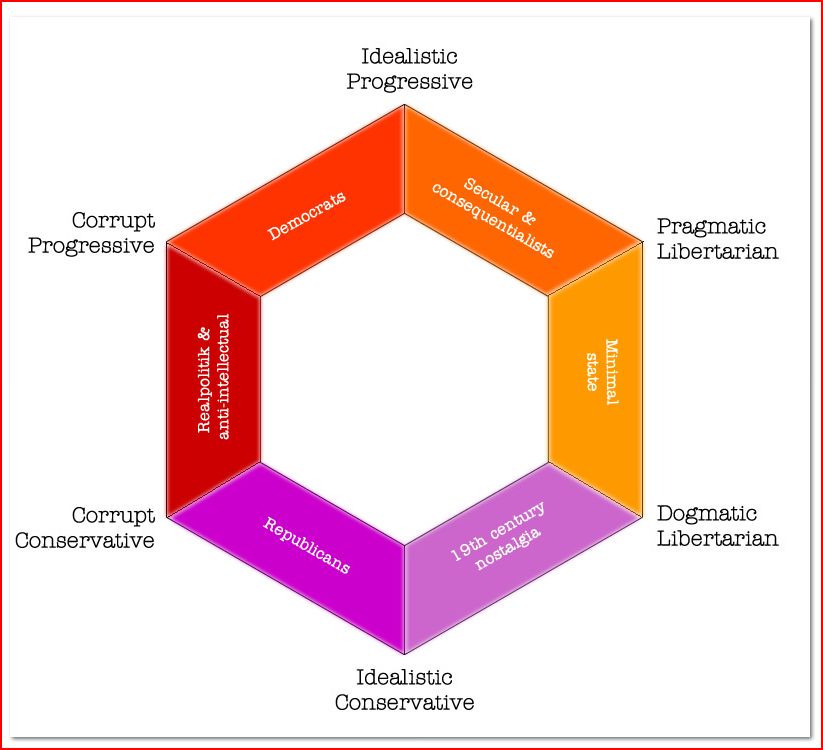
Sumner expands the standard Libertarian square (socially liberal or conservative vs. fiscally liberal or conservative) into an interesting hexagon with two styles each (idealistic or pragmatic) of progressive, libertarian, and conservative based on three sets of ethics: utilitarian, rights, or selfish. Each pair of adjacent nodes shares something in common, such as 19th century nostalgia or anti-intellectualism.
BTW, perhaps I should explain what I mean by “corrupt.”  I don’t mean politicians taking bribes that violate existing laws.  I mean Republicans who support various special interest groups like doctors and seniors (Medicare), farmers, energy producers, car dealers, bankers, and the rich, even if it goes against their supposed “small government” ideology.  And the same would be true about Democrats who support various special interest groups like teachers unions, trial lawyers, government workers, etc, for non-utilitarian/non-egalitarian reasons.
The purpose is less to identify into which of these nodes an individual fits and more to identify why there are still a number of low-hanging political fruits that aren't part of any discussion. The problem is that the real politic groups all agree (the status quo is good) and all the intellectuals agree (the status quo is terrible) and because there is no intragroup conflict, the media doesn't report on the issue. It is to identify political alliances rather than as a personality test.

At thee risk of being more complicated, I think it would be better still to make a nonagon with the three value systems and three ideologies in groups. As is, Sumner's diagram seems to ignore one third of the categories (e.g. selfish libertarians who want no government interference because they assume they would be the strong who survived and would get a yet bigger share of the pie rather than because they believe minimal government produces the greatest economic growth for future generations of the poor).

Klein, on the other hand, believes it is partly lobbying coalitions and partly blindness that create the government process we see: "The budget ends up like the yard of a man who owns only a lawnmower: The grass is trim, but the trees are overgrown and the ivy is everywhere and the gazebo is falling apart. Yet we keep mowing, because that’s what we feel able to do." Yglesias (unsurprisingly) sees a more sinister coalition of conservatives who want to cut government spending so that it is easier for corporations to break the now-unenforced laws and regulations. (As a bonus, here is a discussion and map of states where more than half of their population is in a single metro area - city-state creation time, anyone?)

As fun as these thoughts are to play with, Marron provides more pragmatic suggestions for tax reform, such as: "the first step in any income tax reform should be to broaden the tax base by reducing or eliminating tax preferences.... Policymakers can use the resulting revenue – potentially hundreds of billions of dollars each year – to lower tax rates, reduce future deficits, or both."

Friday, February 11, 2011

Mubarak Steps Down!

HT: Easterly

The vice president announced that power has been handed over to the military.
"In these difficult circumstances that the country is passing through, President Hosni Mubarak has decided to leave the position of the presidency," Suleiman said. He has commissioned the armed forces council to direct the issues of the state."
From CNN:
Egyptian protest leader Wael Ghonim sent out a Twitter message saying "congratulations Egypt the criminal has left the palace." 
Iran takes some credit:
The crisis that is roiling a regional ally of the United States dominated the celebration. Ahmadinejad said that a revered 9th-century Shiite saint, the 12th imam Mahdi, is managing the uprisings in Egypt and Tunisia.
Tavalodet mobarak, Egypt!

What Have You Done for Me Lately?

The BBC on the visit of China's foreign minister to Zimbabwe and four other African countries:
The Chinese use of its veto in 2008 was "a landmark diplomatic decision where it basically saved Zimbabwe from punitive sanctions instigated by an irate and sulky former colonial power", the Chinese news agency Xinhua quoted Mr Mumbengegwi as saying.
"So, now this visit will give an opportunity for Zimbabweans to finally thank China for this act," he said.
Schiller on Adam Smith on self-interestedness (HT: Thought du Jour)
Smith also talks about a selfish passion, which is a desire for praise. He argues that people instinctively desire praise, but that, as they mature, this feeling develops into a desire for praiseworthiness. …. He uses that to show that what people really want is to be deservedly praised. And that turn of mind, which develops as people mature, is what makes us into people with integrity. ….
I think this underlies how the economy works. We start out with selfish feelings, which are intermixed with feelings of empathy for others, and then we develop this mature desire to be praiseworthy. I think it is central to our civilisation that people do that.
The Economist on the West's hypocracy: (Aid Watch on the same: one entry, another)
If the West cannot back Egypt’s people in their quest to determine their own destiny, then its arguments for democracy and human rights elsewhere in the world stand for nothing.

Micro-livestock part 5: Hookworm

By far the smallest micro-livestock opportunity blogged about yet (meant to blog about it last May, anyway). A fellow named Jasper Lawrence heard that being infected with hookworm could be a cure for asthma or allergies, from which he suffered. So he went to Africa and got himself infected by tiptoeing through the feces barefoot. And his sinuses cleared up.

Now he's trying to sell hookworm to others similarly plagued by allergies. In the sequel, of course, the FDA has decided that it doesn't ... um, think he filed the right paperwork. Yeah, that's it. So he's fled to the tropics to spread the love.

Headlines that say it all: Food Safety

USDA trying to match safety standards of Wal-Mart – not there yet

The Way We See Ourselves


An article on national symbols (that I meant to post 6-7 months ago) that largely comes from Wikipedia. Of note is that the US's anthropomorphic symbol (Uncle Sam) is a stand in for its government rather than its people. 

Also featured are Britain's everyman, John Bull, whom Wiki tells us is "well-intentioned, frustrated, full of common sense, and entirely of native country stock ... a yeoman who prefers his small beer and domestic peace, possessed of neither patriarchal power nor heroic defiance."

The German Michel (Michael) similarly shows a national character: "his easy-going nature and Everyman appearance. He also represents the innocent and simple person who must endure and fight against tyranny and injustice."  

Portugal's Joe Public or John Doe is appreciated for "his kindness, his will to help others and, most of all, his utter contempt and disrespect for the powerful ones that try to dominate him."

Despite the popularity of male everymen, every one of the countries the article considers uses a female ideal to represent the country itself.

Some pictures I liked

Another unposted post, from July, but I'll add to it:

Utopia and dystopia side by side. The future or today? Amazing picture.

History of the Beatles told by their hair.

Daily life in Pakistan in Big Pictures (mostly children).

The protests in Egypt in Big Pictures.

Haiti, one year later, also in Big Pictures.

Ginormous Bag o Blog Links

I was going back through my old posts to see if there were any I had drafted but never posted. This was one from September.

Easterly posts on the FAO's new hunger numbers. Skeptical with good reason: the numbers come from models and extrapolations (okay, that's fine, but let's debate the model) rather than country-by-country data gathering.

Rent-controlled housing:
In the end, the goal of the rent control laws is thwarted (the low rents are enjoyed by well-paid tenured faculty rather than the needy), the income tax laws are thwarted (a sizable part of compensation is untaxed), and all this is done by a nonprofit institution (the university) whose ostensible purpose is to serve the public interest.
Roberts unpacks Krugman's argument and finds plenty to blame on government in the current recession:
In fact, if there had been one category called “Taxes and Government Regulations” it might have been seen as the biggest problem, listed by 36% of respondents, up from 29% in the year before and surpassing sales as the biggest problem. ...

So when the stimulus was put in place, 28% of small businesses cited sales as their biggest problem. A year into the stimulus, somehow, the proportion citing sales had climbed to 31%. And today, 18 months or so into the stimulus, the number is still 31%. So somehow, during the first part of the stimulus, during all that government spending,  a greater proportion of small businesses found sales to be to their biggest problem. But the sum of taxes and government regulations went from 30% to 36%.
 First past the post vs. last past: parenting incentives.

M. Nestle on replacing "high fructose corn syrup" with "corn sugars":
I would prefer Corn Sugars (plural) to indicate that it is a mixture of glucose and fructose.  But as long as they don’t call it “natural,” the change is OK with me.
And she links to this comment:
Only Big Food would find a way to make a product full of refined white sugar (which at one time was also demonized) seem like a healthy alternative. It’s like I always say, the food industry is very good at taking criticism and turning it into a marketing opportunity.

Thursday, February 10, 2011

Where the Libertarians Roam

The Economist reports on a survey of people around the world with university degrees who are reasonably well-off for their age group which asked them how much they agreed with Milton Friedman that "the social responsibility of business is to increase its profits." Among the winners are the United Arab Emirates ("not surprising for a small, business-oriented country") and Japan (stakeholder capitalism fatigue?). The role of government among the countries is remarkably different: the article postulates that Sweden scores highly because the government takes care of people well enough that business doesn't need to, but China and most of the EU score much lower.

The Mises Institute, meanwhile, is singing the praises of Mauritius for having a government that has very low corruption, low tax rates, and low spending. I'm still waiting for them to discover Somalia and Somaliland.

If you want to know where they really live, here's the answer.

The Lighter Side: The Coming Storm

Two attempts to line up the contenders for the Republican nomination for US President in 2012 attempt to identify where another candidate could step in and fill a current vacancy. (Hat tip: ilovecharts.tumblr.com)

The first, from the NYTimes, aligns candidates by relative moderate/conservative and insider/outsider, though any such distinctions are going to be more relative than absolute measures. Your mileage may vary. The size of the bubble depicts Intrade's probability of that person getting the nomination. Colors represent geographic interests. Clearly there is a lot of room for mildly-moderate outsiders and extremely-conservative insiders.


 The second, from the not-particularly-conservative-friendly New Republic, notes that we have a decided lack of sane non-Mormons and insane Mormons potentially running.
I am mildly interested in how one calculates non-Mormonism. What makes Palin less non-LDS than Bachman or Pawlenty than Huckabee? Just to represent the subjective difficulty, both die-hard atheists and Baptists would place themselves far from the LDS spectrum, but an LDS person would place a God-fearing, Bible-loving, praying, church-attending Baptist much closer to the LDS spectrum than an equally fervent atheist. Palin, to the best of my knowledge, has been married to just one man and is faithful to her family, making her far more LDS on that score than most of the Republican hopefuls.

Wednesday, February 9, 2011

More on Unemployment

The large change in the unemployment estimate last week got Sumner ready to pop champagne. Yglesias believes the news is largely measurement error: "Basically, more people had jobs a month ago than we thought had been the case, and also there were fewer unemployed people than we thought had been the case."

I doubt that it has anything to do with the fact that we changed how we are measuring unemployment in the US -- accounting for up to 5 years' unemployment at a stretch instead of only 2. So now people who were listed as 2+ years can be listed as 3. That doesn't change how many are unemployed, only our understanding of unemployment dynamics.

Aid Thoughts discusses the problems of using the same notion of unemployment in Sub-Saharan Africa that we use in the US:
Firstly, the condition of ‘being without work’ discriminates against women who are involved in economically productive activities. ... Women in Africa are very likely to combine economic activities with ‘non-economic’, household activities, and thus work intermittently over the year, or to work from home in either own-account or waged occupations – massively increasing the likelihood of being under-represented as employed labour. What’s more, in many countries, economically productive activities conducted by women (which may be crucial inputs to smallholder agriculture or home-based goods production) are classed as ‘housework’ and not an input into production. Men carrying out separate parts of the same production process are counted as working, self-employed. Another, equally large problem with the idea of unemployment exists in much of Sub-Saharan Africa: the condition of being completely without work hardly ever exists for people of working age without disability.

Unemployment: Leads and Lags

Sumner confesses that he has begun looking at unemployment as a leading indicator, rather than as a lag as is usual. He then goes on to show why this is a useful way to look at unemployment, but doesn't discuss how it could be that something economists and the business press think of as a lag is actually a lead. I'm going to take a stab at it, and do so without arguing we are in a Keynesian world where recovery doesn't happen until people have money to spend.

Thinking of unemployment as a lag is natural. Assuming there are costs in hiring and firing, there is likely a threshold level of change to economic conditions that has to be met before a firm reacts and either hires or fires. Sales go down, inventories pile up, and only then does the firm start letting people go.

From a rational expectations framework, however, we have to assume firms are forward-looking. In the definition of a lagging indicator here, they even claim that unemployment lags output because firms are forward looking. But that means they don't wait for inventories to pile up. When bad news comes that will likely affect sales, it makes sense to cut back a little on hours now so that the inventories don't even pile up. This is an increasingly important problem as inventory management has become a key factor for many firms' operations. Thus it wouldn't be actual changes that matter, but expected changes, and we're back to Sumner's world where expected inflation and expected Fed actions are what matter. In other words, unemployment ought to LEAD because hiring and firing decisions will be made in advance of conditions.

One difficulty is that unemployment is an aggregate of three decisions (hiring and firing by firms and entering and exiting the labor force). If fires remain constant while hires slow down, unemployment increases in advance of bad news.

My guess would be that hires are a better leading indicator than fires, and fires a better leading indicator than entry and exit from the labor force. People start looking for jobs once they receive positive signals that they could get hired, but if they haven't been looking it may take some time for them to receive those signals. Put together, unemployment The Aggregate behaves like a leading indicator as firms adjust to expectations but will behave like a lagging variable as discouraged workers come back.

Anyone in favor of breaking unemployment down into these three pieces and seeing how each flow corresponds with various measures of NGDP?

[IE - I am assuming that firms are more forward looking because they are constantly gathering more information about future conditions while the discouraged unemployed likely face some information accumulation costs. I am also assuming that the monetary and non-monetary costs of hiring and not hiring are lower than for firing and not firing. It is cheaper for a firm to put off hiring someone if the news might turn bad in the future than to pro-actively fire someone.]

The Lighter Side: Humor

French kids mulling over what pieces of "ancient" technology might be. (HT: Yglesias)

Apparently Justice Scalia is the funniest person on the Supreme Court, though he is known for repeating jokes. Speaking of humorous SCOTUS decisions, in one timeline they decided that Superman was born in an artificial womb on US soil, so was eligible to run for President. Remember, "the case of Uatu v. Lewis (1993, supra) firmly established that counterfactual legal precedents are binding on lower courts until explicitly overruled by the Supreme Court."

I reported earlier on unusual incentives to get married in Haiti. In Cuba, the unusual incentive is to be able to move. It may be true that 85% of the population has a home, but that doesn't mean they are allowed to sell it. They can only trade homes for one of equivalent value with difficult-to-acquire state approval. Orrrr they can marry the owner of a better home, move the deed to their name, and then divorce.

Another response to the Chinese mother article:
If you're Asian American -- or if you have close Asian friends -- you know that a staple of Asian American humor is stories about over-the-top maternal expectations and demands. Black folks tell "yo momma" jokes; Asian folks tell "my momma" jokes.
 Yes, we really do know that fast food is always bad for us ... just not always?
Me: “Welcome to our store, would you like to try out fruit oatmeal today?”
Customer: “Wait, that actually sounds healthy. I’m confused.”
While sentences like this "my goal for 2011 is to fail more" and this "I have a ‘failure resume’" are not intended to be funny, humor is part of what helps us accept our failures and move forward with hope.

Tuesday, February 8, 2011

Well-Placed Skepticism

Easterly mourns that his and others' critiques are not heeded and the same, tired arguments appear in the same manner as before. In studying the effectiveness of aid criticism, he begins to despair of its usefulness. It's mostly the Millennium Villages Project not listening at the moment, with another, British-led MVP preparing to strike out in a non-randomized fashion in an area of Ghana chosen by the Ghanan government (endogeneity, anyone?).

Barder, who is much more optimistic about what aid accomplishes than Easterly, is also skeptical. He's skeptical that we even need to convince people that development is a good thing. Therefore, the arguments that we need more aid in the national interest are missing the target. People need to be convinced that the aid is effective, and then they jump in gladly, he argues from past focus group sessions. Part of that conviction comes from greater humility in promising what aid can do: we can build schools (ensuring high quality education is harder); we can vaccinate people; we can produce improved seed varieties ethically that increase production; we can do very specific, small-sounding interventions. "The more we defend aid mainly on the basis that it is in our national interest, the more likely it is to be bent to our short-term commercial and strategic interests, the more ineffectively it will be used, the harder it will be to demonstrate its benefits, and the greater the justification for public scepticism." The comments are well-worth reading, particularly the argument that the national interest argument is needed in convincing many US conservatives to work with multilateral organizations.

On net-positive spillovers from emigration (aka Brain Gain, the opposite of the Brain Drain).

Easterly has argued that it was a mistake to give so much aid to Egypt, though the evidence for the conclusion is nothing but a pie chart showing that a lot of aid went through government hands. Birdsall says the question is pretty difficult to answer. "As Nicolas van de Walle shows here, leaders get worse at leading the longer they stay. He recommends donors exit if a leader stays more than 12 years." But does that mean that things (which ones?) would be better in Egypt, Israel, and the Middle East if the US had stopped sending aid that direction 18 years ago? Or as Douthat puts it:
“But history makes fools of us all. We make deals with dictators, and reap the whirlwind of terrorism. We promote democracy, and watch Islamists gain power from Iraq to Palestine. We leap into humanitarian interventions, and get bloodied in Somalia. We stay out, and watch genocide engulf Rwanda. We intervene in Afghanistan and then depart, and watch the Taliban take over. We intervene in Afghanistan and stay, and end up trapped there, with no end in sight.”
Oh, and if you're going to forecast the future, make sure you aren't wrong in Romania just in case they decide to try you as a witch.

Monday, February 7, 2011

Success, Disaster, and One or the Other in the Making: African Agriculture

LDS Charities has been working wth IITA (a Nigerian charity) inLuputa,  DRCongo on a project to increase cassava yields and processing. The local members who devised the project [right] and Brother Squires, director of Agriculture Production Services for LDS Charities, are very pleased with the results:
Families also grow their own cassava, then process it in exchange for a small fee used to maintain the equipment. They often have enough flour to use, preserve for food storage and sell for a small profit in the marketplace. Any surplus is used to help care for the poor and needy.
"This project offers sustainability at its best," said Brother Squires. "These subsistence farmers have improved their self-reliance through increased production, improved marketing and better processing. They have given back to those in need with their surplus product. It's a great success story."
The site supervisor for the project, Nestor Ilunga, is featured in a second article this week as he and his family prepare to visit the LDS temple in South Africa, after a 7 hour bus ride to a plane to the DRC capital to a plane for the 1730 miles trip south. The story was the first time I had heard mention of a "General Temple Patron Assistance Fund" to assist families at great distance to attend the temple. "To date, only one family in the Luputa district has been sealed in the temple: the district president and his wife. Full-time missionaries called from the district have also been to the temple."

Southern Africa has meanwhile been facing floods which have damaged local crop production in "portions of Botswana, Lesotho Mozambique, Namibia, Zambia, Zimbabwe and South Africa." Over 60% crop losses are reported in Lesotho while Mozambique and South Africa have declared a state of emergency.


The Ethiopian government has agreed to allow private Indian farmers to set up shop to crow pulses and edible oils to export back to India. The Indian government for its part is providing assistance with watershed development and other commercial agricultural investments. More on land grabbing.

Roving Bandit brings to our attention a call for papers on food market systems planning, with an emphasis on the planning. The call also includes plans made by NGOs and landscape architects, but the intro paragraph makes pretty clear their interest in meeting "the official who is in charge of ensuring bread supplies to London."Oh dear.

Saturday, February 5, 2011

QE2 and food prices

While I still think it incorrect to assert that the riots in North Africa and the Middle East are driven by food prices, it is also true that they aren't helping. Governments are turning to bread, rice, and circuses to try to prevent further unrest, for instance. There are one or two quotes on Poverty News Blog (the three above links) citing food price concerns by demonstrators, but in the same breath they are really arguing about a lack of wage increase to meet any kind of inflation.

The surprising thing to me is the notion floating around that America's quantitative easing is causing the high food prices. It is true that a weaker dollar increases the price of food in dollar terms. Countries that tie their currency to the US dollar (e.g. China) will experience that as well. Countries that are not tied to the dollar ... don't (to a first approximation). Their currency appreciates relative to the dollar to the same amount and experience no change in their food prices. We saw some of this in the last food price crisis: the appreciation and depreciation of the dollar moved global, dollar-denominated food prices. However, individual countries experienced food inflation depending on their own monetary policies and price transmission mechanisms.

I am thankful for Bernanke, Beckworth, and Sumner who have also argued and tried to demonstrate that QE2 is not causing the current food price spike. In addition to their arguments, let me note that inflation is a very general phenomenon: meat prices go up the same as grains the same as coal the same as haircuts the same as iPhads, to a first approximation. Instead we see some food commodities skyrocketing (meat, sugar), some others rising rapidly (wheat), and a number of others staying relatively flat. They aren't rising at the same time or in the same degree. So doth not inflation.

The other issue is that QE2, for all the good it really is doing, is not a source of massive inflationary pressure. It nudged inflation expectations up from about 1.25% to something still less than 2%. Is the claim seriously that less than half a percentage point of expected inflation -- not realized inflation, mind you, but expected inflation -- going to be responsible for increases in meat prices exceeding 100%? and food price inflation in Egypt of 20%? Really?

During the last food crisis, rich governments promised to do more about food security. They pledged $20 billion specifically for the purpose and established an organization (GAFSP) to disburse it.
In November, 20 poor countries submitted their requests to GAFSP for projects worth $1 billion. Only three got anything. That was unsurprising. Roger Thurow of the Chicago Council on Global Affairs, a think-tank, notes that GAFSP is “already gasping”. America has handed over only $67m of its promised $475m. Congress has whittled down the president’s budget request for a further $400m to $100m. An accompanying piece of legislation to help switch US-AID’s efforts from emergency aid to long-term investment seems to have been torpedoed. Two dozen aid agencies recently warned Mr Obama of a “strong risk” that GAFSP would cease to exist.
Actually funding their promises would do a lot more towards lowering and stabilizing food prices than slowing inflation from less than 2% to even less than 2%.

Friday, February 4, 2011

Economics in Literature: Princess Academy and Traders

The Lovely and Gracious enjoys reading young adult and childrens books and she got me to read The Princess Academy by Shannon Hale, targeted at grades 5-9. A short read, it tells the story of group of girls from a poor village, one of whom will be selected to marry the prince. It also includes a small piece of economics that was running through my head today as I pondered people's reactions during the food price crisis to speculators, traders, middlemen, and other pariahs.

In the story, the villagers live on a mountain and most of them are involved in quarrying rock. Their only contact with the outside world is a group of traders who arrive, bargain for the lowest price they can get for the stone, and leave. During the course of the girls' education to make them worthy of marrying the prince, however, the lead character discovers that their village is the only one that produces this special kind of rock that is highly valued because it is rare. She returns home and convinces her village to threaten to not sell to the traders and take up trading themselves if they don't get a better price. The traders cave and everyone gets to eat that winter ... and live happily ever after.

It seems that I've heard this story repeated often in discussing agricultural development. Allow me to mix smallholder farmers and stone quarriers for a moment:

Scenario 1 (from the book): Producers' cooperatives give producers (more) market power compared to traders, so we want to encourage them. Fight monopoly power with another monopoly. Or at the least with a public education system that teaches kids how to form their own monopoly/cartel.

Scenario 2: What economists have tried to convince people of -- and we can see how little success we've had thanks to the pitchforks that came out at the mention of speculators rigging food markets -- is that traders are good for reducing price volatility and provide essential market services. Yes, it looks like they buy low and sell high, but if they didn't the low would be lower and the high would be higher. In this view, the problem really is too little competition in the trading sector. If the traders really are a monopoly, break them up; if not, encourage the growth of middlemen to reduce their market power (e.g. subsidies, infrastructure to lower costs, spread of market information, the usual). Mr. Government, tear down this monopoly.

Scenario 3 (the 1980s parastatal boards?): If the profits from selling rocks/grain are high enough compared to transaction costs, the only way a monopoly can exist for extended periods of time is with government collusion preventing the growth of the trading industry. What's important could be the political economy of the trading industry. This is a marginalized town with no representation in government, whose citizens are in fact despised by most of the nobility. Since in the story the stone is primarily valuable to the crown and the nobility, it would not be hard to imagine that the traders are in fact or implicitly bankrolled and supported by the government. It is conceivable that in the next book we discover the traders coming into town with a little military might to encourage a more favorable pricing. Let's hope the prince can come to the rescue then because in the last 30 years of governance research we haven't quite figured out how to solve this problem ideally...

Wednesday, February 2, 2011

Big Bag of Miscellany: Moral Hazard, Gambling, and Assorted Rights

Greg Mankiw demonstrating "moral hazard" in the home: "if I do have an accident, make sure the fall kills me."

Laura Freschi lamenting the shift from women's rights to development for women as being cost-effective:
The seeming triumph of the 1990s had been that social justice was seen as a sufficient reason for efforts to be made to secure gender equality. Women’s and girls’ well-being was an end in itself. Today, it is all about calculating the rates of return from investing in a person as if she were a piece of machinery.
Jon Hunstman's (planned and now realized) retirement from being US ambassador to China has increased interest in whether he will run for the presidency.

Using statistics to game the lottery system. The tax on poor math skills may be upgraded to a way for advanced mathematicians to add a little something to their income...

And a short bit on the overuse of instrumental variables as a tragedy of the commons. But if it's a tragedy of the commons, doesn't that mean that we need to centralize economics research output? That's the standard economics answer (at least before Ostrom won the Nobel). Given that most researchers are government-funded, it's probably less of a stretch than it might be. Does someone else's use of my IV constitute a violation of my intellectual property rights?

2011 -- Year of the ...

The promises of a tranquil Year of the Rabbit are nice, but unlikely in our household. The Lovely and Gracious and I learned yesterday that it will be a little girl that we will be welcoming this summer. In the spirit of celebrating the Chinese New Year, we recite to ourselves the marriage advice from the Chinese Zodiac that you marry someone 4 years younger or older than yourself, but never someone 6 years apart. (We happen to be 6 years apart and very happy together.)

But 2011 is not only the year of the rabbit. FAO has declared 2011 the Year of the Forest. The UN has also inaugurated the Year of Chemistry and the Year of Youth. Combining them would suggest we are celebrating the use of chemical fire retardant to fight youthful arsonists. Or maybe we're using homeopathic chemistry to make ourselves look younger.

Conservation groups declared last year the year of the shark. This time we get the Year of the Bat under the banner "Together with bats."

CNN has called for Latin America to celebrate the Year of the Female Politician with Brazil's first female President and several other notable state leaders from Costa Rica to Peru and beyond.

The Center for Consumer Freedom opines we may see The Year of the Nanny. "(Qualities: irritating, finger-wagging, spiteful, incapable of having a good time. Partners best with regulators. Incompatible with freedom and common sense.)" Then again, nearly every year is the year of the nanny to freedom-lovers because some dimension of freedom is constantly on the defensive. This year the theme seems to be food and obesity-related nannying.

The year 2011 will see the "M1C problem," similar to the Y2K bug, but only in Taiwan which dates this as year 100. The Australian of the Year for 2011 is a social entrepreneur who encourages philanthropy for international development.

All of this is assuming that 2011 is not, in fact, the Year of the Zombie Apocalypse. My favorite post on Zombie Politics.

Taco Meat, Too-Much Meat, and Soylent Meat

The Daily Show does it again. Video on the Taco Bell lawsuit and attempts to grow meat without animals. (Hat tip: Barfblog)

Monday, January 31, 2011

Unconstitutional

A federal judge has ruled that the requirement forcing all Americans to purchase health care is unconstitutional. Given the centrality of the clause, the entire act has been declared unconstitutional.

Cue the clowns (CNN whose headlines are all about the Middle East, FoxNews pops champagne, NPR places the story at position #2 behind Egypt, MSNBC merely links to the judge's ruling) and it's on to the next act in our political theater.

Hat tip: my mother

Friday, January 28, 2011

Big Bag of Africa

One of my better-visited posts dealt with Ethiopian monetary policy. The question is: what is the chance of another Birr devaluation? One vote for pretty good based on pretty simple trends. The currency stays relatively stable against the dollar for 5-6 months, then is devalued. The hope with the last one, though, was that it would be large enough to stave off another such episode for a longer period of time. Blattman ponders:
The under-qualified macroeconomist in me expected Ethiopia’s recent devaluation to actually spur rather than slow the manufacturing sector. In time that may be so. But in a place where inputs and machinery are imported, a devaluation is a mixed blessing. Existing firms must be adding real value to production to succeed. The agricultural export sector, where few foreign inputs are needed, seems to have a brighter future.
South Africa is starting its own development agency. "development assistance for the year 2006 is estimated between $363 – $475 million.  This is 0.18% of South Africa’s GDP from 2006 – which matches the figures for US development assistance as a share of the economy."

People seem to enjoy ranking Africa's leaders. Here is the latest (Hat tip: Africa is a Country)

The Economist does Nollywood (Nigerian Hollywood).

How helpful is fairtrade chocolate? One journalist's opinion is here
World cocoa prices easily exceed the Fairtrade minimum. Kuapa has built schools and clinics but competition for beans is fierce and many other buyers offer farmers incentives, such as loans or machetes or insecticides.  Some farmers are loyal to Fairtrade but many have good reasons to sell their beans elsewhere.
Farmers are an important lobby in Ghana, which has seen two government changes in the last five elections, and hence
Ghana has fixed a minimum farm gate price of 3200 cedis, or $2165, roughly two thirds of the world market price.  It is unusual for farmers to be this well rewarded.  During the late 1970s, producers received just 10 per cent of the world market price.
This means fair trade matters less in Ghana than it used to now that the alternative is not as bad.  Here is another good article on the subject.

Speaking of chocolate exporters, there's a new article on Cote d'Ivoire which "traces the civil war to the politicization of citizenship and ethnicity during the democratization process."

The Lighter Side of Miscellany 1

The streets of Ponte A Poppi in Italy have some colorful traffic signs, including angels, devils, and a crucified figure signaling a T-intersection.


Some economics haiku. Not included:
If you are so smart --
Understand how markets work --
Then why aren't you rich?

Warsh tells us the story of a wealthy economist: David Ricardo, inside trader. He learned the eventual outcome of the Battle of Waterloo early, told the English government of the glorious victory, and "Then he went down to his customary chair at the Exchange – and sold! Other traders, suspecting the worst, sold too, the prices of Treasuries tumbling, until at last, Ricardo reversed course and bought and bought and made a killing, his greatest coup ever, one that put even the Rothschild brothers in the shade."

The third in a series, Wondermark presents Socrates, railing against the written word as an abominable technological progres.
Socrates lays out an argument that the written word cannot defend itself in dialogue, and thus cannot effectively teach anything worth knowing. For only through banter, through back-and-forth discussion and rhetorical argument and the working out of problems, can true knowledge be conveyed. Reading mere words, in his mind, is akin to looking at a lake rather than swimming in it — or worse, looking at a lake and thinking that now you know how to swim.
The argument then happened in reverse as the telephone was going to destroy all the advantages of the telegraph, and today text messaging destroys the advantages of the telephone. 

Much ado about China

A book about the Chinese famine (1958-1962) claims that many more people may have died than originally believed: around 45 million. It includes a conversation alleged to take place just before the famine when China had bumper crops, with Chairman Mao reported as saying "With so much grain, in future you should plant less, work half time and spend the rest of your time on culture and leisurely pursuits, open schools and a university, don't you think?...You should eat more.  Even five meals a day is fine!" One commenter reminds us from Amartya Sen that the death rate in India at that time was at least as high, but this is rarely mentioned.

Yglesias wonders what Obama's latest State of the Union speech would have sounded like if given by Hu instead....

Coase recommends that Chinese economists do not take theory or empirics straight from Western models - even his own - but they should develop their own work on how the Chinese economy works.

While China has complained about the US quantitative easing, Beckworth and Wolf point out that the only reason China is importing our inflation - which it doesn't need - is because it is actively pursuing its own monetary policy to maintain exchange rate stability. If they didn't buy up dollars, it wouldn't affect them nearly as much. "While QE2 may be good for the U.S. economy, it seems a stretch to think its optimal for an economy with 10% annual real growth."

Speaking of which, China's largest bank is making a bid to buy a very small retail banking branch in the US. In order to approve of the purchase, the US regulator not only has to approve the Chinese bank, but the bank's regulator. The Economist opines that, while American's can't complain about the spread of the bank per se, "They will hope, though, that if its local operation fails, it won’t have to be bailed out by Uncle Sam."

Jon Huntsman, our ambassador to China and former Utah governor, apparently has a unique style of diplomacy, such as riding a bicycle to some official meetings. He says his goal is to "humanize" the Chinese-US relationship so that the citizens of both nations value it.

Chinese parents have more choice about their children's schooling than US parents.

Unrest: Not Food Riots

Several people posted, and I reposted, that even though the FAO's food price index has reached its old peak, there was very little food-related unrest and explaining why that might be. Some commenters believed we spoke too soon as riots broke out in Tunisia just about that time. They have since spread to several other  countries. Are we getting ready for a new wave of food price riots?

I don't believe so. My primary evidence is that the protesters themselves aren't talking about food and the newscasters aren't talking about food and commentators from those countries aren't talking about food and ... it's just hard to blame food when it seems to be missing from the conversation. Instead, they are about economics (food prices are part of that, but jobs are mentioned more than food) and politics:

Tunisia -- From an interview with a Tunisian (WR)
"So initially, it was a youth movement for economic reform and the creation of jobs... However, this was ultimately the straw that broke the camel's back. ...

Thursday, January 27, 2011

New Maps of the US

I haven't done one of these in a while. Below the fold you will find several interesting maps of the United States by: favorite or unique or official state food, the good thing that state is best at (United States of Awesome), the terrible thing that state is best at (United States of Shame), and the phrase most commonly googled in connection with that state (The United States of Autocomplete -- 13 sports teams, 14 universities, 3 newspapers).  Not included below, one that has to be seen full size to be appreciated: a map of US dialects with exceptional detail.

Um, That's Not a Taco

An Alabama law firm is suing Taco Bell for selling not-quite-enough-ground-beef as if it were legally-close-enough-to-beef in their tacos. "The U.S. Department of Agriculture (USDA) defines beef as "flesh of cattle" and requires that "Taco Meat Filling" contain at least 40 percent beef" but Taco Bell has been selling 36 percent beef instead. The firm isn't asking for damages, but rather for the company to change its advertising to reflect that it is really selling an "edible, food-like substance."
 
A Tucson shop has announced they will no longer sell lion meat tacos after negative publicity from "lion supporters."

South Korea has had to cull 2.2 million animals (not coming to a taco near you) when another outbreak of foot and mouth occurred late last year. FMD is also spreading from Mongolian gazelle into China. According to FAO "The disease does not pose a direct health threat to humans, but affected animals become too weak to be used to plough the soil or reap harvests, and farmers cannot sell the milk they produce due to infection by the virus."

And apparently, those aren't blueberries either.

Wednesday, January 26, 2011

An International Recipe

Pork and Beef from NotCanada: Canada has been so kind as to regularly invite the neighbors over for a good old fashioned meat inspection. It saves time and transaction costs to have US inspectors give an opinion or two on Canadian meat products, many of which are subsequently sold south. Normally the inspectors find some problems at a few individual plants and make some friendly recommendations. This time around, the problems they found were far more systematic, the government had failed to follow up on problems noted in the last inspection, the government had also failed to follow its own manuals at plant level, and 6 of Maple Leaf's plants (Canada's largest meatpacker) were either banned from shipping to the US or served notice that they would be banned if they didn't clean up at once.

Quinoa from Bolivia: Once pushed aside by Spaniards in favor of wheat,quinoa's rising popularity among foodies has increased its price seven fold since 2000 even as production increased tenfold. The increasing price, however, has led farmers to export the vast majority of their crop and instead eat rice and beans, lowering the families' nutritional wellbeing. Bolivia and Peru produce 97% of the world's quinoa. Farmers say it is not lifting them out of poverty, but they are living better.
President Evo Morales' government has deemed quinoa a "strategic" foodstuff, essential to this poverty-afflicted nation's food security. It is promoting the grain and has included quinoa in a subsidized food parcel for pregnant women....
Quinoa (pronounced KEEN-wah) provides 10 essential amino acids, is loaded with minerals and has a high protein content — between 14 and 18 percent. The FAO (U.N. Food and Agriculture Organization) says it is so nutritious it can be substituted for mother's milk.

"This food is about the most perfect you can find for human diets," said Duane Johnson, a 61-year-old former Colorado State agronomist who helped introduce it to the United States three decades ago.

Quinoa isn't a cereal. It's a seed that is eaten like a grain, but is gluten-free and more easily digestible than corn, wheat, rye, millet and sorghum. And it can be substituted for rice in just about anything — from soup to salad to pudding to bread.
Onions from India: A delightful article on the political economy of very particular foods and the importance of keeping the urban middle-class happy, rather than farmers.
You might find it hard to believe, but high prices of onions can trigger the fall of the government in India. In 1998, a supply side shock led to a sharp increase in onion prices in the country and most notably, in the state of Delhi. In the following elections, the ruling party was routed in large part due to its failure to control the price of onions in the capital state. Today, onion prices in India are up again, rising by over 100% in just three weeks in December [and the government has responded in short order.]
Commenters complain, however, that onions are in fact a staple and affect the welfare of the poor greatly. (Eg.: "For many poor people in the villages Onion is the only item eaten with bread.")

Beans from Malawi?: Scientists are arguing that the Malawi government should encourage farmers to plant beans (pigeon pea, actually) with their maize to reduce the cost of Malawi's fertilizer subsidies. Pigeon pea fertilizes the ground so fertilizer costs are cut in half, improves the productivity of the synethetic fertilizers that are used, and stabilize and increase production. Currently the talk is of complementing fertilizer rather than removing them.

Tuesday, January 25, 2011

Another big bag of development

 Haddad argues that agricultural development could help spur and push Ethiopia's high growth rates into the future, but only if done right. He recommends growth-diagnostic-like tools to identify where the bottlenecks are by agroecological zone. Different reports come to different conclusions about the extent to which government money is spent for political purposes rather than development. Government officials appeared to be knowledgeable about the problems of fast growth and to be asking good questions.

Aid Thoughts is concerned about DfiD's new plan to democratize aid by letting people vote on where the money goes. He argues that "This kind of approach will just increase the skew of development financing away from the economy and towards social development, and reduce the use of General Budget Support, the option that most respects the idea of country ownership of the development process. Still, it’s a consultation, so whether you agree with me or not, let them know."

Tales from the Hood ends its series pondering what we've learned about development in Haiti this year by proposing what it has taught about the kind of transparency initiatives that need to happen: "We’ve let our ordinary citizen supporters believe that we can and will solve any problem – from rubble-removal to general world poverty. But one year later, it is painfully obvious in Haiti at least that we can’t. And they’re mad." Being more honest about the difficulty of aid has long been one of their regular themes.

Lots more below the fold.

Honey Laundering

An amazing article on the largest food fraud in US history, courtesy Barfblog:
As crime sagas go, a scheme rigged by a sophisticated cartel of global traders has all the right blockbuster elements: clandestine movements of illegal substances through a network of co-operatives in Asia, a German conglomerate, jet-setting executives, doctored laboratory reports, high-profile takedowns and fearful turncoats.
What makes this worldwide drama unusual, other than being regarded as part of the largest food fraud in U.S. history, is the fact that honey, nature’s benign golden sweetener, is the lucrative contraband....

Monday, January 24, 2011

Sentences I agree with, provisionally

From The Economist on inequality:
rather than fretting about inequality itself, policymakers need to differentiate between its causes and focus on ways to increase social mobility.
 Boudreaux on the decline of manufacturing in the US:
But if you do have children, do you ever tell them that you want them to grow up to work in a factory?  Do they ever express such a yearning to you?  My guess is that you want your children to become doctors or lawyers or architects or research scientists, and that they, too, have such aspirations – that is, aspirations to work, not in manufacturing jobs, but in service-sector jobs.
And a Chinese philosopher on the purpose of education:
“A healthy society cannot come about when people study not for the purpose of gaining wisdom and knowledge but for the purpose of becoming government officials.” – Ye Shi

Big Bag of Development

Quote of the day from before my birth:
In 1976, U.S. relations with Nigeria reached an all-time low in the face of a particularly clumsy American handling of the Angolan-Cuba-South African issue. Henry Kissinger, whose indifference to Africa bordered on cynicism, decided at last to meet Joseph Garba, the Nigerian foreign minister, at the United Nations. In a gambit of condescending pleasantness, Kissinger asked Garba what he thought America was doing wrong in Africa. To which Garba replied stonily: “Everything!” Kissinger’s next comment was both precious and, I regret to admit, true. He said: “Statistically that is impossible. Even if it is unintentional, we must be doing something right.”
An interactive map showing where the US is providing aid through its four largest programs.

CGD reviews how the policies it recommended to help Haiti have faired over the last year. The largets victories were in trade and debt relief, with migration and training issues heavily neglected and reforestation almost tried.


"China has lent more money to other developing countries over the past two years than the World Bank"

I was introduced this week to a wonderful new blog that stocks useful data resources for development: devecondata.blogspot.com. 27 data sets relevant for agriculture so far, over 20 for education, more than a dozen for democracy, politics, trade, geography and demography, 11 relevant for Africa, and lots more.

Bill Gates confesses: development is harder than I thought at first. Okay, the actual quote was that "We were naïve when we began."

Blattman credits big pushes with success in at least one area: disease eradication and reduction. He critiques an article claiming that malaria eradication is hopeless.

Miscellany: contacting me

1 - I have been sick for the last week, so if you have been trying to contact me through my office, that's why I haven't been there. One of the things I appreciate about academia is the ability to work effectively from home when sick. Please leave a message, which I check daily, or contact me on my cell.

2 - Within three days I received three solicitations based on this blog. One is obviously spam and it's made me wary of the other two. If you genuinely tried to contact me last week, please send another email to confirm.

3 - One of the blog posts I never expected to generate as much traffic as it did was on cutting costs through fonts. Apparently the notion is quite popular over at USAID too: "Even something as seemingly miniscule as changing our default font can save us money in printing costs and we'll do it."