Showing posts with label Race. Show all posts

Monday, April 16, 2012

Babies in Nigeria

The Times decided it had been a good few months since it last sounded a Malthusian warning against population growth in Africa. So they said, let's pick on Nigeria! That's always fun. When I read the good Dr. Blattman asking for additional opinions, I knew it was time for me to break radio silence again.

Nigeria defies a lot of the overpopulation stories. I spend a lecture with my development students on Malthus and overpopulation, and I've got to say, I find the evidence very non-Malthusian.

Nigeria as a whole is less densely populated than New York State (or 6 other US states). Actually, NYS is a very good comparison: there's a large mass of population in one teeny corner, and the rest of the state is vast tracts of underpopulated farmland with a couple rust-belt cities "not living up to their potential," as we recite in far too many student papers over here. In the last governor's election, the top debate topics were the brain drain out of NYS and corruption. They had to put the capitol city outside of NYC to keep it away from the big city politicking, crime, and corruption, just like Abuja. But I digress:
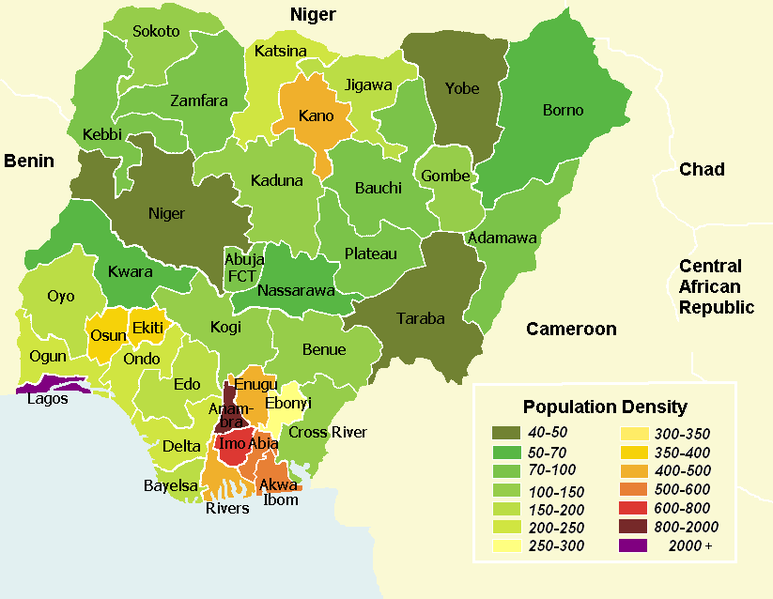
Check out the map for Nigeria's population density. The density in Lagos is 2000/square mile - 1/5 the density of Washington DC; 1/9 the density of Singapore. A couple other states in the south are also fairly well packed. Altogether, 15% of the population lives in high-density states. The vast majority of the country is in the 40-150 per square mile category. If anything, that is underpopulated. By comparison, NY city is up around 5000 per square mile, there are few pockets of high population (Buffalo, Rochester, Syracuse, Albany, from west to east) and everything else is in the 1-250 range. At 250/square mile in Ithaca, deer ate all my garden vegetables and raccoons regularly sacked garbage cans without locks on them.

Then we have the difficulty that the overpopulation is higher in areas that have higher GDP/capita. Lagos and Port Harcourt are not the poverty-stricken areas, but the wealthy ones. It's the underpopulated north that has the higher poverty rate.

Because really, the Times (and family) only discover there are actual cities in Africa when it wants to trot out its tired Malthusian stuff. Notice they only talk about fertility rates (6 kids per woman!), not population growth rates (2% last year, because 2 of those kids died before age 5 and the life expectancy is still under 50). Notice they don't mention that food production has kept up with population growth for over 50 years. Notice they don't mention that birth rates have been falling for 30 years, right in line with standard population transition models.

You could make a reasonable story out of all this based on the Harris-Todaro model: the way to solve the overcrowding in Lagos is to provide a little more development in the rural areas. But then the problem isn't too many people, but not enough development shared unequally.

Among my favorite comments on the subject, however, are still Fengler's and Dickens':
Fengler: Many think this is a big problem. ... I am less certain that the rapid population growth in Africa, especially in Kenya, is the fundamental development challenge: ... despite Africa’s rapid population growth and Europe’s stagnation (even decline in few countries) the old continent remains much more densely populated than Africa. If we look at Western Europe – where I come from – there are on average 170 people living on each square km. In Sub-Saharan Africa there are only 70 today. This gap will narrow in the next decades but even by 2050, Western Europe is expected to be more densely populated than Africa. I am following the population debates in Europe, especially in my (densely populated) home country Germany. I have never heard anyone argue that there are too many people in Europe.
Ever and again, I hear the immortal words:
``If these shadows remain unaltered by the Future, none other of my race,'' returned the Ghost, ``will find him here. What then? If he be like to die, he had better do it, and decrease the surplus population.''
Scrooge hung his head to hear his own words quoted by the Spirit, and was overcome with penitence and grief.
``Man,'' said the Ghost, ``if man you be in heart, not adamant, forbear that wicked cant until you have discovered What the surplus is, and Where it is. Will you decide what men shall live, what men shall die? It may be, that in the sight of Heaven, you are more worthless and less fit to live than millions like this poor man's child. Oh God! to hear the Insect on the leaf pronouncing on the too much life among his hungry brothers in the dust!''

Thursday, February 16, 2012

Proving I'm Alive: Big Bag of Blogs


Bellemare on Swinnen's paper on who wins and loses from high food prices and on the benefits to rural smallholders of joining marketing chains.

Tabarrok showing me why I should be very, very afraid: Kucinich and co. try a real life enactment of Atlas Shrugged.

Sumner discovers a second career as Bernanke's shrink, showing how his psychology  helps determine the fate of this recession. (If you wanted to be more sensational about it, you could talk about the discovery of the sinister figure in the shadows: Vincent Reinhart. That would be overdoing it a touch.)

The early impacts of AGRA's investment in Ghana, combining fertilizer subsidies, market access, and variable loan structure depending on outcome (essentially removing downside risk).

I was getting ready to run some proper experiments out here, only to learn that my very presence might bias the games. Of course, now this proposes that I need to replicate this (preliminary) finding itself. How general is the result? (HT: Aid Thoughts and Roving Bandit)

Urbanization in Africa is mostly about population growth rather than migration.

Tuesday, December 27, 2011

Development in India: The element of time

One of the main differences between those who advocate for more government intervention and less is the time scale involved. Those who tend to favor a bit more free market in their society tend to be thinking on a time scale of a generation or two while those who favor a bit more government tend to be thinking on a time scale of either 1 year or 100 years (depending on if they're an environmentalist or not). "Yes, that program will increase the growth rate, but people are starving today," say the one. "Yes, but lowering the growth rate means more people will starve in the future," say the other. Time plays many different roles:

Thursday, December 22, 2011

Test Questions I Have Used: The price of everything


In the final for my introductory microeconomics students, I posed a question based on a post on Wronging Rights. It involved an NGO buying up AK-47s in Africa to scrap and sell as jewelry in the West as a means of "doing something" about conflict. The question was to identify why this was a terrible idea, thinking about the incentives increased demand has on the supply side. WR subsequently put up a correction based on an email to the NGO. They do not go around buying guns from dealers, but they buy guns that have been confiscated by the government of the Democratic Republic of Congo and the UN. If anything, this encourages the government to confiscate more guns, which should do good things for reducing demand and supply.


On a midterm for the same class, I also posed a question based on the growing gender imbalance in some Indian states. Having 8 women to 10 men ought to increase the "price" of a bride that husbands pay, or in this case reduce the price the family of the bride has to pay the groom's family. This article from the World Bank discusses one campaign to encourage single men to get indoor plumbing and a toilet: No loo, no I do. And what do we find? Single men are becoming much more likely to have a toilet for prospective brides in states that have a low female-to-male ratio.


In class we also debated the ethics of kidney donations just in time for a slough of posts to go up around the blogsosphere about them.

Sunday, November 6, 2011

LDS Diversity and religious differences

CNN visits an LDS congregation in Washington DC and finds a very mingled, multicultural group:
On this Sunday, the Sacrament - what Mormons call the remembrance of the Last Supper and what other Christians call Communion - is said in French, a nod to the area's burgeoning West African population.
It is not a special multicultural celebration Sunday. For this growing Mormon congregation in northeast Washington, it's just another weekend.
“It’s 30% Caucasian, 30% African-American, and the rest is a combination of first-generation immigrants from around the world,” says Bishop Robert Nelson, the lay leader of this congregation. ...
“We’re in most of the free world right now,” Allen says. "We have a presence in Russia and Ukraine and the Baltic countries. We have a growing presence in Africa ... Nigeria, Kenya … then we have, Japan, Korea, Taiwan. There are small congregations in India, and the church is growing in those places.”
The church's membership has doubled since 1988, to 14.1 million Mormons worldwide.  Six million Mormons live in the United States. ... But like many other churches, there has been explosive growth in the LDS Church in Latin America. There are more than a million Mormons in both Mexico and Brazil. There are nearly a million Mormons in Asia and 300,000 in Africa, according to church statistics.
This was a lovely article describing the Church's growth in India an the faith of the members there [some of them, pictured right.]
Yglesias reports on a paper analyzing differences between Protestant and Catholic Swiss cantons, though he is also somewhat skeptical. "“Our empirical results suggest that ceteris paribus in a Reformed Protestant electorate support for increasing leisure time will be about 13 percentage points lower than in a Catholic electorate, and that support for government intervention will be about 11 percentage points lower."
Another study finds that LDS and Protestant youth who are active in their religions are much more likely (over 90%) to marry someone from their faith than are active Catholic or Jewish youth (60-70%). There is also a sizeable difference between less-active LDS and Protestants (60%) and less-active Catholic and Jewish youth (45%). Active LDS youth tend to marry earlier and are much less likely both to have multiple sexual partners or to cohabit before marriage than other youth and less likely to divorce or separate.
"We have this really unusual thing that is happening in America now," Brother Busby said. "The majority of the people don't marry until they are in their later 20s. Many of these churches have strong values and opinions about abstinence, but then couples feel like they can't get married until they are almost 30, causing more and more to eventually cave in and become sexual. Eventually they are worn down, something happens, and they don't stay together and then an individual begins to have multiple sexual partners."

Thursday, October 13, 2011

Big Bag of Africa: Statistics, Governance, and Food

Shanta at the World Bank discusses the importance of good statistics to understanding what goes on in Africa:

Today, only 35 percent of Africa’s population lives in countries that use the 1993 UN System of National Accounts; the others use earlier systems, some dating back to the 1960s. To show that this is not an arcane point, consider the case of Ghana, which decided to update its GDP last year to the 1993 system.  When they did so, they found that their GDP was 62 percent higher than previously thought.  Ghana’s per capita GDP is now over $1,000, making it a middle-income country. ... 
Only 11 African countries have comparable data for the same year. For the others, we need to extrapolate to 2005, sometimes (as in the case of Botswana) from as far back as 1993.
In short, even the economists’ celebratory estimate of poverty declining in Africa during a period of growth needs to be taken with a grain of salt.  In reality, there are many countries for which we simply don’t know.
What’s going on here?
The vice president of Zambia, Guy Scott, is, to not put too fine a point on it, white. Jayawardane argues that this will be most surprising to people who believe African countries are primarily divided along ethnic and tribal lines. For Zambians and many other countries, however, status and occupation are much more important dividing lines.

A very vocal critic of Nigeria's government, Richard Dowden, was invited to speak to the government. He reports his shock at seeing Pres. Jonathan nodding and smiling encouragingly as he and other speakers described what was wrong in the government, including being the highest paid government in the world. His assessment of the president is cautiously optimistic, though he also still has some real questions.
My impression of President Goodluck Jonathan is that he is Nigeria’s first intellectual president – a laid back former academic who wants to walk round a problem before deciding what to do about it. He likes to listen and ask questions – taking his time to understand and reframe the problem.
In other news, nearly half of Zambia's maize production got soaked during the rains last week. While it does not have to be destroyed - the government is optimistic it will dry oat - it may well decrease the amount of maize for human consumption that would have been available after another bumper harvest.

Ghana is providing northern farmers with 110 combine harvesters as part of its agricultural subsidy programs that currently lower the price on 100-150,000 tons of fertilizer.

Banana wilt has already wiped out 20% of the crop in one Ugandan district and is threatening nearly all the rest. This is an area where bananas/plantains are a major staple food.

Friday, June 17, 2011

The Dark Side: bailouts and path dependence

(via Mankiw) “Our benchmark results suggest that the ARRA created/saved approximately 450 thousand state and local government jobs and destroyed/forestalled roughly one million private sector jobs. State and local government jobs were saved because ARRA funds were largely used to offset state revenue shortfalls and Medicaid increases rather than boost private sector employment. The majority of destroyed/forestalled jobs were in growth industries including health, education, professional and business services.”
 
Blattman refers us to the dark sideof path dependence: “Pogroms during the Black Death are a strong and robust predictor of violence against Jews in the 1920s, and of votes for the Nazi Party. In addition, cities that saw medieval anti-Semitic violence also had higher deportation rates for Jews after 1933, were more likely to see synagogues damaged or destroyed in the Night of Broken Glass in 1938, and their inhabitants wrote more anti-Jewish letters to the editor of the Nazi newspaper Der Stürmer.”


Cardon, commenting on Aid Watch’s citation of his work on development in the US South: “It was the structure of institutions and social capital that had built up around slavery that constrained the South’s ability to make a peaceful and prosperous transition. … Even when we get unambiguous changes from an Evil system (like slavery) to a Good system (like freedom), societies with a new Good system will be constrained by norms and social capital that have accumulated around the Evil system. … Someday, I want to write a paper in which I ask whether cotton was to the antebellum South as oil and diamonds are to some countries today: an exportable commodity that provides high incomes for elites but that masks the underlying pathological institutions."

Big Bag of Interesting Sentences

Marron: Zanran is Google for data.
 
Economist: The alternative-medicine industry plainly excels as a placebo delivery service.
 
Blattman: Why use spray cans when you can simply strategically clean dirt?  [right]
 
McArdle via The .Plan: [Affluent white people in Manhattan] tend not to view themselves as affluent because they believe that living in Manhattan is a natural condition, like psoriasis, rather than a very expensive personal choice.

Yglesias on racism and egalitarianism in colonial America: there are multiple dimensions of inequality and social privilege, and tradeoffs between them do happen at the margin.

Fromson (via The .Plan) tells us that health food was created by cults (I’ve always felt there was something cultish about health food fads): The 1974 edition of the Spiritual Community Guide, "The Yellow Pages of the New Age Movement," listed 2,470 addresses throughout the country. ... 31.2 percent of the total, were health-food stores or restaurants. ... [U]nlike large religions, which can sustain themselves with tithes and donations, smaller groups usually have to generate revenue through actual businesses—and the restaurant industry has low barriers to entry.

Some of my soon-to-be colleagues at AUN evaluated Nigeria’s mobile phone network, finding that service has not improved in the last decade. Among the problems they want the government to address is corruption in activating SIM cards: "The registration and activation of SIM cards for MTN and Airtel took beyond seven days in Yola. This has led to some level of corruption on the part of their agents or employees, who expect some gratification before they would upload the registration request to head office," the report said.

The Economist on India’s new foreign policy efforts: Mr Singh promised $5 billion of loans on easy terms over the next three years for Africans willing to trade with India, plus another $1 billion to pay for education, railways and peacekeeping. It is a steep rise in aid and assistance—last year India gave a mere $25m to Africa

Monday, May 23, 2011

Food Stamps and Soda in 3 Acts


The political economy of soda, part 1, NYT via M. Nestle
Eighteen members of the Congressional Black Caucus recently urged the Obama administration to reject New York’s proposal. The plan is unfair to food stamp recipients because it treats them differently from other customers, they said in a letter to Agriculture Secretary Tom Vilsack.
While Coca-Cola and PepsiCo are among the largest contributors to the nonpartisan Congressional Black Caucus Foundation, a research and education institute, caucus members say their positions are not influenced by such contributions.
Policy advice, Part 2 from Wilde:
1. You never should have called the proposed policy a ban. Has there ever been a controversy over the "ban" on SNAP spending for hula-hoops and yo-yos? The "ban" on SNAP spending for gasoline? No
Part 3 … is just funny.

Run-Of-The-Mill Requests

Gas station | Madison, WI, USA
(A customer sets all their items up on the counter. This includes a six-pack of beer.)
Me: “Okay, your total will be $12.12.”
(The customer hands me their food stamp card.)
Me: “I can run this through, and it’ll take most of the total off. But beer isn’t covered under this program. I apologize.”
Customer: “Excuse me, what?”
Me: “Yeah, alcohol isn’t covered under the Supplemental Nutritional Assistance program.”
Customer: “But beer is nutritional. It has wheat in it.”

Thursday, May 5, 2011

US Demographic and Labor Changes

Interesting factoids from the Census with a lot of great maps and charts (HT: Newmark): Where has US population growth been above average? Mostly the mountains and deserts of the West, metropoloitan Texas, all of Florida, and the DC-NYC corridor.

Detroit is now smaller than it was in 1920.

Not adjusting for inflation, the greatest per capita income growth happened in DC, Louisiana (!), Wyoming, North Dakota, and Montana, growing by 50% between 2000 and 2010. The states that were unable to keep up with the 27% inflation over the decade: Navada, Michigan, Georgia, and Colorado, with Ohio and Indiana just keeping up.

(HT: Economist) “… Whites still constitute a slender majority, 54%, of those under 18” but with minorities accounting for 92% of the population growth of the last decade, fewer than half of the children my sons age or younger are white. So even though population growth has been in traditionally Republican-leaning states, if the growth is largely in Democrat-leaning population, there could be some real political shifts in the long run.

Combine all this with declining male employment, particularly for the less-educated and the picture looks a lot grimmer. The Economist’s article on US employment policies makes for interesting reading.
French complains that government regulation is making it more costly to hire and fire people. He argues this leads firms to hire seniors rather than teens and that this does a real disservice to the future of the country. The one difficulty is that the regulations he cites do not discriminate between the young and the elderly. His primary argument applies just as surely without any government interference at all:
Mr. Jones with a 40-year track record of showing up on time and really needing to supplement his Social Security check is a surer, safer bet than Danny Jones, who, while seeming bright and enthusiastic,  has never held a job and has classes and band to schedule around.  Who knows if Danny Boy will stick around?

Friday, March 25, 2011

Interactive Maps

Interactive third world America in maps: which areas have the highest levels of poverty, unemployment, low health, low education that we associate with low human development index (HDI) scores? My own congressional district scores in the second quintile (that's bad). The neighboring district that includes Ithaca proper is a full quintile ahead of us, largely because school enrollment is much higher and they have many more PhDs.

Mapping poverty, food security, health, and agriculture in Yemen.

Mapping food security programs by country. (HT: Poverty News Blog) You can see, for instance, that 103 of the 104 projects in Haiti work in Port-au-Prince, 20 in the Artibonite, and so forth.

What countries are as productive (total GDP) as Chinese provinces (interactive)? A nice companion to the earlier map updating this for the US. I note that central countries stand out: Middle East, central Asia, and central/Eastern Europe.

Mapping America: see the breakdown of ethnic diversity by census track for anywhere and everywhere in the US. HT: Clark Taylor

Monday, February 28, 2011

Mormons in Africa series

The Church of Jesus Christ of Latter-day Saints put out a series of news reports last week on the church's activity in Sub-Saharan Africa. The Church's Africa Fact Sheet can be found here. There are nearly 320,000 Mormons in Africa, roughly 100,000 of them in Nigeria. The fact sheet also provides statistics for the church's humanitarian aid. The initiatives are described in more detail here and I regularly link to more information.

Elder Richard G. Scott, a senior member of the Quorum of the Twelve Apostles, visited Mozambique in January. In his last visit in 1999 there were 40 Mormons in Mozambique, while there are now over 5000. He spoke to members in several meetings, with some members traveling two days for a chance to be there, as well as to doctors and nurses teaching neonatal resuscitation techniques to 53,000 medical professionals so far. His message was one of hope, reassurance, and encouragement. Another apostle, Jeffrey R. Holland, prophesied in Burundi that “Africa will someday be seen as a bright land full of ... hope and happiness.” Several African Church leaders tell their stories here.

This article tells several personal stories: one from a rural family in Madagascar who spent 27 years searching for religious truth and two accounts from South Africa. One of them describes the love expressed by white and black members for each other during Apartheid:
Dominic had never seen that type of affection generated from a white person toward someone of darker skin. “You don’t understand how big that was, how amazing it was to see that — how shocking. It went against everything society had taught me.” ... He was baptized and started attending church and was again amazed by the acceptance he felt. “They taught the same thing to me as the white boy sitting next to me at church. That broke a lot of boundaries for me. That said to me in my heart and mind that we are equal.”
This is a first-hand account by an LDS Kenyan journalist. Another article talks in a very introductory way about the 7,000 members in Uganda. The fastest Church growth currently is in the Democratic Republic of Congo.

The Church runs a program called the Perpetual Education Fund which provides low-interest loans to help people to receive education, usually in order to secure better employment. PEF is helping 2,300 people in Africa so far. The average loan in Africa is $1,200 for a year of schooling. 570 people have finished their education with the program and have seen large increases in income. Funds come from donations by members, myself included, and is run by volunteers.

Most genealogical records are preserved orally in Africa. The Church's FamilySearch program is attempting to record and preserve these family history records. The article quotes a Ghanaian proverb: When an old man dies, it is as if a library has burnt down.

Tuesday, January 4, 2011

Big Bag o Blog Links to start the new year

China in Africa meets Micro-livestock: a new research program is introducing Chinese weaver ants to African fruit trees to combat pests. The researchers note that if this works, it is: green and organic, another source of income and jobs (rearing ants to sell farmers), and a viable protein source for people who don't mind eating ants.

Half of a charter city: Dijbouti, Ethiopia. The charter city part comes at the end of a lengthy musing on Ethiopian political history, wondering why democracy has taken so little hold.

A policy entrepreneur in India is using Facebook to increasing citizen access to government (ie - complain here) and improve information sharing between government sectors.

GMOs meet Florida orange juice to prevent an insect-borne bacteria which causes "greening" that wipes out the crop and the tree. "Most scientists who have studied the problem seem to agree that genetic modification, and the cultivation of trees resistant to the bacteria that causes "greening" disease, currently hold out the only real long-term hope of fighting it." That was the conclusion of a report sponsored by the Florida Department of Citrus and U.S. National Academy of Sciences

Obama is signing the food safety bill today ... but where will the money come from?

A defense of large incomes for people in finance: "As long as we have an economy that is increasingly dominated by “idea companies,” where the idea is really, really hard to discover and really easy to implement once discovered, finance will earn huge gains." (Response to the responses)

On the gains from having a single currency in the US. To Libertarians, this is called the transaction cost side of private currency creation.

Education spending and minorities: it's easier/more cost-effective to educate a homogeneous population. Tino shows that once you remove immigrant populations from the analysis, the relationship between education spending and outcomes is large and positive. It only looks like additional spending worsens or has no effect on outcomes in the full sample because it's much more expensive to educate more diverse groups, who have lower outcomes for a variety of reasons. Within minority groups too, there is evidence of the same positive effect. The 0-effect sometimes observed is an artifact of lumping groups together.

Which shipping company is best for your package? Depends on the type of package. USPS is gentlest with packages but worst with Express Mail. All carriers were less careful with Fragile boxes.

Monday, October 25, 2010

On Structural Unemployment and Market Failure

My cousin asked me what the talking heads mean when they say the recession is "structural" and how the market failed.  (I note the Wiki on structural unemployment, could probably use some help if any of you feel like it).

Structural unemployment means that there are jobs out there somewhere, but the people looking for work don't have the skills/locations/something else to take them. There are frictions and transaction costs involved. If it were as costless to move as many economists blithely assume, there would be less unemployment for instance, but is that a case of markets breaking down or of people having an emotional attachment to their homes with high psychic costs for leaving?

The reason commentators just say "Oh, it's all structural" is that we can be a little fatalistic: very little that government policy can do. Except that's not quite right. Policy can be used effectively to reduce transaction costs, like the financial part of moving to find work or strengthening the meager job training programs.

My problem with the structural explanation right now is that they need to show me the jobs that are going begging. There are some. I've blogged about them. But not enough for 1/20th of the labor force. And how does structural unemployment (5-7% of the population) explain a more than 20% drop in average planned consumer holiday spending since 2007?

The reason I think there is something to the structural argument is that it's not just some random 5% of the work force that lost and now can't find work (5% unemployment is "normal" and we're 5% above that. I say "normal" because if we got down to 5% unemployment, almost everyone would stop talking about us being in a recession). Far more African-Americans are unemployed than whites, more high-school educated or dropouts than college educated, more men than women. There's some reason to suspect there's a structural issue there.

But if most of the unemployment problem really is about the less-educated then there is a role for monetary policy.  See here. There's a demand side and a supply side. Growth in businesses, housing starts, etc. increases demand for low-skilled workers, and to the extent monetary policy can increase demand for labor, unemployment goes down. Improving adult education or retraining changes the supply side and enables individuals to find work. The other possibility is to (at least temporarily) roll back the minimum wage increases Congress passed recently or even (!) the employer contributions for Obamacare which together bring the cost to the firm of hiring even a low-skilled worker to over $13 an hour.

So, by the by, if you believe we have a structural unemployment situation and that the Real Problem is minimum wage increases and Obamacare, then it's government failure, not market failure. If you believe that the Real Problem is tight monetary policy for the last two years, then it's government failure, not market failure. If you believe that the Real Problem is lack of education and it's our government supplying the education, that's a government failure too. If you believe that the Real Problem is racial integration, that's ... not a government failure or a market failure, but a humanity failure.

Monday, October 18, 2010

Overheard at Cornell: Race

My tweets during the seminar given by Stephen Trejo of UT Austin on "Intermarriage and the Intergenerational Transmission of Ethnic Identity and Human Capital for Mexican Americans":

[This is] One of the funniest economics seminars in memory on intermarriage and ethnic identity of Mexican Americans. 

 Story 1 - How did 4 million Irish immigrants become 40 million Irish Americans? Turns out Irish/French or Irish/Germans emphasize Irish. Maybe Irish have more fun...

Story 2 - 1970s census asked if a person came from "Central/South America." Bunch of people in Alabama et al. checked Yes.

Story 3 - We have two questions (Hispanic, then race) because so many Hispanics would put "other, Mexican" or "other, Latino" etc. for race. 

Story 4 - Survey of adult identical twins: which race do you identify with? One twin said African-American, one twin said white. 

Story 5 - Another set of identical twins with complex heritage were coded as being from different races by Harvard admissions. 

The more serious discussion below the fold:

Friday, September 24, 2010

Big Bag o unusual Blog Links

The effect of political connections: say you're a former Congressional staffer and you become a lobbyist. When your former boss leaves the Senate, your income goes down by over 50%.

Yglesias continues to excuse and praise Republicans for being two-faced
As you see here with Ryan (and in the generally Calvinball like approach the GOP has taken to the reconciliation question over the years), Republicans are determined to follow the actual laws and rules. When in the minority, they don’t rebel. They don’t murder their political opponents, they don’t organize coups d’état. What they do is they try to win legislative battles through all the tools at their disposal. And when in the majority they . . . do the same thing. They believe, strongly, that letting wealthy businessmen get what they want is good for America, and they go about doing that with seriousness of purpose. Many Democrats, by contrast, seem to believe that their highest responsibility is to make themselves look good, to preen for the cameras, or to maximize their own personal authority.
But they’re wrong and Ryan is right. The procedural rules are levers to be deployed on behalf of important goals, not holy writ to which policy objectives should be subordinated.
Extra points for using Calvinball in a sentence.

Two great websites with interesting maps: one of US city segregation, the other of European stereotypes (the rest of Europe according to France, according to Germany, etc.)

How swimming lessons saved Taiwan. No, really. [if only I could remember to whom I tip my hat...]

A gathering of over 10,000 West African LDS youth, many of them discovering theater for the first time as they act out religious scenes. Lots of colorful, engaging pictures of the event.

It's called "The economics of Star Wars" but really it's the accounting of Star Wars, and only the revenue portion at that.

Blattman compares and contrasts rural vs. urban living and the advantages of each, coming out in favor of urban. I share his skepticism of the overly romanticized rural but that isn't enough to convince me.

Asian immigrants and their effect on cuisine:
South Korean investment in the U.S. got a major boost in 2008 when the federal government decided to no longer require visas for visiting South Korean citizens. The move has already shown results. For the first six months of this year, some 450,000 South Koreans entered the U.S., a 38% rise over the same period last year. [This worries Korean-American restaurant owners who will have to step up their game or be outshone.]
And a use for extra garden produce: Woman fends off bear with zucchini.

Meanwhile in Zimbabwe


Godfrey Marawanyika tells about one Zimbabwe's successful new farmers. Around 2000, Mugabe seized the land of many white farmers and passed it out to some of his more clearly African constituency. The article has a fascinating schizophrenia of a tale in three parts: that one farmer's success, the overall perceived failure of the plan, and hence a dual picture of Mugabe as folk hero and corrupt tyrant. The racial comments are also worth reading. Here are excerpts of these points:

To get him started, a neighbouring white farmer lent him a tractor to prepare land to grow maize and tomatoes and in time he tried tobacco farming. The white farmer declined to be interviewed, but Mhembere said the gesture put him on a path toward success, placing him among a new generation of farmers who increased Zimbabwe's tobacco output for the first time in eight years. ... [Production is currently half what it was in 2000]

Mugabe said the scheme was needed to correct the legacy of colonialism, but the reforms were marred by deadly political attacks against farmers, who saw their land turned into militia bases for ruling party attacks on the opposition. Hundreds of thousands of black farm workers on white farms were forcibly evicted, while Mugabe's top aides seized prize farmland. Small farmers like Mhembere were often left with little support to finance their operations. Production of both food and cash crops like tobacco plunged, leaving Zimbabwe dependent on food aid and drying up foreign currency reserves.

For nearly a decade, government failed to help the resettled farms use their land effectively with a select few benefitting from handouts from the central bank, while their meagre incomes were ravaged by hyperinflation....

It remains to be seen if Zimbabwe's farms are solidly on an upward trend, but Mhembere says land reforms were among the best policies Mugabe adopted since independence from Britain in 1980. 
"If ever President Mugabe did anything for the majority in this country it is the land reform which is real empowerment for blacks. Land reform is about sharing, land reform was never about chasing whites. The problem is that some of the whites did not want to share."
Meanwhile, Mugabe and 80 person, $2 million, entourage arrived at the UN MDG Summit to declare US/EU sanctions were preventing them from achieving the poverty and hunger goals and claim that they are doing very well at meeting the education and HIV goals.