Showing posts with label Africa. Show all posts

Friday, July 25, 2014

Why do they matter? Fish and McD's

Pinstrup-Anderson, co-author on my textbook, recently asked what fish have to do with food and nutrition security. He answers that it matters a great deal and recommends a new report by a high-level panel of experts on the subject.
The current debate and the many papers written recently about how agriculture can be made more nutrition sensitive also miss the point.  We should talk about how the food system, including fisheries and aquaculture and the total supply chain, can be made more nutrition sensitive.  If we limit the discussion and policy recommendations to agriculture, we are foregoing some very big opportunities for improving food security and nutrition. ... 
The report, which is available at www.fao.org/cfs/cfs-hlpe or in hardcopy from cfs-hlpe@fao.org, is a goldmine of policy-related knowledge about the fisheries and aquaculture sectors, their importance, sustainability issues, governance and recommended policies for consideration by governments, the private sector, civil society and international organizations. It provides a comprehensive assessment of the interaction between the fisheries and aquaculture sector and food and nutrition security. The report is a must-read for those of us interested in food policy.
Handjiski points out that all of Sub-Saharan Africa only has two countries with McDonald's franchises. Even though countries like Seychelles, E. Guinea, Gabon, Botswana, and good old Nigeria have a higher income than Indonesia, Egypt, Pakiston, or Moldova did when they got their first. He suggests that, since having a McDonald's requires a certain level of infrastructure, entrepreneurship, and access to a large number of ingredients, it can be a development indicator:
In almost 60 percent of cases, developing countries grew [significantly] faster in the five years, compared to the previous five, following the opening of the first McDonald’s. ... What this means is that McDonald’s may be viewed as one of the tipping points for when a country has amassed sufficient urban middle-class, investment security and supply chains for economic take off.
 Speaking of which, there was also a recent article about how Americans' general stupidity with fractions stopped A&W from beating McDonald's Quarter Pounder with a "Third Pounder". People said 3 is less than 4 and therefore 1/3 is less than 1/4. Ouch. In related interesting news, New York states has decided that a burrito is a sandwich for tax purposes.
.

Monday, July 21, 2014

Jobs in Africa

The African Economic Outlook (here) came out this month. It predicts continued 5% growth overall, with about 7% in the west and only 3-4% in the north and south. For Nigeria, and my former students should pay attention, it points out that most of that growth is NOT in the oil sectors: agriculture, trade, and ICT growing fastest. It also advises countries to invest more in the value added industries. Given that the vast majority of my intro economics students and even the people on the street in Nigeria not only could but did tell me the same thing on multiple occasions, I'm less impressed. It's a right answer, of course, but more needs to be done to identify why it isn't happening when everyone already knows it's the right answer and to take the political economy more seriously.

Oh, and as an aside, take a look at this graph from the AEO:
I could be wrong, but I don't think that's how gears work. The bottom two would turn just fine, but the Human Rights gear is pushing the Unequal Access gear counter-clockwise while the Exclusion gear is pushing it clockwise. From a graph standpoint, this undermines the presumed point that each of them exacerbates the others. It suggests maybe that a poor human rights record makes unequal access not as bad, or that unequal access improves human rights...

Teal argues that the increase in education supply in Africa is a good thing, but only provisionally. The question is: why is more education good? It's good from a human rights/development perspective, clearly. But whether increased education will bring people out of poverty depends in part on whether or not there are jobs available that demand the increased skills.
"Without the factories the dramatic increase in the primary educated work force will indeed see little economic gain from their education. The recent increases in the demand for education beyond the primary level certainly suggests that both students, and their parents, are aware that low levels of education have little value in the job market place. Focusing on meeting that demand rather than focusing on why that demand has arisen may well be to miss the critical problem facing educational policy in Africa."
One of the informal jobs I saw often in Nigeria is that of the porter. People, usually boys, wandered the Jimeta market with wheelbarrows, offering to carry my purchases. The Sudanese government, however, has decided that it is in the public's interest to create a monopoly on wheelbarrows in Khartoum. Porters are not allowed to own their own wheelbarrow, but must rent them at high fees, ruining what little income they were getting from a pretty thankless job.

El Alaoui, Aicha, Elhadj Ezzahid, and Jallal Eladnani (2013). "Estimating NAIRU: The Moroccan Case", MPRA Paper No 56815.
In intermediate macro we are introduced to the Non-Accelerating Inflation Rate of Unemployment (NAIRU). The idea is that if the level of unemployment is lower than NAIRU, you can expect inflation to increase, and to decrease if unemployment is higher. They estimate that the NAIRU has decreased from around 13% in 1998 to about 9% today. There is no explanation for why this happened and the policy conclusion - Morocco needs looser monetary policy based on the fact that the unemployment rate was consistently higher than NAIRU - does not capitalize on the fact that inflation has been remarkably low and sometimes negative since late 2009 or discuss the bank's mandate, goals, or governance.

Friday, July 11, 2014

Lit in Review: Nigerian Agriculture 3

(This post was started October 2011 and never finished. Let's get it out and done.)

Eze, Kwonko, Orebiyi, and Kadiri, "Land Tenure System, Farm Size, innocation, and Agricultural Productivity in South-East Nigeria"

From the abstract: "The laws of inheritance and increase in population led to the subdivision and fragmentation of existing farmland in such a manner that the sizes of farm holdings discouraged agricultural commercialization. ... It was also shown that mechanization of agriculture was impracticable under land fragmentation." They conclude that farmer cooperatives would consolidate fragmented farms, reducing time and energy waste and allowing more modern innovations and mechanization to improve efficiency and production.


What I learned from reading the Marginal Revolution magazine

(This post was written April 2013 and I'm not sure why it wasn't posted then)

I've been interested by the occasional posts by people who read a magazine cover to cover, then report on what they learned. These couple next posts are based loosely on that idea. I've been thoroughly busy and stressed this semester without much time for semi-curricular reading, which means the posts have been piling up in my reader.

While our NUC accreditors were at AUN, though, I needed to be on-call to answer questions. Completely unable to concentrate on research writing, I did a lot of reading. Below are a few of the things I learned reading every post from a few weeks' worth of Marginal Revolution:

Lit in Review: Money in India, Africa, and helicopters

Gupta, Abhijit and Rajeswari Sengupta. 2014. "Is India Ready for Flexible Inflation Targeting?" , Indira Gandhi Institute of Development Research Working Paper, June 2014.

The standard intermediate macro take has been to encourage some form of flexible inflation targeting or Taylor rule approach. In developing countries, however, financial systems are less well-developed which makes the lags between data, policy, and outcomes more troubling and, because food prices form a much larger portion of the price basket, if most central banks had responded to the recent food price spikes by sharply tightening the money supply the results would have been dire. India has followed a "multiple indicator approach" since 1998 that focuses more on stable interest rates and exchange rates, but also uses money, credit, output, trade, capital flows, government debt, and the inflation rate. The lack of a single policy rate reduced the clarity of signals sent to the market and introduced (predictable) variance in other variables, however, so in 2011 the RBI officially focused on the weighted average overnight call money rate.

Gupta and Sengupta estimate a Taylor rule for India using 90-98, 98-04, and 04-13 data. Inflation matters less and less for policy making, particularly in the last period that includes the food price spike - albeit the Wholesale price index (WPI) matters more than the CPI. They also estimate exchange rate stability, monetary independence, and capital account openness over time (the impossible trinity) and show that exchange rate stability has much less weight today than it did even as recently as 2000 when it was the primary goal. The increased monetary independence this bought indicates it would be more possible than in the past for India to follow some kind of Taylor rule.

Buiter, Willem. 2014. "The Simple Analytics of Helicopter Money: Why it Works - Always" Economics, Discussion Paper 2014-24.

Milton Friedman called a permanent increase in the money supply a "helicopter drop." It turns out that Quantitative Easing (QE) fits that description so long as people believe the Fed is not likely to sell off its assets. Buiter cites other research that says helicopter drops might successfully increase aggregate demand, but they also might fail. He then demonstrates that there are three conditions for this to always boost aggregate demand: 1) people want cash for reasons other than earning more money (ie - people value cash even when there is modest inflation because we use it as a medium of exchange); 2) the price of money is positive; 3) cash is irredemable (ie - it's not a liability for the government and not backed by gold). He claims it was failure to consider this last condition that led to the erroneous idea that helicopter drops would not increase AD. (PS - that picture is really not fair to our former Chairman, but it's entertaining.)

Asongu, Simplice. 2013. ''A note on the long-run neutrality of monetary policy: new empirics", MPRA Paper 56796 and AGDI Working Paper WP/13/032, posted 23 June 2014.

Money is neutral in the long-run in Africa too.

As it should be.

Thursday, August 29, 2013

Why markets don't work in Africa - ILRI


I am hoping this gives me an easier time showing it in class.

Friday, August 31, 2012

Lit in Review: Child Undernutrition and Labor

Harttgen, Klasen, and Vollmer, "Economic Growth and Child Undernutrition in Africa," GlobalFood Discussion Paper.

They add to the short but slowly growing literature on the impact of economic growth on child undernutrition that I based my dissertation work on. They add Klasen (08), Friedman and Schady (09), and Subramanyam et al (11) to the ones I knew about.

They identify a micro-macro paradox: increasing household income reduces undernutrition significantly but increasing average incomes doesn't make nearly the same difference. It is rather disturbing to me to see for how many SSA countries there has been significant improvement in GDP/capita, but a worsening of child hunger. Among the things they find that matter more than GDP/capita, household asset rank matters, suggesting that inequality may be an important part of the story.

Bhagowalia, Menon, Quisumbing, and Soundararajan, "What Dimensions of Women's Empowerment  Matter Most for Child Nutrition?' IFPRI Discussion Paper 01192

Women's empowerment can be a fairly vague (their preferred word: complex) term, so it is nice to see the authors breaking various dimensions of it down to see which are correlated with better outcomes. From the abstract: "Results from logit models indicate that both a greater degree of women’s empowerment and greater maternal endowments [read: height and education] are associated with better long-term nutritional status of children [in Bangladesh]. Attitudes toward domestic violence have an effect on child stunting and mobility; participation in decisionmaking is an important influence on dietary diversity. Consistent with previous studies, maternal height and maternal schooling decrease the probability of stunting, and maternal schooling is positively associated with dietary diversity. While these are not immediate measures of empowerment, they are positively associated with child nutritional outcomes and reflect prior investments in women and girls." However, they have almost no control variables in the regressions, so it is uncertain how much is due to these factors directly, and how much is the fact they signal correlation with socio-economic status or other factors.

De Paoli and Mendola, "Does International Migration Increase Child Labor?" Centro Studi Luca d'Agliano Development Studies Working Paper 339.

An interesting data combination allows them to look out how out-migration of workers from different skills impact local labor markets, and how those impacts affect some 200,000 children studied in 38 different countries. They find that allowing low-skilled workers to emigrate increases local wages for the parents, reducing child labor. It might have also been the case that it raised the wage for child labor, which would increase child labor, but this does not seem to be a significant factor. They also see that female emigration reduces child labor by more than male emigration. "According to our estimates, a 10% increase in the migration rate decreases the probability of child labor by 1.2 percentage points (p.p.) and the total time of weekly work by 7.3 hours." I count 209 reported regressions and, at first glance at least, the vast majority tell the same overall story.

Friday, August 24, 2012

Lit in Review: Poverty and Livestock in Eastern Africa

Tsehay and Bauer, "Poverty Dynamics and Vulnerability: Empirical Evidence from Smallholders in Northern Highlands of Ethiopia," presented at the IAAE August 2012.

They study Yetmen and Shumsheha in rural Ethiopia. Between 1994 and 2010, the percent of households owning oxen increased from 5% to 75% and 46% and livestock assets more than tripled in value. Literacy has gone down, but school enrollments are up significantly.

The poverty dynamics are quite interesting. Half of the households are worse off, moving down from subjacent or medial poor to ultra poor (<$0.50/day) and 1/4 moved up - not out-of-poverty up, but up to slightly-less-poor. The worsening happened between 2004 and 2010, while 1994-2004 had seen significant improvement.

Table 5 shows the number of times out of 4 rounds that a household was poor:

          Yetmen             Shumsheha
0          9.8                   6.93
1         27.45                31.68
2         35.29                30.69
3         19.61                24.75
4          7.84                 5.94

Wainaina, Okello, and Nzuma, "Impact of Contract Farming on Smallholder Poultry Farmers' Income in Kenya," presented at the IAAE August 2012.

Their study of 180 smallholder farmers in Nakuru county finds that farmers contracting with Kims Poultry Care Center received roughly 27 percent more revenue per bird than independent farmers. They used matching propensities.

I'm uncertain whether they mean that "KPCC is the only large poultry farm that works with smallholder farmers in Kenya..." or the only one that works with smallholders in a contract that also provides inputs and interlinked credit. Markets for inputs and outputs tend to be quite thin, so partnering with KPCC improves market access significantly. So these results may not be typical of contract farming overall. Oddly enough, independent farmers have statistically larger birds than contract farmers, so the revenue per kg difference is slightly larger. Extension agents and higher education make farmers less likely to sign a contract, so they aren't explaining the difference.

Smallscale farmers have 100-500 birds, medium scale is 500-1000. The county has 40-45% poverty. It sells processed chicken and eggs to local tourist hotels and throughout East Africa.

They regularly reference Nyaga, 2007; poultry sector country review, FAO

Gelan, Engida, Caria, and Karugia, "The Role of Livestock in the Ethiopian Economy: Policy Analysis using a computable general equilibrium model for Ethiopia," also IAAE August 2012.

From the abstract: "We extend an existing dynamic recursive general equilibrium model for the
Ethiopian economy which better models the livestock sector. A separate herd dynamics
module enables us to specify stock-flow relationship, distinguishing between the capital role
of livestock and the flow of livestock products. We also improve the underlying system of
economic accounts, to better capture draft power and breeding stocks." What they look at is growth in total factor productivity (TFP) - how efficient or productive the sector is - comparing a positive shock to TFP growth in livestock, cereals, or cash crops. So imagine you wanted to invest in agricultural productivity in Ethiopia and ask which of those three you should invest in.

They find that an increase in livestock TFP growth from 0.5% to 3.1% would do as much to increase total agricultural GDP as an increase in cereal TFP growth from 2.2% to 4.3%. Livestock TFP growth would also improve export value more than cereal or cash crop TFP growth. Even though domestic prices for livestock decrease, labor income goes up fastest with livestock TFP growth, so the poor benefit the most from livestock TFP growth. Cereal TFP growth improves their caloric consumption by the most.

Monday, April 16, 2012

Babies in Nigeria

The Times decided it had been a good few months since it last sounded a Malthusian warning against population growth in Africa. So they said, let's pick on Nigeria! That's always fun. When I read the good Dr. Blattman asking for additional opinions, I knew it was time for me to break radio silence again.

Nigeria defies a lot of the overpopulation stories. I spend a lecture with my development students on Malthus and overpopulation, and I've got to say, I find the evidence very non-Malthusian.

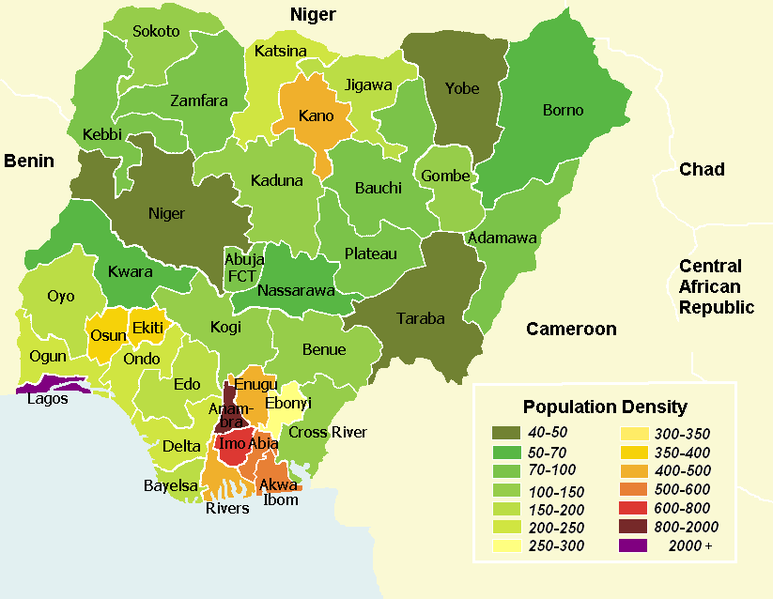
Nigeria as a whole is less densely populated than New York State (or 6 other US states). Actually, NYS is a very good comparison: there's a large mass of population in one teeny corner, and the rest of the state is vast tracts of underpopulated farmland with a couple rust-belt cities "not living up to their potential," as we recite in far too many student papers over here. In the last governor's election, the top debate topics were the brain drain out of NYS and corruption. They had to put the capitol city outside of NYC to keep it away from the big city politicking, crime, and corruption, just like Abuja. But I digress:

Check out the map for Nigeria's population density. The density in Lagos is 2000/square mile - 1/5 the density of Washington DC; 1/9 the density of Singapore. A couple other states in the south are also fairly well packed. Altogether, 15% of the population lives in high-density states. The vast majority of the country is in the 40-150 per square mile category. If anything, that is underpopulated. By comparison, NY city is up around 5000 per square mile, there are few pockets of high population (Buffalo, Rochester, Syracuse, Albany, from west to east) and everything else is in the 1-250 range. At 250/square mile in Ithaca, deer ate all my garden vegetables and raccoons regularly sacked garbage cans without locks on them.

Then we have the difficulty that the overpopulation is higher in areas that have higher GDP/capita. Lagos and Port Harcourt are not the poverty-stricken areas, but the wealthy ones. It's the underpopulated north that has the higher poverty rate.

Because really, the Times (and family) only discover there are actual cities in Africa when it wants to trot out its tired Malthusian stuff. Notice they only talk about fertility rates (6 kids per woman!), not population growth rates (2% last year, because 2 of those kids died before age 5 and the life expectancy is still under 50). Notice they don't mention that food production has kept up with population growth for over 50 years. Notice they don't mention that birth rates have been falling for 30 years, right in line with standard population transition models.

You could make a reasonable story out of all this based on the Harris-Todaro model: the way to solve the overcrowding in Lagos is to provide a little more development in the rural areas. But then the problem isn't too many people, but not enough development shared unequally.

Among my favorite comments on the subject, however, are still Fengler's and Dickens':
Fengler: Many think this is a big problem. ... I am less certain that the rapid population growth in Africa, especially in Kenya, is the fundamental development challenge: ... despite Africa’s rapid population growth and Europe’s stagnation (even decline in few countries) the old continent remains much more densely populated than Africa. If we look at Western Europe – where I come from – there are on average 170 people living on each square km. In Sub-Saharan Africa there are only 70 today. This gap will narrow in the next decades but even by 2050, Western Europe is expected to be more densely populated than Africa. I am following the population debates in Europe, especially in my (densely populated) home country Germany. I have never heard anyone argue that there are too many people in Europe.
Ever and again, I hear the immortal words:
``If these shadows remain unaltered by the Future, none other of my race,'' returned the Ghost, ``will find him here. What then? If he be like to die, he had better do it, and decrease the surplus population.''
Scrooge hung his head to hear his own words quoted by the Spirit, and was overcome with penitence and grief.
``Man,'' said the Ghost, ``if man you be in heart, not adamant, forbear that wicked cant until you have discovered What the surplus is, and Where it is. Will you decide what men shall live, what men shall die? It may be, that in the sight of Heaven, you are more worthless and less fit to live than millions like this poor man's child. Oh God! to hear the Insect on the leaf pronouncing on the too much life among his hungry brothers in the dust!''

Friday, February 24, 2012

Ethiopian Bank Run Friday

There was a run on the bank today. I nearly missed it.

All of us at the conference were told to visit the bank to get refunds and daily stipends. We could only do so today, and we could only do so during one of two coffee breaks. To someone teaching Game Theory this semester, this sounded like a perfect set up for a simple coordination game.

I played a waiting game. I dislike waiting. When I observed most of my colleagues heading across during the first break, I decided the clear game solution was for me to wait to the second coffee break so I wouldn't have to wait so long in line. They indeed got back late, it taking more than 45 minutes to service them all.

When I eventually went with just three other colleagues, I was feeling pretty good about my choice. But then one of us told a joke: the bank was out of money and would only have enough for him and not for us.

I suddenly realized that if I were in a bank run game, I had played the entirely wrong strategy. Observing other people racing to get their money out in the early period, I ought to have gone early also. We covered that extensively in the Cornell macro group – sunspots determining bank runs, psychology determining bank runs, self-reinforcing beliefs, on and on. If you see other people running, run.

When I get back to AUN, I will be introducing my game theory class to risk and uncertainty. What if there is a probability p that I’m playing the bank run game and probability (1-p) I’m playing a waiting game? At what critical value of p should I go with the first group instead of with the second? I smell a midterm question. And if you’re in Eco 404 this semester, you’re welcome.

Friday, February 17, 2012

Lit in Review: Ghanaian Agriculture

Egyir, Adu-Nyako, and Okafor examine how the "Made in USA" poultry label affects consumer choice in Ghana. Among the statistics they offer, domestic production accounts for 10% of the poultry market. In 2010, the local price was just under $4/lb while imports cost under $1.10/lb Costs could be brought down with better management and vaccine delivery. Two decades ago, fish provided 60% of the animal protein they consumed, but poultry has been growing in importance. Most of the chickens (60%) are bought directly from the farm, with supermarkets only serving the high income group. The poultry packing industry is in its extreme infancy.

500 consumers were surveyed about their attitudes on how likely they were to purchase domestic chicken, versus Tyson (US), Brazilian, European, or Asian chicken. 56% were likely to buy Made in the USA, and 72% to buy Ghanaian. Asian chicken did not score very highly. More than 80% recognized COOL chicken. (That's Country of Origin Labeling, not the fellow on the right.)

Here is Kris Klokkenga's description of the differences between trying to farm in Illinois and in Ghana:

Thursday, February 16, 2012

Proving I'm Alive: Big Bag of Blogs


Bellemare on Swinnen's paper on who wins and loses from high food prices and on the benefits to rural smallholders of joining marketing chains.

Tabarrok showing me why I should be very, very afraid: Kucinich and co. try a real life enactment of Atlas Shrugged.

Sumner discovers a second career as Bernanke's shrink, showing how his psychology  helps determine the fate of this recession. (If you wanted to be more sensational about it, you could talk about the discovery of the sinister figure in the shadows: Vincent Reinhart. That would be overdoing it a touch.)

The early impacts of AGRA's investment in Ghana, combining fertilizer subsidies, market access, and variable loan structure depending on outcome (essentially removing downside risk).

I was getting ready to run some proper experiments out here, only to learn that my very presence might bias the games. Of course, now this proposes that I need to replicate this (preliminary) finding itself. How general is the result? (HT: Aid Thoughts and Roving Bandit)

Urbanization in Africa is mostly about population growth rather than migration.

Tuesday, January 17, 2012

Best of 2011

Time for some intense naval-gazing. I wasn't going to do one of these, but then I enjoyed others' so much for the posts I missed that it seemed much more interesting.

Top Ten Posts of 2011
1. Google's statement on AUN's amazing internet usage, got a lot of doubting comments and a few  defending and very plausible explanations.
2. Nutrition Labeling, describing the new requirement that meat include information on calories from fat.
3. Unemployment: Leads and Lags - Breaking unemployment into separate decisions to hire or fire will give us a better indicator of where the economy is going (has been) than total unemployment.
4. AEA session on agricultural export bans during the 07/08 food price crisis.
5. Microinsurance in Kenya via cellphone
6. My first visit to AUN. Classes will resume Thursday the 24th
7. Low saturated fat diet vs. low simple carbohydrate diet
8. QE2 and food prices - debunking the idea that the Fed is causing global food price inflation
9. Food safety, food movements, and paternalism
10. Lit in Review: Food Demand -- Ethiopia and Speculators
Honorable Mention (because I thought it was fun): The socially acceptable price of fried chicken, also known as the political economy of fast food markets in South Korea.

Top Ten Posts of 2010 (in 2011)

1. My pictures of the Thorvaldsen's Christus and apostles statues, mentioned in a Church lesson this year.
2. Lit in Review: Grossman and Helpman, there has been steady interest in summaries and other papers that make use of the "Pay to Play" model of lobbyists.
3. Food in Africa: Too much and too little discussing the problem of getting food from food-surplus states to food-deficit states. There was never a large spike, but a steady stream of interest throughout the year.
4. High Hopes for Rwandan Agricultural Development
5. Food Security in Nepal which has been of increasing interest lately
6. Cutting Costs Through ... Fonts?? Some fonts go easier on the printer's ink
7. Population Health vs. Individual Health - commentary on macro vs. micro in economics and health
8. Ethiopian Monetary Policy - combines monetary policy, food prices, Ethiopia's development goals (food self-sufficiency), and growth prospects
8. Five from vacation: education, hyperinflation, and Chinese food safety.
10. Fed governor: if we could guarantee 5% NGDP growth, it would be great - I'm glad this made the list because I think it was my most significant post, interviewing Governor Dudley about what they are targeting and Sumner's policy.

Where did my visitors come from in 2011?

Understanding Isaiah in South Sudan


* - This was originally posted January 9, 2011. That post had too many visits from spam engines, so I have reposted it hoping to clear my cache a little.


The referendum on Southern Sudanese independence is today. It is a good day to pray, for all sides.

For those who are unfamiliar with Biblical geography (as I was until I did some searching) when Isaiah was speaking about the land of Cush, he really was thinking about the same neighborhood - Eastern Africa, south of Egypt, Ethiopia in particular which is next door in our modern maps. Chapter 18, which the video cites, speaks mostly of the woe on the "land ... beyond the rivers of Ethiopia" until the last verse, which speaks of their suffering and finally being gathered "to mount Zion." Chapter 11, which references Cush more explicitly, speaks of a second, Millennial gathering of God's people out of Cush and assorted lands to Zion. Zephaniah 3 similarly speaks of people beyond the rivers of Ethiopia being gathered (vs. 10) and bringing offerings to God (vs. 12) in the last days. Any other reference to Ethiopia I find is about it being smitten by Assyria or getting ready to join Egypt in afflicting Israel. So I see a lot more about a gathering out of the area, rather than divinely ordained political independence, but it can't be denied that it's a regular theme of the Old Testament prophets for God's people. [Quick bias check: do you think of them as 'God's people' because the south is mostly Christian or because they could have intermingled with Ethiopian Jews, or can you see the Muslim north as also part of God's people who accept Isaiah as a prophet and are living in the same area?]

Hat tip: Poverty News Blog

Friday, January 13, 2012

One week later in Jimeta

One week after the shooting in Yola and on the 4th day of the fuel subsidy strike, the Yola-Jimeta area is remarkably quiet. My family went shopping and saw that there were far fewer vehicles on the road, many shops were closed - in some cases whole streets of shops gated and locked up - and the main market itself was quieter than usual, though there still a decent amount of traffic around the stalls. It was very strange to see so little activity.

I carefully wrote down the prices of everything we bought and noted that nothing had gone up significantly. The small pouch of water that in other cities had doubled or trebled in price was still the same N5 as ever. Our huge block of mozzarella cheese was even down N500 since last time.

There were two big differences. Faro Water, the local bottling plant owned by AUN Founder Atiku Abubakar, has joined the strike, so there were no refill water jugs. One shop did still have cartons of water bottles we could buy.

Second, a couple key intersections now sport dedicated police searching every car. Each motorcyclist had to stop, dismount, and walk their bike through. Pedestrians passed with their hands in the air. Each car had to show what was in the trunk and sometimes answer questions. I may post some of it later. Most of the travellers, and our driver, laughed at most of it.

The road to the church where the shooting took place is blocked to all traffic.

Thursday, January 12, 2012

Random Links: food governance, being LDS, behavioral economics

C. Juma on how to improve Africa's research infrastructure - basically, make research institutions more like teaching institutions and teaching institutions more research oriented.

A fascinating Kenyan website called I paid a bribe. The tagline is: uncover the market price of corruption.

The price of orange juice at a 34-year high.

Price transmission in NYC from subway to pizza.

Why are Americans eating less meat? Partly higher relative prices, partly recession, party "Flexitarianism."

WalMart pays Nicaraguan farmers less than other retail outlets, but offers much less price variance in compensation. Since food price variance has increased, this might be a better deal than it used to be.

"What is essential to being a good Mormon? According to the [Pew] survey [of pretty active American members of the Church of Jesus Christ of Latter-day Saints], 80 percent said "believing Joseph Smith saw God the Father and Jesus Christ" is essential to being a good Mormon, 73 percent said "working to help the poor,"" Other interesting sound bites:
  • The Latter-day Saints surveyed had a more favorable opinion of Pres. Obama than LDS Senate Majority Leader Reid (25 to 22)
  • 97% of us identify as being Christians, believe in Jesus' resurrection, and use the word "Christian" as the single word that best describes us, while 49% of non-Mormons do not think we're Christian
  • Most of us rank being a good parent as more important than career or religious activities
  • 60% of converts cited church beliefs as why they joined. 60% of converts joined between 18 and 35 years old.
  • 82% say they have a food storage, and almost half have 3 months stored up. When Pres. Ensign came to check on us and assess our needs, we were happy to report that we had 1-2 weeks of food stored up and enough cash to satisfy our needs. Water was another story, but we could boil the tap water to make more as needed and had already refilled a 5 gallon (20 liter) drum with boiled water.
  • Even though most identified as conservative, we are much more positive about immigrants and immigration than the average conservative.
Asking people to give a lot of examples actually convinces them that something is less likely than asking them only a few examples. It is the ease of coming up with the marginal example that matters rather than the total number.

Bellemare on how to do well in an economics class.

Friday, January 6, 2012

"I started the war against subsidies."

Head of the Central Bank, Sanusi, explaining in more detail why he is against the fuel subsidies in Nigeria. There is a pretty thorough description of how the subsidy really supports corruption and some of the evidence of it. Interesting throughout.
So for two years I have been convinced that this thing is a scam and that it cannot be stopped because the entire controls have been compromised. ... So yes, I am willing to take all the criticism and labels and be unpopular but this has to stop and govt can find other ways of alleviating pain.

Removing it has costs in terms of nigerians paying more for PMS-which by the way is not the fuel for genrators, power plants, production facilities, heavy duty goods transportation trucks and even luxury buses. It is fuel used by the middle class and car owners to drove around town and from city to city not to employ workers and produce goods and services. Diesel which is critical to manufacturing and employment creation is not subsidized

1. I am a strong advocate for subsidies if they are for production and not consumption, and if they benefit the poor and not middle men and rent seekers. The US government subsidizes cotton and wheat farmers and nigeria spends its reserves importing wheat from america and keeping american farmers employed....

Finally: removing subsidy is not a silver bullet that solves our economic problems. And there is a huge trust deficit that government has to address. Government needs to investigate subsidy payments and punish any violations of extant guidelines. It needs to cut on unnecessary and waste ful expenditure. It needs to fight corruption and show seriousness in that. It needs to deliver on capital projects, power and infrastructure including irrigation, farm-level storage and agri-processing. These are all valid issues that are to be taken IN ADDITION to and not in place of subsidy removal.

Wednesday, January 4, 2012

Price transmission in Nigeria

With the fuel subsidy's disappearance, the price of gasoline increased from N65 ($0.40) to N140-N150 (just under $1). What other prices go up and how quickly? I'll be updating this post from time to time with new prices as I learned them:


Small plastic bag with water: N5 up to N10; larger bag in Lagos from N60 to N150 Jan 4   (reported through Twitter from numerous sources)


Jan 5 from our shopping - taxi service price up from N1000/hour to N2000/hr; water jug refills unavailable; most food sold at the same price; lower selection of bread than usual; 


Jan 5 NigeriaNewsDesk Twitter report: Many filling stations outside Calabar, the Cross River State capital, are selling premium motor spirit, popularly known as petrol, for N250

Fourth-hand Twitter report: Packet of St Louis Sugar was N100. Post subsidy N250


A student reports: A bowl of raw foreign rice has gone from N250 to N270 in Kaduna while a similar bowl of black eyed peas has gone from N120 to N180.


Jan 9 - water jug refill up from N350 to N375. Tailoring services and fabric same price as before.

Monday, January 2, 2012

Lit in Review: Case Studies about LDS in Africa

Martinich, author of the LDS Church Growth blog, has published a series of case studies on the growth of the Church of Jesus Christ of Latter-day Saints globally, including on opening new cities for missionary work in general and two case studies in Ghana and Ethiopia showing how that was done specifically. Of interest to me, he recommends leaders use cost-benefit analysis in determining where new cities should be opened as part of the "homework" required for the revelatory process.

In Sunyani, Ghana, there were previously no members of the church in late 2010 when 6 young missionaries and one senior couple were sent in to form three "groups" (very small congregations ... yes, very small) in a city of less than 100,000. In the course of one year they had not only turned two of them into "branches" (small, but self-sustaining congregations, in this case around 50 people attending each week) but a fourth congregation had also been formed. The branches are being led by local leadership instead of missionaries.

In Awasa, Ethiopia, one family had been meeting since 2003 but did not become a branch until 2008 (average attendance about 20). When full-time missionaries were assigned in mid-2010, attendance rocketed from 20 to 70 by the end of the year. There are now four congregations there, though attendance has been highly variable and most of the members appear to be under the age of 21. Some local religious leaders also joined the Church during this time period. The groups are still heavily dependent on the missionaries for leadership and training.

In other posts, Martinich reports on recent Church growth in Sierra Leone and the temporary removal of senior missionary couples from the Democratic Republic of Congo following the election violence last month.

Monday, December 26, 2011

Scrooge and a Big Bag of Christmas

Marron's Twelve Days of Christmas list for the global (but mostly US) economy, including 10 new Steve Jobses to rise and replace the fallen, 7 fed governors (we've been making do with 5 for the longest time) pushing for a 5% nominal GDP growth target, $3 trillion in budget cuts, and 2 new currencies (letting the Euro drop a couple countries).


Scrooge's name came from misreading the tombstone of Adam Smith's grandnephew? Are you sure this isn't a Dan Brown plot reject? If not, how about considering below the moral hazard of Scrooge:


In which a friend of mine tries to show a Pakistani a Currier and Ives Christmas, and ends up finding its deeper meaning with an Alaskan crab fisherman.


The First Presidency of the Church of Jesus Christ of Latter-day Saints included this in their Christmas message:
This joyful season will bring to each of us a measure of happiness that corresponds to the degree in which we have turned our minds, feelings and actions to the spirit of Christmas.May this Christmas season be a time of prayers for peace, for the preservation of free principles, and for the protection of those who are far from us. Let it be a time of forgetting self and finding time for others. 
C. S. Lewis on two types of causality, that of work and that of prayer: "Prayers are not always -- in the crude, factual sense of the word -- "granted". This is not because prayer is a weaker kind of causality, but because it is a stronger kind."


Delicious satire: a response to Band Aid's "Do they know it's Christmas?" is found in Plaster Cast's "Yes, We Do." (HT: Blattman)