Showing posts with label Environment. Show all posts

Thursday, December 20, 2012

Lit in Review: Climate Change and Investment in Vietnam

Dang, Anh Duc (2012) "Cooperation makes beliefs: Weather variation and sources of social trust in Vietnam" ANU Working Papers in Economics and Econometrics #596.

Dang - a PhD candidate at ANU - begins with Durante's (2009) finding that large weather variation in medieval times led to more collective action in Europe and hence to more social trust. Applying a similar methodology to Vietnam's 1927-1995 regional rainfall variation (both monthly and maximal), Dang shows that regions that had higher weather variability also have higher social trust. Social trust is measured by surveys asking if respondents feel they can trust their community and if there is someone outside their household to whom they could turn for help in hard times. Oddly, while recognizing that migrants are part of an interesting dynamic with social trust, Dang excludes them completely, focusing only on households where at least one adult has lived in that community their entire life. I also find it odd that he is worried about unobserved non-geographic factors that would determine both rainfall and social trust among people who haven't migrated.

Among the implications of this work is that climate change is likely to impact individual adaptive behavior through changing levels of trust and social cooperation. This will tend to mitigate some of its negative effects on individuals.

Chinowsky, Paul, Amy Schweikert, Niko Strzepek, and Kenneth Strzepek (2012) "Road Infrastructure and Climate Change in Vietnam," UNU-WIDER Working Paper 2012/80.

They consider the tradeoff between expanding road access to more areas today and upgrading and maintaining existing roads to prepare for and respond to climate change. Even while assuming sea levels rise by one meter, they show that the large majority of cases involve costs in the lower end of the distribution. Despite that, it is cheaper in terms of foregone roads to adapt to future climate change than to await its eventual impact and rebuild roads once the uncertainty is resolved. In the minimum impact scenario, Vietnam would be no worse off for making adaptive investments.


Wednesday, December 28, 2011

Big Bag of Ethical Endorsements

Tabarrok endorses GiveWell's endorsement of the Against Malaria Foundation as a good charity to give money to. This sparked a debate in the comments about whether you should really give money to just one charity or to many and why we give in the first place. One argument (Landsburg's) says that if your contribution is small relative to the size of their total budget and if you are primarily seeking to do the most good with your money, you should only invest in one charity. Your small donation won't run into diminishing marginal returns, so there's no reason to diversify. On  the other hand, if you are concerned about other things, you may want to do something else:
  • if I receive increasing marginal utility to the number of organizations I give to (up to a point), then I'd rather give a small amount to several organizations than a larger amount to only one; [translation: I feel like I'm a better human being because I give to 10 organizations than if I only donated to one]
  • if I am uncertain which problem is the worst, it makes sense to donate to several organizations working on different problems (say, measles, climate change, and gender discrimination); [Note: if this is your difficulty, you might want to check out the Copenhagen Consensus, whose Nobel Laureate panel agreed child hunger was global problem #1)
Boudreaux meanwhile endorses Caplan on the perceived moral difference between nepotism and nationalism:
Despite its mighty evolutionary basis, almost everyone recognizes moral strictures against familial favoritism.  Almost everyone knows that “It would help my son” is not a good reason to commit murder, break someone’s arm, or steal. ...
Nationalism, in contrast, is widely seen as an acceptable excuse for horrific crimes against outgroups.  Do you plan to murder hundreds of thousands of innocent foreign civilians?  Just say, “It will save American [German/Japanese/Russian/whatever] lives” – and other members of your tribe will nod their heads.  Do you want to deprive millions of foreigners of the basic human rights to sell their labor to willing buyers, rent apartments from willing landlords, and buy groceries from willing merchants?  Just say, “It’s necessary to protect American jobs” in a self-righteous tone, then bask in the admiration of your fellow citizens.
Yglesias endorses cash donations, even as a way to teach children about the value of giving well:
Food drives do teach a lot of valuable lessons to kids. Until, that is, you learn that giving $10 will buy twenty times as much food for poor people aswould donating $10 worth of canned goods. Once you actually know the facts, then all it seems like you're doing is teaching kids to be too lazy to scrutinize the world. ... We shouldn't be teaching kids that it's okay to be indifferent between helping one family and helping twenty families. It's a huge difference!
Cook endorses de Tocqueville:
The greatest advantage of religion is to inspire … principles. There is no religion which does not place the object of man’s desires above and beyond the treasure of earth, and which does not naturally raise his soul to regions far above those of the senses.
Because in part that is my tradition as well, I wondered at Wronging Rights  perceiving religion solely as being in conflict with human rights. I pointed out in my comments that this in part stems from a confusion about what is meant by "religion". I wrote in part:

Friday, December 23, 2011

Agriculture repeats itself

Chapter 10 of my textbook on Food Policy for Developing Countries discusses nanotechnology and the fact that companies have a vested interest in ensuring that nanotech does not become the next great consumer scare. To do that, they need to make sure there is public debate, address consumer concerns early on, openly, forthrightly, and without condescension. Governments have an important role to play also in clarifying up front what standards will be required. Having a clear regulatory framework will encourage companies to invest and make it easier for them to demonstrate openly that their products meet safety standards. Here is M. Nestle agreeing on the scope of the problem and supplying some new reports on the subject.

There is a hefty debate brewing on which framework should be used to debate international agricultural policies. Doha is going nowhere slowly. At COP17 African countries had been reasonably unified, but are less so now that South Africa is calling for a greater environmental focus, with Ghana, Mali, and Tanzania prominent on the other side of the debate. One of the better arguments in the article:
Harjeet Singh of ActionAid International said that farmers with fewer than two hectares would only be able to make $3 a year at the present rate for carbon. He said he did not doubt the intentions of South Africa in "pushing for climate-smart agriculture as the answer to agriculture's problems" but added that "climate-smart agriculture could benefit South Africa a lot because your farmers are large-scale and carbon markets work for agriculture on the industrial scale".
Cote d'Ivoire has announced the (re?)formation of a state cocoa board that will take over most of the higher level market functions. The article seems to be written from a Ghanaian-centric viewpoint, worrying about how the CdI board will be able to compete with Ghana's and the likely impact on world prices [which will be lower, duh, because the civil war kept cocoa production and sales much lower].

And for variety, here is an interview with a Zimbabwean crocodile farmer. He has 10,000 crocs at a time, which he exports to Europe and Asia to sell their skins and meat. Among his major costs are importing the beasts to feed the crocs and trying to get enough eggs to keep the project at that size.

Thursday, December 1, 2011

Big Bag of Africa: Agriculture and Millennium Villages

A new paper is out that finds almost zero impact from the Millennium Villages Project. Wanjala and Muradian surveyed Kenyan MVP recipients and their non-recipient neighbors in the district and found that while "the project caused a 70% increase in agricultural productivity among the treated households, tending to increase household income, it also caused less diversification of household economic activity into profitable non-farm employment, tending to decrease household income." To say Clemens cheers would not do his sentiments justice, but Blattman certainly has a more skeptical take on the paper. He shows that there may be a problem with their evaluation strategy, effectively matching away the most important gains. If so, then "MVs actually raise incomes by 10% and assets by a third." The cordial debate between Clemens and Blattman on the latter's blog is impressive and worth reading. (HT: The .Plan that got it from MR, who got it from CGD, which is where I ought to have read it in the first place.)

Record heat in Zimbabwe killed several hundred livestock recently due to lack of water and good grazing land. Climate change is of course suspected to have contributed. The difficulty is in identifying how many cattle would have died had temperatures been just 1 degree Celsius less, or how much more likely this event was as a result of climate change.

In Nigeria, there are increasing tensions between cattle-herders and farmers in Abia as cattle are reported to have destroyed crops worth millions of Naira (tens of thousands of US dollars). Note, the article has a heavy pro-farmer bias.

Closer to my home, a new national government program in Adamawa State hopes to increase farmer yields by 300% with improved varieties of sorghum. The project is led by Prof. Babtunde Obilana, who plans that the government will buy more of the sorghum to use for its school feeding program.

Meanwhile, the LDS Church has a third stake in Port Harcourt. A stake is a group of congregations, and this means that church membership in and around Port Harcourt has grown by around 50% since 2002 when the last stake was created. It is very likely that new stakes will also be formed in Benin City, where the three current stakes have grown to some of the largest in the Church worldwide and could easily be split into 5-6 stakes.

Mozambique's national statistics arm has a new report showing that 99.9% of their agriculture is for subsistence only.

Botswana's government tries to make sure that government subsidies don't go to farms that are not being actively used, a process called black listing. This article discusses blacklisting figures for the last few years and the costs involved.

Friday, November 11, 2011

Mixed Bag: good and bad in African agriculture

In the most distressing news I've heard recently put in a positive light, 20 Tanzanian farmers were invited to Uganda to learn more about using human feces as fertilizer. They would like to convince us that this is a good thing because fertilizer use is so low, but it's also a great way for spreading diseases. Their numbers are 20 years old, but show that a lot more fertilizer is supposedly distributed than was ever spread on crops. That doesn't suggest the problem was lack of fertilizer availability.

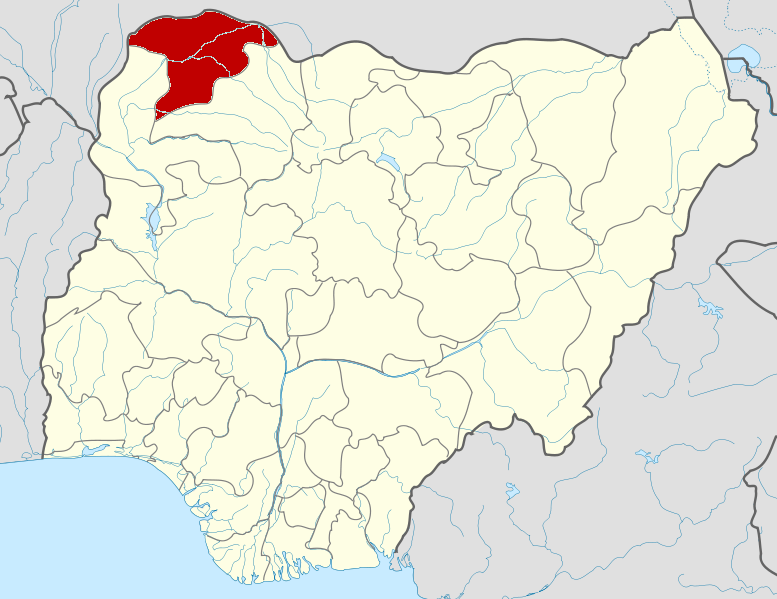
Flooding in northwestern Nigeria (Sokoto state, pictured) destroyed 1 billion Naira worth of crops ($6.7 million).

In much happier news, ICRISAT has been providing some Mali farmers with groundnut (peanut) seeds that take only 3 months to harvest instead of 4. As rain patterns have shifted, assumedly due to climate change, the rainy season has been getting shorter and shorter. If I understand the report correctly, it claims that groundnut production has also increased 10-fold.

They also established a cooperative (starting at 20 members, now 65) to coordinate storage. Each member of the cooperative contributes 20 kg of groundnuts for storage. 10 of them they get back later in the year (as a form of forced storage for behavioral economics reasons) and the other 10 are sold (for about $320) to give the cooperative a source of loanable capital.

Ugandan rice production is up significantly - 66% during the last decade. Instead of importing rice, they now export to South Sudan, Kenya, and DRC. The article credits Nerica (New Rice for Africa) with much of the growth. I take the article to be saying that a new survey by the Ministry of Agriculture claims that rice exports are now valued more than any other traditional food export.

Zimbabwe is going to start handing out agricultural input vouchers to vulnerable farmers this week, entitling them to "10 kilograms of maize seed, one 50-kilogram bag of compound D and one 50 kilogram bag of ammonium nitrate fertilizer."


Monday, September 12, 2011

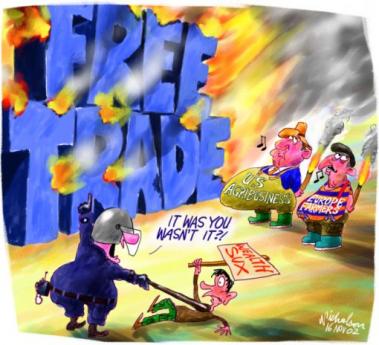
How can anyone not support free trade?

My cousin asked me that today, by happy coincidence the very day I prepare to lay the foundation so my micro principles students can understand why the vast majority of economists do support free trade. I responded to him, in part (and from a US-centric standpoint): 


But you ask me why other people don't think the way we do, so this is my attempt to give them a fair shake. I actually had to write a paper once on why some people don't support free trade. The short answers are:

  • They don't understand free trade. (#1 reason)
  • If they understand free trade is good in general, they may not understand what is really meant by "strong" and "weak" currencies or where trade deficits come from. Those we aren't going to cover in micro principles, but they are important parts of understanding free trade.
  • They understand that free trade maximizes total utility, but they are concerned about the distribution of the gains and losses. The ethics behind free trade says that the winners could compensate the losers of a change to free trade, but in general they don't - no more than the winners of protection compensate the losers. If you think most of the losses will hit poor people, there is a reasonable ethical ground for wanting to discourage some trade. Now, we could do things better by still allowing trade and doing something else for poor people, but I can understand the argument anyway. This analysis also usually forgets the much poorer people in another country who gain a job that allows them to survive.
  • As a rich country, the US can afford little luxuries like high labor and environmental standards that other countries may not. If you are categorically opposed to child labor in sweatshops or unsustainable fishing and air pollution, you might be concerned about more production moving to areas that don't regulate those items as much. There are arguments that go the other way, but again I can understand why someone who places a high value on the environment might not want production to move away from where we can regulate it.
  • If there are any externalities (like air pollution) you can also make the argument that the market price does not reflect the true costs and benefits, so markets will oversupply goods. Moving to somewhere that has a larger disparity between private and social costs (either because the firm will be more polluting there and increase the social costs, or different regulations lower private costs, or whatnot) will tend to exacerbate that problem.
  • It's a colonialist/egalitarian thing. If the rules of free trade agreements favor countries that are already wealthy (and they do), it is possible for a government to harm its citizens by opening to freer trade. The rules of accession to the WTO, for instance, allow current members to exact concessions from new members that either nullify WTO rules (WTO-) or require higher standards for entry (WTO+) so that the "rules-based" system becomes a power-based system. For egalitarian reasons, someone might not like that arrangement even if they like free trade per se. 
Now these aren't actually the arguments most people make. But if they had more sophisticated economic reasoning, these are the types of arguments they would make and they are the points brought up by the 2% of economists who don't care as much for free trade (e.g. Stiglitz). This is also ignoring the infant industries argument (favored by Rodrik), the national defence argument, or most arguments that point out that we may have more goals than efficiency and freedom (like food self-sufficiency). I'm also missing the anti-corporatist element and the more blatant self-serving protectionist arguments [made in particular by the corporatist element, right].

Tuesday, September 6, 2011

Happy Labor-tarian Day

Have solidarity with the working class and get the government off their backs. Many of the poorest pay over 100% marginal tax rates as benefits phase out in strange and unpredictable ways. It sets up strong counter-incentives to work. Employer payroll taxes reduce demand for labor across the board.
From Cafe Hayek:
taxes on corporations are taxes on people:

I remember that in addressing the issue in the 1980s, the late Herb Stein said that it’s as if people think that if the government imposed a tax on cows, the tax would be paid by the cows.

Labor and environmental regulations are actually preventing the government from producing Obama's sought-after clean tech jobs (HT: Newman).
Catalan at Mises discusses the moral and pragmatic consequences of Libertarianism for the poor:
As a “quasi”-consequentialist I tend to judge libertarianism by the outcomes of certain policies (or, better said, lack of policies). I honestly believe that the free market could better provide for the “less fortunate” than an interventionist economy, and that an interventionist economy will lead to the further impoverishment of the “less fortunate” over the long run. [My father] disagreed and I gave the example of the food industry. In more capitalistic countries, where regulation on food production and distribution is relatively minor, food is plentiful — there is a surplus that can be exported. There are some who are “malnourished”, but malnourishment in the United States is not the same as malnourishment in Sudan, for the most part. Yet, in countries where food is rationed there is widespread malnourishment and famine.
While I tend to favor his overall sentiment when applied to the US, the malnourishment of Sudan is scarcely caused by too much government today. You can make the case that the problem is too much of really bad government in the past, but if even 15 years of no central government have not turned things around in a significant way, maybe there needs to be something more. A good part of the reason our markets function well includes significant amounts of public goods provided by our government. Could they also be supplied by the market? Perhaps. Experience around the world shows that where government does not provide them, markets have provided in insufficient quantities to get their market system where it could be.

On the bright side, at least one sector is hiring: the downward-pointing arrows manufacturers.

Tuesday, August 16, 2011

Development = Washing Machines

As I prepare to teach development economics next week, how thankful I am for Gapminder and one Hans Rosling who explains things so very well.


Monday, August 15, 2011

Stewards of the Earth

On GMOs, Roman Catholic bishops in Kenya are credited with "taking a new stance," and though it's only a small switch it's surprising to me how many people are against it. What's the new stance? If you're going to starve to death because of famine, it's really much better to eat genetically modified food than to die. ... I know, what was the policy before? Death before GMO? And there are people against this!? I think we need to call in Jon Stewart for this one.


On "over"population, I wish there were far more people arguing that babies are not the problem. Here is one argument from Yglesias:
It’s especially mistaken, I think, to try to look at children as a negative environmental externality. The beginning of wisdom here is to note that pollution isn’t “bad for the planet.” The planet is a gigantic roughly spherical chunk of rocks that can easily survive whatever level of greenhouse gas emissions or whatever else we care to pump into the atmosphere. The big picture ecological threat is a threat to human beings, and to the continued existence of ecological conditions that are conducive to human flourishing. Radical population reduction would sharply reduce the quantity of anthropogenic ecological impacts, but to what end? The goal needs to be to reconfigure human activity in order to make it sustainable over a longer time horizon. But sustained human flourishing requires both acceptable levels of ecological impact and also the continued production of new human beings.
On the lowered and falling prospects for jatropha, a new report by Wu and Kant addresses the Indian and Chinese largely failed plans:
It appears to be an extreme case of a well intentioned top down climate mitigation approach, undertaken without adequate preparation and ignoring conflict of interest, and adopted in good faith by other countries, gone awry bringing misery to millions of poorest people across the world. And it happened because the principle of “due diligence” before taking up large ventures was ignored everywhere. As climate mitigation and adaptation activities intensify attracting large investments there is danger of such lapses becoming more frequent ...
On the land grab, there is a new film out attacking the primary banana corporation in Cameroon. Among the interesting political economy issues:
"If you look at the congressman of the region, he is also the director of public relations of the company, the minister of trade of Cameroon is also president of the board of directors of the company."
An interesting paper showcases informal seed exchange between farmers for preserving seed diversity in Mozambique following a disaster. They argue food aid should include local seed varieties as part of the package to speed diversity recovery following a disaster.
The research established that nearly 90% of the farmers in the affected areas received cowpea relief seed immediately after the back-to-back calamities. Two years after, only one-fifth of the recipient farmers were still growing the seeds, while more than half sourced their seeds from markets. However, this did little in restoring cowpea diversity in the affected communities as the seeds bought by farmers from the market were mostly uniform, coming from other districts that grew just one or a few select varieties. 
On the other hand, about one-third of the affected farmers obtained seeds from friends and relatives living within the same or neighbouring localities to restock their farms – the same people that they have been exchanging seeds with prior to the disasters. This practice was the main reason why cowpea diversity was restored in these areas, the study showed.

Thursday, June 2, 2011

Big Bag of Inequality: Global, Environmental, and Ideological

Economix (HT: MR) brings us this fascinating graph. The people in each country are ordered left to right by income and from bottom to top based on their position in the global income distribution. We see that Brazil has enormous inequality: the poorest are as poor as anyone in the world and the richest are as rich as any American. In the US, however “the typical person in the bottom 5 percent of the American income distribution is still richer than 68 percent of the world’s inhabitants.” Meanwhile even the richest people in India are only about as well off as the poorest in the US.

In my food policy textbook, which Per and I just finished proofreading for the last time, we discuss how climate change is expected to be beneficial for colder climate areas and harmful for areas that are already warm. This exacerbates global inequality. A recent working paper by Richard Tol of ESRI argues that this was only the case since 1980. Prior to 1980, climate change had a positive net-impact in most countries.

Then there’s ideological inequality in the classroom: 
The distribution of academic talent was the same across “Republican” and “Democratic” classrooms, judging from SAT scores. But the Republicans gave grades of C-minus or worse 6.2% of the time, compared with 4% for Democrats. And Republicans awarded the gold star of A-plus 8% of the time, compared with only 3.5% for Democrats.”
Some more on ideology and economic knowledge (HT: Yglesias) and the kinds of questions asked by a Libertarian economics teacher of his intro course.

Big Bag of Food Policies: Farm Bill, Seeds, and Antibiotics

Elliott calls on budget cutters to not only cut the direct farm payments from the next Farm Bill – intended as a bridge away from trade-distorting policies that never got off the ground – but also from the trade-distorting subsidies that still exist. And shocking as it is for me to agree with my former Sentaor Feinstein, do so I must:
Oh, and Congress could save another $3 billion this year and $6 billion in future years by voting to eliminate the subsidy for ethanol as proposed by Senators Dianne Feinstein (D-CA) and Tom Coburn (R-OK). Senator Tom Coburn (R-OK) rightly calls it “bad economic policy, bad energy policy and bad environmental policy.”
FAO and the African Union have teamed up to create a Forum for Africa Seed Testing to speed up seed policy harmonization and promote seed markets. Guei, an FAO senior officer, indicates that “Inadequate supply of quality seeds for both food and cash crops is one of the biggest bottlenecks to food production on the continent..."

Loglisci (HT: Wilde) reminds us that Denmark has been using antibiotics in livestock only when needed by illness – rather than keeping all animals constantly under a mild dose of antibiotics as we do in the States – for a number of years. As a result, they use a lot fewer antibiotics and they have had less trouble than we have from the growth of antibiotic-resistant superbugs. This hasn’t prevented increasing use of antibiotics as hog population has grown (see chart), but it is far lower today than it was at peak and lower still than it would have been without the law.

Friday, May 20, 2011

The opportunity costs of cheap food

Our food costs more than the price at the grocery store. In addition to the environmental costs, M. Nestle worries about food safety costs that would be much cheaper to prevent than cure. While the argument made by companies and Nestle is that prevention shows up in consumer costs while clean up doesn’t, I would argue that private clean up does show up in consumer costs. It’s only when government and public health systems bear the costs that they don’t show up directly in food costs. She worries also about human costs, including obesity caused in part by cheap, subsidized calories and expensive, unsubsidized vegetables, and:
I was reminded of externalized food costs when reading about the remarkable efforts of a Salinas teacher to educate children of itinerant farmworkers. The kids are trying to learn under disrupted, impoverished, crowded living conditions. If their parents were paid and housed better, we would pay more for food. …
The CEO of a large U.S. meat company told me that if he raised wages by $3, he could hire locals and not have to deal with immigrant labor. But then he would have to raise the price of his meat by 3 cents per pound (I’m not kidding). That amount, he claimed, would price him out of competitiveness. …
Speaking of which, Florida tomato pickers (mostly immigrants) have recently been awarded a much better contract, including higher wages, being informed about their legal labor rights, and many are cheering that the industry is really beginning to turn around. Expect some of the hidden costs of tomatoes to be less hidden.

In support of this notion of the unseen costs of our food system, Batz and colleagues at the University of Florida’s Emerging Pathogens Institute identify the 10 pathogen-food combinations that cost us the most in terms of public health (medical care, lost productivity, chronic disabilities including permanent physical and mental damage to infants, etc.):
Campylobacter in poultry — costs $1.3 billion a year [sickens more than 600,000 Americans annually]
Toxoplasma in pork — costs $1.2 billion a year
Listeria in deli meats — costs $1.1 billion a year
Salmonella in poultry — costs $700 million a year
Listeria in dairy products — costs $700 million a year
Salmonella in complex foods — costs $600 million a year
Norovirus in complex foods — costs $900 million a year
Salmonella in produce — costs $500 million a year
Toxoplasma in beef — costs $700 million a year
Salmonella in eggs — costs $400 million a year
Another source Nestle misses is the taxes needed to pay for government food policies in the form of taxation.

An example of unusual environmental costs of a food system comes from Zimbabwe, whose justice department has decided to solve undernutrition in overcrowded prisons by adding elephant meat to the menu. The government’s position is that there are three times as many elephants as conservation groups think, so they have “an elephant overpopulation crisis.”

Interesting Sentences

The Economist: The world could be on the verge of a great management revolution: making robots behave like humans rather than the 20th century’s preferred option, making humans behave like robots.

HT: Grandiloquent Bloviator: “If you’re not the consumer, you’re the product.” Also known as: there is no such thing as a free lunch on the internet. If you can’t tell what the website is trying to sell you, they are either selling your eyes to advertisers or your information. 
Beckworth: “money is special: it is the only asset on every other market (i.e. it is the medium of exchange) and thus is the only one that can affect every other market.  Money, therefore, is what makes it possible to have economy-wide recessions.
Marron: Sometimes, it’s more than $100 lying on the sidewalk: “You can sell 9,999 shares of The Donald …  at $0.52 a piece [on Intrade]. In just that one trade, you can pocket almost $5,200 of free money.” The only question is whether the government decides this is an illegal activity for influencing voting and elections. “For the latest Trump action, click here.”
The Economist: “The [United Arab Emerites] government aims to reduce the rising number of single local women by offering prizes of up to $19,000 to men who marry them.”
 
The history of political cartooning in South Africa: “I tried to define when South African cartooning started … all the way back to a cartoon which was published in 1819 by George Cruikshank who was a leading London caricaturist of the day. I called it the Cruikshank’s cannibal cartoon. It shows the white settlers being devoured by these cannibal figures – these huge, hulking monstrous figures. … For me that became an iconic cartoon, a prototypical South African cartoon.”
 
Yglesias on Chomsky’s denunciation of Osama’s death as an illegal assassination: “International law is made by states, powerful states have a disproportionate role in shaping it, and powerful states have obvious reasons to not be super-interested in the due process of suspected international terrorists or the sensibilities of mid-sized countries. Many people are pacifists and/or strong critics of western military power, and that’s fine. But it’s simply not the case that international law is identical with these policy preferences. On the contrary, one of the main functions of the international institutional order is precisely to legitimate the use of deadly military force by western powers."

Calzadilla, Rehdanz, and Tol: “Trade liberalization tends to reduce water use in water scarce regions, and increase water use in water abundant regions, even though water markets do not exist in most countries “

Easterly and Freschi: “Belief in Hell raised … economic growth potential. … A different twist than the Protestant Ethic: Scared Rich?

Monday, April 25, 2011

Unusual Political Economic Explanations

A good question from Cowen: “What is the political economy of a world where so few people work?” That deals with labor force participation rates rather than unemployment rates per se, but I would hazard that it makes the US look much more like Europe. Cowen believes that it will be more likely to lead to a change in ethical principles (moving from “protecting all the old people against major health care catastrophes” to guaranteeing everyone a particular annual income) which will involve a change in policy instruments from Medicare to welfare checks.
The political economy of energy: If we had no nuclear power, the world would produce an additional 2 billion tons of CO2, roughly the total emissions of Germany and Japan combined, much of it from gas plants. Of course, that number doesn’t count for the demand-depressing effects of higher energy prices. Japan, however, seems less concerned with nuclear power itself than with the political economy of how it is run, with senior bureaucrats who regulated the nuclear power industry being invited to “cushy jobs” in it. “An energy portfolio, like any other, is a basket of risks: of security of supply, cost and environmental damage. Fear and uncertainty, which nuclear fission produces as unavoidably as it does iodine-131, distort people’s perceptions of those risks.”
Yglesias was debating the political economy of why our tax code is convoluted and an unnecessary headache for millions of filers. I filled in one answer just before he gave it, but his other answer I think is quite doubtful:
Under the circumstances, the sensible thing would be for the IRS to send everyone a sheet of paper that says “based on the income that’s been reported to us and your family status from last year, your taxes owed (or refund owed to you) is $X with standard deductions. If something’s changed, or if that income number is wrong, or if you want to itemize deductions, you should fill out forms blah blah blah. Otherwise, just send a check.” A lot of us would still need to wrestle with the forms and nobody likes to give up money, but this would be much more convenient for millions of people. We don’t do it because H&R Block and TurboTax don’t want to lose customers and, crucially, because the conservative movement wants taxes for ordinary people to be as annoying as possible. Rich people don’t care about this kind of simplification because they itemize their deductions and hire accountants. But they benefit from middle class people resenting the tax process because it helps them build the case for low tax rates.
I would be interested to know just how much H&R Block and Turbo Tax are giving in campaign contributions to specific members of the relevant committees to fight against tax simplification. I am doubtful that it is anywhere near as significant as, say, the contributions for the Farm Bill or any hint of regulation of meat processors.

Tuesday, April 19, 2011

Economics of climate change policies (and public choice)

Boudreaux, who I have heard argue that there are almost no externalities in real life (by his definition), claims that there is a problem with the rhetoric used by climate change hawks:
I neither deny that climate change is occurring nor that its occurance [sic] is the result of human activity.  (I’m no natural scientist, so my ability to judge the science is inadequate.)...

So much of the conversation by climate-change hawks takes place as if the demonstration of the existence of a cost is sufficient to prove that that cost must be reduced. And, too, so much of that same conversation takes place as if the political authorities to be charged with reducing this cost will act both wisely and in the public interest.
Both stances are most unscientific.

Monday, April 18, 2011

Your tax dollars at work

From Dave Barry:
in the Jefferson National Forest, ... the Forest Service had built a mountainside road that was designed, according to the article, "to blend in with the environment." It had a darkish color scheme, because, as you campers know, the environment consists primarily of dirt.
Unfortunately, there was an unscheduled flood, which exposed some large tacky white quartz rocks that frankly did NOT fit in with the natural road design. You can imagine how this offended the fashion sensibilities of the Forest Service personnel, who decided to do exactly what you would do if you were in charge of a national forest and had accidentally consumed a massive overdose of prescription medication: paint the rocks. They did a few tests to select just the color they wanted, then they spent two days spraying paint on the rocks, and before you could say "massive federal budget deficit, " the hillside looked just the way God would have created it if He had received the benefits of Forest Service training.

Thursday, April 7, 2011

Economists' Unusual Ethics

“If you think government should get off our backs and encourage self-reliance – for moral reasons of course – you probably think cutting it will be good for the economy too.
If you think the government should help people more, you probably also think with uncanny conformity that this would be good for economic growth.
Whatever our morality, it’s efficient. Funny that.
Speaking of economists’ unusual morality, here are the number of deaths per terawatt of energy. If nuclear still scores as well next month, the suggestion (to economists) will be that we aren’t killing enough people via nuclear and killing far too many by coal. Of course, we also aren’t killing enough people with wind and water power .

On the economics and ethics of red light cameras (they give you a ticket if you drive through a red light). The economic incentive for the companies running them is to have a shorter yellow signal so they catch more people. That also leads to more accidents and fatalities, even though the cameras are designed to reduce accidents by getting more people to not speed through.

Those stories are about economics as moral philosophy. Are we scientists? One of the arguments against us being a “hard” science is that we’re not very good at forecasting. Sumner retorts, “Are physicists very good at predict earthquakes, tornadoes, heat waves, etc?  Obviously not.  … Physicists claim that their models explain those phenomena, so we have just as much right to expect them to predict tsunamis as we have to ask economists to predict recessions.”d

Friday, March 18, 2011

Five Second: Economist on the new food regime; Part 3

If I had realized I was so close to finishing this, it would have only been a two part blog post. Oh well.

Companies have invested four times as much in maize as in wheat, and yields have accordingly increased twice as fast. This article discusses possible advances being worked on in wheat. “It is a long shot, but by 2050 wheat plants could be making their own fertilizer…”

One potential downside of the full-costing/polluter pays/payment for environment services approach we advocate in our upcoming textbook:
If there were a real carbon price, farmers would think of their fields in terms of the carbon embodied in crops and soil. That in turn would influence what they grow (elephant grass, perhaps, rather than wheat). And they would have to decide not just which crops to plant but whether to use them for food, carbon capture or things like bio-industrial raw materials. Competition for crops is already a problem, and likely to get worse.
The Economist concludes on an upbeat note: “There are plenty of reasons to worry about food: uncertain politics, volatile prices, hunger amid plenty. Yet when all is said and done, the world is at the start of a new agricultural revolution that could, for the first time ever, feed all mankind adequately.”

Wednesday, March 16, 2011

Unusual thoughts: livestock

Free Derange
Grocery Store | Venice Beach, CA, USA
Me: “Hello, how can I help you?”
Customer: “Yes, what does free range chicken mean?”
Me: “That means our chickens are not raised in cages. They get to walk around outside, which is important to the quality of life for the animals.”
Customer: *with a horrified expression* “How do you make sure they don’t eat bugs and stuff while they’re outside?”
Me: “We make sure the farmers put up a sign ‘don’t eat bugs’ in chicken scratch so they can read it.”
Customer: “Oh, okay. I’ll take two breasts.”
“Immigrants to the United States, rights advocates say, are treated like cattle. Little do they know how wrong they are. Cattle are treated much better.”  A marvelous article describing how cattle have much freer, better quality migration than humans, free of discrimination and with instant access to welfare (subsidies)

FAO is providing North Korea help fighting foot and mouth disease.

Among the points that comes out of the Worldwatch Institute’s report on agricultural innovations is that we can double food production in areas that are currently low producing areas using agro-ecological methods. Change.org would like to spin that into saying that we could get by with only organic methods everywhere, which is not actually supported by the findings. Organic methods out-produce traditional agriculture. It also requires more time and monetary investments.

Monday, March 14, 2011

Five Second: Economist on the new food regime; Part 2

Comparing biofuels: “Brazil gets eight units of energy for every unit that goes into making it, so the process is relatively efficient and environmentally friendly. In contrast, American ethanol produces only 1.5 units of energy output per unit of input…”

Preventing waste: “Grain is often heaped on the ground and covered with a sheet: no wonder the rats get at it. Losses could be reduced by building new silos and better roads and providing more refrigeration, but those things are expensive. … If Western waste could be halved and the food distributed to those who need it, the problem of feeding 9 billion people would vanish.

“But it can’t. Western spoilage is a result of personal habit and law. Education or exhortation might make a difference, but the extent of waste is partly a reflection of prices: food is cheap enough for consumers not to worry about chucking it out, and prices seem unlikely to rise by enough to change that attitude.”

Introducing a dairy to western Kenya doubled farmer milk income. The article covers major improvements in seed availability, but infrastructure still lags behind seriously: “When India began its Green Revolution in the 1960s, it had 388km of paved roads per 1,000 sq km of land, and only about a quarter of its farmland was irrigated. Ethiopia now has just 39km of roads per 1,000 sq km, and less than 4% of its land is irrigated.”

A lengthy section also on livestock, on the difficulty of scaling up backyard operations and the economic value of moving to battery systems for instance. Did you know that “India has the world’s largest dairy herd”? “China raised it output of both eggs and milk tenfold.” The article is also bullish on genetically-assisted breeding. Not modification, but tagging genes to make the breeding process much faster.