Showing posts with label Europe. Show all posts

Tuesday, June 12, 2018

Another example of the importance of starting dates

Back in October, Yglesias reported on how the Trump stock market rally wasn't all that impressive. Other countries' stock market indices had risen by more than ours had. To illustrate this, he included this graph comparing the US S&P 500 with Japan's Nikkei, Germany's DAX, and France's CAC indices:

It clearly shows that, while the S&P500 has risen considerably since Aug 2016, the rise is not as large as the gains experienced by other countries. He concluded:
That said, the fact that stock market enthusiasm over the past year has been worldwide with the United States lagging other key countries seems like a strong indication that Trump hasn’t done anything that’s particularly successful or exciting. ... For whatever reason, markets are up just about everywhere, not only in the United States. And markets generally seem to be up by more in countries with boring, competent-seeming leadership than they are in the United States.
I liked the graph and it is a good idea to think in terms of such counterfactuals, but I also had my doubts. Why normalize all the indices at the end of July, half a year before he became president and months before he won the election? In the middle of the semester I felt it was interesting enough to mention to my honors students while bringing up a concern or two, but I eventually forgot my desire to investigate further.

Well, time to investigate! Compare if you will the following graphs with three different normalizations: Yglesias' end-of-July 2016, the election in 2016, and the inauguration in 2017. I'm extending the data out to today, using weekly closing numbers.

The S&P's relative performance has improved since Yglesias wrote, so that even using his normalization the US is now modestly outperforming Europe and has been for the most part since the Tax Cut and Jobs Act. The Nikkei is still outperforming the S&P by a wide margin, but his conclusion would now have to be that the President's antics haven't harmed the US.

If we normalize just before the election, however, we see that the US is right on par with Japan and outperforming Europe by a wide margin.

And normalizing from the inauguration shows the US ahead of every other country with the most boring and competent seeming Germany performing worst.

So what's the takeaway? We need more crazy antics? I doubt it. My three lessons for today are about how little we know:

1) If you're going to do this kind of analysis, be forthright about why you are choosing your starting dates. Starting dates are everything. That's part of why statistics gets its reputation for lies: you can make the same numbers tell almost any story you want. If you want US stock returns to look as bad as possible, start at July 3, 2016 (really close to Yglesias' starting point) so that Japan is 20 points ahead of the US. If you want the US stock returns to look as strong as possible, go back nearly 3 years ago to June 28, 2015 and give Trump credit for growth that happened during Obama's term, putting the US 20 points ahead of Japan. Or maybe just pick a credible day from which we can justly and reasonably judge the President's performance.

2) Let's please remember on all sides that the stock market is not a great indicator of how the economy as a whole is doing. The correlation may even be negative in the very long run (http://www.businessinsider.com/equity-returns-and-gdp-per-capita-2014-2)

3) Let's not draw too many life lessons about how to run an economy and a presidency until all the data points are in. 

Thursday, January 26, 2017

Lit in Review: Social insurance programs

From the AER meeting in 2015:
"Despite the consensus that higher unemployment benefits lead to longer durations of unemployment, the precise magnitude of the effect is uncertain."

Card et al. "The effect of unemployment benefits on the duration of unemployment insurance receipt: new evidence from a regression kink design in Missouri, 2003-2013"
They find an elasticity of 0.35 pre-recession and between 0.65-0.9 during and after. [Translation: increase unemployment benefits by 1% and people stay unemployment 0.35% longer before the recession.] Why the difference? Could be jobs are harder to come by, so you're less likely to turn one down if your benefits aren't that generous. Could be that unemployment benefits lasted so much longer during the recession.

Coile, Duggan, and Guo. "Veterans' Labor Force Participation: What role does the VA's disability compensation program play?"
They find that increases over time in the generosity of disability compensation closely coincides with the decrease in veterans' labor force participation and that veterans have become increasingly sensitive to economic shocks. Back of the envelope calculations suggest no more than 55% of DC recipients who would not have been eligible before it became easier to get disability would be working without it.

Nekoei and Weber. "Recall expectations and Duration Dependence" in Austria
They survey a bunch of unemployed people and break them into two groups: those who expect to be hired back to their old job (temporary unemployment) and those who don't (permanent). Interestingly, 42% of separations are planned to be temporary, but only 58% of temporary layoffs actually are, while 19% of permanent layoffs are recalled. "On average, jobs ending in temporary layoffs lasted a shorter period but paid higher wages." They find that temporarily laid-off workers are less likely to look for a job (51% don't even try) and, even if they do, don't look as hard for one (use fewer search methods).

Monday, July 28, 2014

Big bag of blogs

Adam Smith put forward the basic idea of the stationary bandit vs. roaming bandit applied to India. Basically the Britishers overseeing India who expected to leave again were there primarily to take as much they could get their hands on, while those who had a more permanent interest wanted to invest in the country and make it more prosperous. Trying to get the incentives of the temporaries to align was difficult, in part because of the more permanent leaders didn't understand their own interest perfectly either.

People who lived in East Germany were more likely to cheat than people who lived in West Germany.

Cass Sunstein's (and Sumner's) defense of utilitarianism. The most interesting line for me is this argument:
the enterprise of doing philosophy by reference to such dilemmas is inadvertently replicating the early work of Kahneman and Tversky, by uncovering unfamiliar situations in which our intuitions, normally quite sensible, turn out to misfire. The irony is that where Kahneman and Tversky meant to devise problems that would demonstrate the misfiring, some philosophers have developed their cases with the conviction that the intuitions are entitled to a great deal of weight, and should inform our judgments about what morality requires. A legitimate question is whether an appreciation of the work of Kahneman, Tversky, and their successors might lead people to reconsider their intuitions, even in the moral domain.
Large retail chains give higher wages, mostly because there are a lot more middle-management and support positions.

A description of how people lived in Britain 100 years ago. It makes for a fascinating comparison to show how much living standards have improved.

Why you should probably self-publish.

Monday, April 16, 2012

Babies in Nigeria

The Times decided it had been a good few months since it last sounded a Malthusian warning against population growth in Africa. So they said, let's pick on Nigeria! That's always fun. When I read the good Dr. Blattman asking for additional opinions, I knew it was time for me to break radio silence again.

Nigeria defies a lot of the overpopulation stories. I spend a lecture with my development students on Malthus and overpopulation, and I've got to say, I find the evidence very non-Malthusian.

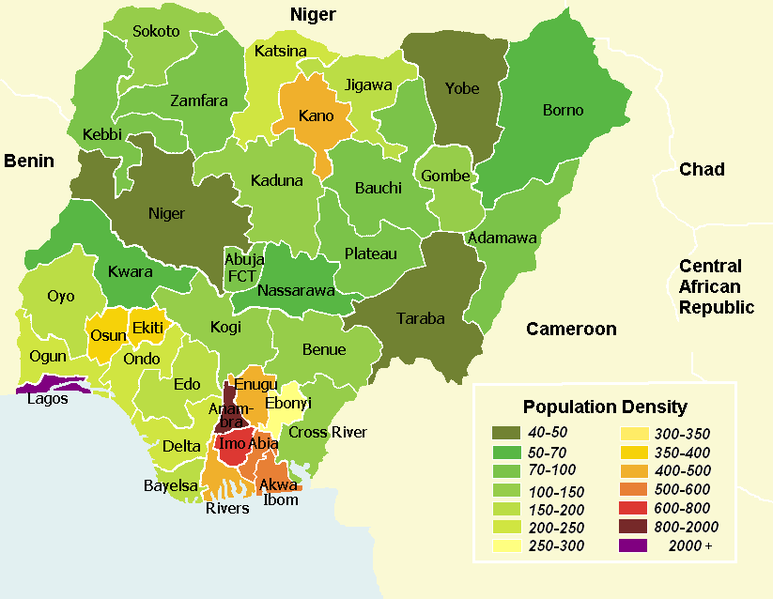
Nigeria as a whole is less densely populated than New York State (or 6 other US states). Actually, NYS is a very good comparison: there's a large mass of population in one teeny corner, and the rest of the state is vast tracts of underpopulated farmland with a couple rust-belt cities "not living up to their potential," as we recite in far too many student papers over here. In the last governor's election, the top debate topics were the brain drain out of NYS and corruption. They had to put the capitol city outside of NYC to keep it away from the big city politicking, crime, and corruption, just like Abuja. But I digress:

Check out the map for Nigeria's population density. The density in Lagos is 2000/square mile - 1/5 the density of Washington DC; 1/9 the density of Singapore. A couple other states in the south are also fairly well packed. Altogether, 15% of the population lives in high-density states. The vast majority of the country is in the 40-150 per square mile category. If anything, that is underpopulated. By comparison, NY city is up around 5000 per square mile, there are few pockets of high population (Buffalo, Rochester, Syracuse, Albany, from west to east) and everything else is in the 1-250 range. At 250/square mile in Ithaca, deer ate all my garden vegetables and raccoons regularly sacked garbage cans without locks on them.

Then we have the difficulty that the overpopulation is higher in areas that have higher GDP/capita. Lagos and Port Harcourt are not the poverty-stricken areas, but the wealthy ones. It's the underpopulated north that has the higher poverty rate.

Because really, the Times (and family) only discover there are actual cities in Africa when it wants to trot out its tired Malthusian stuff. Notice they only talk about fertility rates (6 kids per woman!), not population growth rates (2% last year, because 2 of those kids died before age 5 and the life expectancy is still under 50). Notice they don't mention that food production has kept up with population growth for over 50 years. Notice they don't mention that birth rates have been falling for 30 years, right in line with standard population transition models.

You could make a reasonable story out of all this based on the Harris-Todaro model: the way to solve the overcrowding in Lagos is to provide a little more development in the rural areas. But then the problem isn't too many people, but not enough development shared unequally.

Among my favorite comments on the subject, however, are still Fengler's and Dickens':
Fengler: Many think this is a big problem. ... I am less certain that the rapid population growth in Africa, especially in Kenya, is the fundamental development challenge: ... despite Africa’s rapid population growth and Europe’s stagnation (even decline in few countries) the old continent remains much more densely populated than Africa. If we look at Western Europe – where I come from – there are on average 170 people living on each square km. In Sub-Saharan Africa there are only 70 today. This gap will narrow in the next decades but even by 2050, Western Europe is expected to be more densely populated than Africa. I am following the population debates in Europe, especially in my (densely populated) home country Germany. I have never heard anyone argue that there are too many people in Europe.
Ever and again, I hear the immortal words:
``If these shadows remain unaltered by the Future, none other of my race,'' returned the Ghost, ``will find him here. What then? If he be like to die, he had better do it, and decrease the surplus population.''
Scrooge hung his head to hear his own words quoted by the Spirit, and was overcome with penitence and grief.
``Man,'' said the Ghost, ``if man you be in heart, not adamant, forbear that wicked cant until you have discovered What the surplus is, and Where it is. Will you decide what men shall live, what men shall die? It may be, that in the sight of Heaven, you are more worthless and less fit to live than millions like this poor man's child. Oh God! to hear the Insect on the leaf pronouncing on the too much life among his hungry brothers in the dust!''

Thursday, January 12, 2012

Lunch for Jonathan and Obama

They do things differently in the US and UK from Nigeria, and yet it's not so very different after all.

There is a delightful BBC show (Lady Thatcher's favorite during her term) called "Yes, Prime Minister." Elegant. Witty. And it introduced the world to public choice. In the very first episode's side story, the PM is cranky because no one is there to make him lunch. The staff explain that the cafeteria is only for staff, not the PM. Because the staff is doing government work, the government pays; but the PM is political, so the government can't pay for his lunch. However, meeting with ambassadors is government work, so he announces he will have lunch with a different ambassador every day so that the government will make his lunch. It goes back and forth quite entertainingly and later fits in to how defence budgets are created. Remarkable stuff.

I also have in my collection an old radio bit called The First Family, a series of comedy sketches around the Kennedy family. There's one where during a meeting of heads of government, Pres. Kennedy tells them he has been taking some criticism for the expense of all the fancy state dinners, and economy starts at home, so today they will be having a typical American businessman's lunch. Hilarity ensures as Castro orders a chicken sandwich with a live chicken, Kruschev wants the eastern half of Adenauer's "Western sandwich", and Abdul Nasser and Ben Gurion find peace over pastrami. At the end of the sketch, the President then asks each of them to pay for their sandwich.

Pres. Jonathan, encouraging us to eat cassava bread
to reduce wheat imports.
Over here, the removal of the fuel subsidies has brought to light just how much is budgeted to feed the President and Vice-President: 1 billion Naira. That would be US$6.5 million by exchange rates. The one data point I have tells me it costs twice as much to feed our family in Nigeria as it did in the States, so a not-quite Purchasing Power Parity exchange rate would put it at closer to $3 million. Still a hefty sum.

The breakdown:
           N477million for meals and catering for the office itself; -- note we're not just buying food, but hiring labor too
           N293 mil for Pres Jonathan's meals at home and office;
           N104 mil for Vice-Pres Sambo's office.
           N90 mil for kitchen supplies - similar to last year - half for the state house, half for the President's home

Among the things I would like to know, based on the humor I've already consumed, is how much of that is for feeding official guests. As my colleague Alvin Lim put it when I asked him that question, "I guess the President can't serve his important guests meat pies."

Over here, they have been touting British and American austerity, expounding on the great poverty of our millionaire leaders. On the other hand, it appears Pres. Obama's $4 million vacation to Hawaii this Christmas was also paid by taxpayers, mostly because it costs $3.3 million just to fly Air Force One there and back again. Another quarter million goes to paying for security's hotel and per diem. FactCheck tells me that Pres. Obama has used Air Force One less than Dubya did in his first two years.

So for which would you rather be taxed? $3mil to feed your leader for a year or $3mil to fly him across country for a one-week vacation?

Monday, December 26, 2011

Scrooge and a Big Bag of Christmas

Marron's Twelve Days of Christmas list for the global (but mostly US) economy, including 10 new Steve Jobses to rise and replace the fallen, 7 fed governors (we've been making do with 5 for the longest time) pushing for a 5% nominal GDP growth target, $3 trillion in budget cuts, and 2 new currencies (letting the Euro drop a couple countries).


Scrooge's name came from misreading the tombstone of Adam Smith's grandnephew? Are you sure this isn't a Dan Brown plot reject? If not, how about considering below the moral hazard of Scrooge:


In which a friend of mine tries to show a Pakistani a Currier and Ives Christmas, and ends up finding its deeper meaning with an Alaskan crab fisherman.


The First Presidency of the Church of Jesus Christ of Latter-day Saints included this in their Christmas message:
This joyful season will bring to each of us a measure of happiness that corresponds to the degree in which we have turned our minds, feelings and actions to the spirit of Christmas.May this Christmas season be a time of prayers for peace, for the preservation of free principles, and for the protection of those who are far from us. Let it be a time of forgetting self and finding time for others. 
C. S. Lewis on two types of causality, that of work and that of prayer: "Prayers are not always -- in the crude, factual sense of the word -- "granted". This is not because prayer is a weaker kind of causality, but because it is a stronger kind."


Delicious satire: a response to Band Aid's "Do they know it's Christmas?" is found in Plaster Cast's "Yes, We Do." (HT: Blattman)

Thursday, December 8, 2011

Gogol in Nigeria: Dead Students

One of my favorite Great Works of literature I stumbled on in my own reading was Gogol's Dead Souls. It tells the story of a fellow in Russia who wants to prove that he has a large farm.

The way to prove you have a large farm is to show that you have a lot of people living and working on it. The way you prove that is that the census man comes along and counts the people working on your farm.

But of course, time passes between census visits. On a very large farm, any number of people will pass on or leave the farm before the census man comes again. The protagonist therefore goes to a number of owners of very large farms -- each satirically representing a different element of Russian society -- and asks to buy their "dead souls" from them. No bodies need be moved, no lives disrupted. He merely wants to buy the right to claim them as workers on his farm.

It's a very entertaining, slightly macabre work and a real pity Gogol died before finishing it.


----------------------


So here I am proctoring a final for one of my classes. There are about 30 students registered for the course. They are all real people. I've seen all of them in class at least once. For some reason, however, there are 5 students who I've seen ONLY once. They have turned in no homework. They didn't attend class. I've seen no emails from them. They've never come to office hours. There have been no attempts to drop the course. They aren't sitting here right now to take the final.

I have some dead souls.

Wednesday, June 1, 2011

Well, that didn't take long: McD's

San Fransisco passed a ban on selling children toys with happy meals unless they met certain dietary guidelines. It did not take McDonald's long to demonstrate how easy it is to get around such legislation:

McDonald's started a program of giving music away with their Big Mac Extra Value meals back in 2004. It is apparently coming to the rescue of the Happy Meal too. After all, the ban is about toys and advertising to children, which I don't think many people would argue is the target demographic for Cascada music. Raffi she is not.

Friday, May 20, 2011

Will the Real Capitalists Please Stand Up?

More Chinese believe in capitalism than Americans (as a percent, let alone in total numbers).

Not only that, but “Denmark isn’t just the most free market economy, and the most egalitarian, and the most civic-minded, and the happiest. It’s also the most entrepreneurial.” This is important for future growth:
The basic premise is that entrepreneurial capitalism is especially important when a country is near the technological frontier, and when there is great uncertainty about which products to produce, and how to produce them.  And that means that free market policies that promote entrepreneurship are now more essential than ever.
To see the distinction between the “what to produce” and the ”how to produce” questions, consider Viagra and Facebook.  Viagra was a product for which the need was well understood (as rhinos have learned to their dismay) but where it was not understood how to produce the product.  Facebook was a discovery of a need that had been heretofore overlooked.  Entrepreneurial firms are especially good at solving these sorts of questions, although that doesn’t necessarily mean the firms must be small (as we saw with Viagra.)  Central planning is relatively good at producing steel and washing machines and apartment buildings–well understood needs with easy to follow blueprints for production. …
Could it be that pirates believe in (a little) law and order, or do they only believe in the Kuznets curve? In part the argument being made is that you need markets in order for piracy to pay, so you need basic laws and public goods to make piracy profitable, just not so much as to really put a stop to the better organized crime syndicates.

Just for fun on the topic of questioning America's commitment to capitalism, an over-reading of Goodnight Moon sees it as an allegory of human alienation. The format is exceptionally nihilistic, as “good night” is said to capitalism and communism, motherhood, and everything else. This anti-capitalist rant recently read to us by ... former Bush advisor, Mankiw. If even the vast right-wing conspiracy is secretly subverting capitalism with nihilistic children's literature, we're in trouble.

Monday, April 25, 2011

Five Second: Sumner Defending Mankiw on taxes

The original post is a month old, but is highly relevant today. Sumner defends the Laffer curve and Mankiw:
I’d argue that this data is strongly supportive of the view that both the US and Europe are near to tops of the Laffer Curve for total taxation.  I did not say then, nor do I claim now, that we are precisely at the top.  But I also don’t see any reason to believe that if we raised taxes from 28% to 40% of GDP, that revenue would rise anywhere near proportionately, with no change in GDP per capita. …
For instance, in Mankiw’s data the Germans raise $13,893/person with taxes of 40.6% of GDP.  The US raises $13,097/person, with taxes of just 28.2% of GDP.  The progressive denial of the Laffer Curve is an implied claim that if we raised our tax rate to German levels, our GDP would not decline, instead we’d raise an astounding $18,856/person in tax revenue, despite the fact that no other major country with Euro-style tax rates comes close to raising that kind of revenue.  Quite a leap of faith.
[In the comments he adds:]
When comparing two large continental size economies, it makes sense to either compare totals [to] totals, or most succesful [sic] parts to most successful parts. I’m fine with either. I think Massachusetts or NYC or the SF Bay area of California could raise $18,000 per capita. I don’t think Mississippi or the border region of Texas could raise even $13,000.
Sumner defends the notion that the US tax system is more progressive than most European systems (and Mankiw):
Lindert showed that Europeans were able to raise more tax revenue only by having more regressive tax systems than the US, i.e. tax systems that relied more heavily on consumption taxes.  This is now pretty much common knowledge in the public finance area.  But many American progressives keep insisting that we can get closer to the (egalitarian) European model by making the US tax system more progressive, by having the rich pay more. 
Sumner argues that the solution these two facts suggest is to not assume the problem is that we don’t collect enough money, but that we don’t use it very well and focus on improving outcomes. He favors decentralization, changing spending priorities (less military), and do more cash grants on a county basis for what is needed in that county.
[In the comments he adds:]
For instance, I believe that our government spends about as much as the Canadian government on health care (per capita). The difference is that with that money they cover everyone, and we cover much less than 50% of the population with government health programs.
One of his commenters argues that the left does not believe everything Sumner claims they do, that they accept tax rises create increasing deadweight loss and slower-than-proportional revenue growth, but that the things they could spend the tax money on are worth those costs.

Friday, February 11, 2011

The Way We See Ourselves


An article on national symbols (that I meant to post 6-7 months ago) that largely comes from Wikipedia. Of note is that the US's anthropomorphic symbol (Uncle Sam) is a stand in for its government rather than its people. 

Also featured are Britain's everyman, John Bull, whom Wiki tells us is "well-intentioned, frustrated, full of common sense, and entirely of native country stock ... a yeoman who prefers his small beer and domestic peace, possessed of neither patriarchal power nor heroic defiance."

The German Michel (Michael) similarly shows a national character: "his easy-going nature and Everyman appearance. He also represents the innocent and simple person who must endure and fight against tyranny and injustice."  

Portugal's Joe Public or John Doe is appreciated for "his kindness, his will to help others and, most of all, his utter contempt and disrespect for the powerful ones that try to dominate him."

Despite the popularity of male everymen, every one of the countries the article considers uses a female ideal to represent the country itself.

Friday, January 28, 2011

The Lighter Side of Miscellany 1

The streets of Ponte A Poppi in Italy have some colorful traffic signs, including angels, devils, and a crucified figure signaling a T-intersection.


Some economics haiku. Not included:
If you are so smart --
Understand how markets work --
Then why aren't you rich?

Warsh tells us the story of a wealthy economist: David Ricardo, inside trader. He learned the eventual outcome of the Battle of Waterloo early, told the English government of the glorious victory, and "Then he went down to his customary chair at the Exchange – and sold! Other traders, suspecting the worst, sold too, the prices of Treasuries tumbling, until at last, Ricardo reversed course and bought and bought and made a killing, his greatest coup ever, one that put even the Rothschild brothers in the shade."

The third in a series, Wondermark presents Socrates, railing against the written word as an abominable technological progres.
Socrates lays out an argument that the written word cannot defend itself in dialogue, and thus cannot effectively teach anything worth knowing. For only through banter, through back-and-forth discussion and rhetorical argument and the working out of problems, can true knowledge be conveyed. Reading mere words, in his mind, is akin to looking at a lake rather than swimming in it — or worse, looking at a lake and thinking that now you know how to swim.
The argument then happened in reverse as the telephone was going to destroy all the advantages of the telegraph, and today text messaging destroys the advantages of the telephone. 

Tuesday, December 14, 2010

Sentences that Intrigued me a month ago

Not sure why this didn't post then, but here they are:


Coulmas describing Japan - "A growing percentage of the population, both married and never married, without children has no vested interest in society, with hitherto unknown consequences for its self-image and sense of purpose"

Reported by Economix - "Bulgaria’s defense ministry on Thursday lifted a ban on women serving aboard submarines just as parliament decided to mothball the country’s only submarine."

Kaestner and Khan on Medicare Part D - "much of the additional use of prescription drugs that results from gaining prescription drug insurance is [of ] relatively low value in terms of health benefits"

On EU regulators: "Nonsensical decisions may be taken by majority vote on things that are really about the UK." But who will supervise the supervisors of the supervisors?

LDS around the world

The Church of Jesus Christ of Latter-day Saints (aka Mormons) had a brief, government-authorized presence in Burundi before civil strife broke out in 1992. Last August the first officially recognized church unit in Burundi held meetings again. The article tells the story of the Malabi family, their sacrifices, and the regrowth of the Church in Burundi. It mentions how a group of hundreds of people who wanted to join the Church had formed an informal church group and when they found Bro. Malabi asked him to visit them and teach them more.
Brother Malabi made the long trip to Uvira to teach them two or three times a month. This continued for five years. He traveled at his own expense, usually alone but sometimes accompanied by his wife or one of his children. When asked how much he paid for each trip, he responded, "$10". That travel expense of $30 per month was 5 percent of his total monthly income of $600.
I thought I had blogged about this earlier, but I can't find it now:  LDS Apostles Holland and Christofferson visited a number of African countries last month, pronouncing blessings on Burundi and Angola."Elder Holland expressed his feeling that Africa had been held in reserve by the Lord in the spirit of "the last shall be first" and that Africa would someday be seen as a bright land full of gospel hope and happiness." Both blessed "government leaders as they seek to serve the people and prayed that persons of ability and integrity would be drawn to public service." Picture shows members in Zimbabwe.

Proselyting missionaries save up to help pay for their endeavors. A recent article showcased what a young man in the Democratic Republic of Congo does to save for his mission:
Each day, Sedrick pushes his bicycle, laden with 200 pounds of bananas, for two hours to get to the market. He sells the bananas for the best price he can, then rides back for another load. He does this several times a week. Sedrick has been doing this backbreaking work for four years.
Sedrick told me that he makes about $3 a trip. From that he must buy his food, repair his bicycle and save for his mission. His savings will only pay for the high cost of getting a passport in the DR Congo. Member contributions to the General Missionary Fund will pay the rest.

Putnam and Campbell's study of religion in America shows that "Religious Americans are more likely than others to act in a variety of ways that benefit society, and they tend to be more actively engaged in the surrounding social sphere as well."

The Kosovo ambassador to the US was a refugee ten years ago during the ethnic cleansing. This week during a trip to speak at Utah Valley University he visited Church headquarters and LDS Humanitarian Services to thank the Church of Jesus Christ of Latter-day Saints for their humanitarian involvement during that time.

Church service missionaries (different from proselytizing missionaries) rebuilt schools in Peru following the 2007 8.0 earthquake.
The Church provided the rebuilding resources then contracted with local construction companies to build the classrooms. Church engineers, added Brother Ramirez, oversaw every aspect of the school building, from the foundation to the roof and right down "to the amount of mixture in the cement." ...

Gil Villa is the mother of a child attending the Chincha school. She has noticed a difference in the students and her fellow parents since the rebuilt classrooms were opened last year. The children, she said, take ownership of their school. They are quick to report vandalism and other abuses. And the parents are doing their part to help.
"Every week parents come to clean the school," said Mrs. Villa. "We come every Friday to polish and wax the floors. We clean everything so on Monday, when the children return, they find a clean school."
 And a brief mention of last week's flooding in Venezuela and LDS relief efforts there, and cholera relief efforts in Papua New Guinea and Haiti. The Church also established its first stake [multiple congregation unit] in Guam for the 2,000 LDS living there.

Monday, November 29, 2010

Big Bag of Monday

The last several weeks I have been concentrating on finishing the last proofs for our textbook, getting out job applications, and overcoming a Thanksgiving-week stomach flu so that despite increasing work hours 50%, the something that gives is what - let's face it - matters less: this blog. So without even worrying about catching up, this week will just feature some links to other people's interesting thoughts and I'll leave it at that.

Yglesias on TSA: But don’t ask yourself “what amount of hassle and expenditure is worth paying to prevent terrorist attacks,” ask yourself “what amount of hassle and expenditure is worth paying to shift terrorist attacks off airplanes and onto buses”? Much of the resources currently spent on “security” measures would be much better spent on having more police officers.

Wronging Rights on rethinking areas of state failure: I'm struggling to think of any country in history where the police haven't ever effectively ceded large chunks of territory to violent criminal gangs. (Frankly, the list of places where they aren't doing that at the moment is pretty short.) ... In wealthy, developed countries, we expect the police to enforce laws, investigate crimes, and come when someone calls for help. But in places without the rule of law - where the state doesn't have a monopoly on violence, and the state's use of violence isn't constrained by law - that's just not the role they play. There, the police are just another group that uses violence on behalf of the powerful.

Sumner on the monetary union: I get frustrated when I read people arguing the Eurozone problem is that the ECB can’t come up with a one-size-fits-all policy stance.  ... Actually money is even tighter in Europe than in the US.  It’s too tight for every single Eurozone member.   Nominal GDP is well below the levels of early 2008.

Marron notes that housing price decreases make core inflation look lower than it would otherwise ... but it's still respectably low at 1.3% if you take housing out. It's just not as spectacularly low. As I argued earlier, the question is what kind of inflation we are worried about. Changes in food, fuel, and housing prices are important for human welfare, but are not necessarily indicative of the effects of  Federal Reserve engineered increases in the money supply.

Marron on business uncertainty in Afghanistan being a greater concern for businessmen than physical uncertainty.

Cafe Hayek on the double imported "all-American" turkey's Mexican heritage. Speaking of animals, The Economist notes that pets and non-livestock near humans have been growing heavier and more obese over the last several decades as well.

Friday, November 19, 2010

Index of Indices

Owen Barder on the UK's drop in the Commitment to Development Index (peacekeeping, naval fleets that protect trade, low arms trade, among others) - from 5th to 16th out of 22 in only 5 years. How did that happen? Arms exports. The UK exports more arms than anyone else to poor, undemocratic governments, allows in the fewest unskilled and student migrants, and research focuses on defense and IP rather than development. After the Scandinavian countries come New Zealand and Ireland, then Portugal, Canada, Spain, and the US.

On changes in the HDI (wealth + health + education) over 30 years, Nepal more than doubled its old score. Other large improvers include Tunisia, China, Egypt, Morocco, and India. Rodrik on the unsung development miracles in North Africa, crediting a willingness to experiment, particularly with gender issues.

Oh, and the US for the first time is in the HDI's Top 5 [3rd highest years of schooling, top 5 GDP, life expectancy slightly lower than most] and South Korea broke into the top 25 unexpectedly. Denmark has been losing out in life expectancy (which in the top of the distribution gets nearly all the weight), Iceland's banking crisis and Finland's double-dip recession have hit both of them heavily in GDP and both are heavily dependent on EU trade.

The Economist on corruption: changes corruption perceptions, successes from various actors. Zutt from the WB on Kenyan corruption, casting a bit of doubt on perceptions indices (nothing unusual) and that we may believe there is more corruption in Kenya because there is a free press to tell us about it. He does come around at the end to admit some of the things the government has not done to show its commitment to fighting corruption.

Newsweek credits Utah as a "promised land" and "the new economic Zion" because its ability to bring in new businesss that prosper during the recession. “Utah’s people are, indeed, an employer’s dream," the article said. "They are healthy, hard workers (pouring in 48 hours a week on average), and exceedingly stable, with the highest birthrates in the nation. The large number of young Mormons who spend two years on a conversion mission also means a huge swath of the population earned its sales stripes in hostile terrain.” Alternatively, for those living outside Utah, a ranking of Top 10 Northeastern US cities to raise an LDS family. Ithaca scores quite highly for having an educated populace and its proximity to church history sights ... but no mention of the less-welcoming cultural elements. Personally, I would recommend next door Dryden for a better fit. Nearby Elmira also scores highly.

Wednesday, November 17, 2010

Random Acts of Development

Randomization the easy way: Fantasy Development. Pick your projects, players, books and duke it out with your colleagues to see who can develop the greatest development team.

A call to make the World Development Report a Wikipedia project so that all the (internet-connected) world can participate - also known as Development 3.0

Novel microfinance: goats replace money.

Current world population, updated every second.

Taiwan ($34,700/capita) surpasses Japan ($33,800) in PPP but not market exchange rates.
Review of a "pre-economics" book on How an Economy Grows, Libertarian style. Or, if you prefer, the account of the rise of two Indian corporate leaders "in the thick of the sweatiest corporate wrestling matches."
The first digital images of records from Ghana have been published on beta.FamilySearch.org

NAFTA gives Mexico some advantages (against China) in trading with the US, but needs to do more to take advantage of them. But the former trade minister who negotiated NAFTA "points out that the multiplier effect of exports in Mexico is unusually low. Each export dollar generates only $1.80 at home, compared with $2.30 in Brazil and $3.30 in the United States." Contrary to most trade discussions that argue that developing countries need to focus on building processing plants, the article argues Mexico needs to concentrate on building more of its own inputs so it can gain more from its exports and get access to more markets.

The effect of unconditional cash transfers on London's longest-term homeless. "Of the 13 people who engaged with the scheme, 11 have moved off the streets. ... The outlay averaged £794 ($1,277) per person ... [while] the state spends £26,000 annually on each homeless person in health, police and prison bills."

The difference between quantity education and quality education in Uganda. Private educators are perceived as offering a much better product: 90% of university students were privately educated [students - find the selection bias in that sentence]. The interviewee believes universal education was still a good idea just for getting the culture to believe in universal education and the policy is being followed up with universal secondary education. By way of comparison: building a school in Ethiopia.

Fair Trade Waylaid

Supermarket | United Kingdom
Customer: “Excuse me, where is the tea?”
Me: “Right this way.”
Customer: “Do you have any tea that isn’t fair trade?”
Me: “Excuse me?”
Customer: “Do you have any tea that isn’t fair trade? It’s more expensive!”
Me: “I’m sorry, but I think you are missing the point.”
Customer: “It’s more expensive! That isn’t very fair to me!”

Tuesday, October 5, 2010

I laughed out loud. Twice.

"IT COST a fortune, created long-standing grievances on both sides and annoyed the British and French. But most Germans wouldn’t have had it any other way." -- The Economist on Germany's reunification, papering over a lot of perpetual Ossi discontent.

Friday, September 24, 2010

Big Bag o unusual Blog Links

The effect of political connections: say you're a former Congressional staffer and you become a lobbyist. When your former boss leaves the Senate, your income goes down by over 50%.

Yglesias continues to excuse and praise Republicans for being two-faced
As you see here with Ryan (and in the generally Calvinball like approach the GOP has taken to the reconciliation question over the years), Republicans are determined to follow the actual laws and rules. When in the minority, they don’t rebel. They don’t murder their political opponents, they don’t organize coups d’état. What they do is they try to win legislative battles through all the tools at their disposal. And when in the majority they . . . do the same thing. They believe, strongly, that letting wealthy businessmen get what they want is good for America, and they go about doing that with seriousness of purpose. Many Democrats, by contrast, seem to believe that their highest responsibility is to make themselves look good, to preen for the cameras, or to maximize their own personal authority.
But they’re wrong and Ryan is right. The procedural rules are levers to be deployed on behalf of important goals, not holy writ to which policy objectives should be subordinated.
Extra points for using Calvinball in a sentence.

Two great websites with interesting maps: one of US city segregation, the other of European stereotypes (the rest of Europe according to France, according to Germany, etc.)

How swimming lessons saved Taiwan. No, really. [if only I could remember to whom I tip my hat...]

A gathering of over 10,000 West African LDS youth, many of them discovering theater for the first time as they act out religious scenes. Lots of colorful, engaging pictures of the event.

It's called "The economics of Star Wars" but really it's the accounting of Star Wars, and only the revenue portion at that.

Blattman compares and contrasts rural vs. urban living and the advantages of each, coming out in favor of urban. I share his skepticism of the overly romanticized rural but that isn't enough to convince me.

Asian immigrants and their effect on cuisine:
South Korean investment in the U.S. got a major boost in 2008 when the federal government decided to no longer require visas for visiting South Korean citizens. The move has already shown results. For the first six months of this year, some 450,000 South Koreans entered the U.S., a 38% rise over the same period last year. [This worries Korean-American restaurant owners who will have to step up their game or be outshone.]
And a use for extra garden produce: Woman fends off bear with zucchini.

Friday, September 17, 2010

The multiple paths to nirvana

Sumner adjusts the World Economic Forum's "Global Competitiveness Report" to reduce the bias in favor of large economies and he is quite happy with the result:
It seems to me this list is exposing a perspective that is orthogonal to the tired left/right debate over big government.  It suggests multiple paths to nirvana.  To explain why, let me return to the three models of neoliberalism discussed in my ‘Great Danes’ paper.  I see those three models as providing answers to the three basic questions of governance:
A.   What values should government policies embody?
B.   What policies effectively deliver those values?
C.  When there is a dispute about which policies work best, how should the dispute be resolved?
The first question is moral, and the answer I give is “utilitarianism.”  Unlike 99% of people in the humanities, I regard utilitarianism as a radically egalitarian value system—where people put the best interest of society ahead of their own narrow self-interest.  The second question is scientific, and my answer is ‘economistic’ policies, those that are implemented by people cognizant of the (counter-intuitive) way taxes and regulations often distort decision-making.  The sort of fiscal regime you get if 100 Martin Feldsteins sat down and designed a country on a pad of paper.  In other words—Singapore.  The third question is political, and my answer is democracy.  And I don’t mean just having elections; I mean a system where the people actually govern.  Where every school is a separate school district.  Where taxes must be approved by referenda.  Where every decision is made at the lowest feasible level of government.
Low and behold, all three of these models are represented in the top 5 of my list.  What are the odds of that?  Even better, the other two countries (Sweden and HK) are nearly as good examples of hyper-egalitarian and hyper-economistic neoliberalism as Denmark and Singapore.  So here’s my point.  These countries don’t at all resemble each other.  You can’t get much more different than Hong Kong and Denmark, at least by the criteria used by most people on the left and right.  But they all do at least one thing extremely well.  They all are exceptionally good at one of the three attributes of a highly successful neoliberal society.  Either they are highly civic-minded (Denmark, Sweden), or highly aware of the sorts of policies that produce economic efficiency (Singapore, Hong Kong) or highly democratic.  Switzerland had more national referenda in the 20th century than the rest of the world combined.  And it also seems that all three have very good governance.