Showing posts with label Derrill. Show all posts

Friday, February 24, 2012

Ethiopian Bank Run Friday

There was a run on the bank today. I nearly missed it.

All of us at the conference were told to visit the bank to get refunds and daily stipends. We could only do so today, and we could only do so during one of two coffee breaks. To someone teaching Game Theory this semester, this sounded like a perfect set up for a simple coordination game.

I played a waiting game. I dislike waiting. When I observed most of my colleagues heading across during the first break, I decided the clear game solution was for me to wait to the second coffee break so I wouldn't have to wait so long in line. They indeed got back late, it taking more than 45 minutes to service them all.

When I eventually went with just three other colleagues, I was feeling pretty good about my choice. But then one of us told a joke: the bank was out of money and would only have enough for him and not for us.

I suddenly realized that if I were in a bank run game, I had played the entirely wrong strategy. Observing other people racing to get their money out in the early period, I ought to have gone early also. We covered that extensively in the Cornell macro group – sunspots determining bank runs, psychology determining bank runs, self-reinforcing beliefs, on and on. If you see other people running, run.

When I get back to AUN, I will be introducing my game theory class to risk and uncertainty. What if there is a probability p that I’m playing the bank run game and probability (1-p) I’m playing a waiting game? At what critical value of p should I go with the first group instead of with the second? I smell a midterm question. And if you’re in Eco 404 this semester, you’re welcome.

Monday, February 6, 2012

This is how we do things here

We have now lived in Nigeria for six months. This is how we do things here ... this weekend.

I'm flying to Addis for a conference in a couple weeks. There are two airlines that service Yola to the capitol, each of them flying at a random time (it follows a Poisson distribution) in the "morning" and "afternoon". My flight from Abuja to Addis leaves in the early afternoon, so I need the flight that really is in the morning. I dropped by the airport to buy my ticket (which you can't do online) in cash (another necessity for the time being).

There I was informed that they are no longer doing morning flights. This has been the case for ... 3-4 days now. They'll probably start up again, another source informed me, sometime this week. So I asked them, if I come back next week and you do morning flights then, can I get a ticket then? Yes. Okay. So I'll go get my ticket next week. If they still aren't, I'll have to fly out the night before and overnight in Abuja.

Thursday, December 8, 2011

Gogol in Nigeria: Dead Students

One of my favorite Great Works of literature I stumbled on in my own reading was Gogol's Dead Souls. It tells the story of a fellow in Russia who wants to prove that he has a large farm.

The way to prove you have a large farm is to show that you have a lot of people living and working on it. The way you prove that is that the census man comes along and counts the people working on your farm.

But of course, time passes between census visits. On a very large farm, any number of people will pass on or leave the farm before the census man comes again. The protagonist therefore goes to a number of owners of very large farms -- each satirically representing a different element of Russian society -- and asks to buy their "dead souls" from them. No bodies need be moved, no lives disrupted. He merely wants to buy the right to claim them as workers on his farm.

It's a very entertaining, slightly macabre work and a real pity Gogol died before finishing it.


----------------------


So here I am proctoring a final for one of my classes. There are about 30 students registered for the course. They are all real people. I've seen all of them in class at least once. For some reason, however, there are 5 students who I've seen ONLY once. They have turned in no homework. They didn't attend class. I've seen no emails from them. They've never come to office hours. There have been no attempts to drop the course. They aren't sitting here right now to take the final.

I have some dead souls.

Friday, September 30, 2011

More First World Problems

The number one search on this blog lately has been First World Problems.

I am thinking about problems I no longer have, now that I live in Nigeria:

I don't worry about the escalating price of gasoline because I don't have a car anymore.
I also don't worry about finding parking places, or paying for parking.
I don't worry about paying doctor bills to half a dozen doctors because I don't have specialists out here.
I don't worry about finding a place for stuff that doesn't fit inside my home, because I don't have most of my stuff anymore.
I don't worry about 75 degrees feeling too hot to go to sleep.
I don't worry about snow, or getting a good winter coat, or making sure the kids are warm enough. (Though some of our maintenance staff do worry about children being too cold.)
I don't worry about trying to fit in. I stick out like such a sore thumb, there's no hope. (Not that there was ever much hope for me blending in.)

Here are some from tonight's Twitter feed, in case you wanted something slightly more humorous:

The clasp on my string of pearls broke. (courtesy Texas in Africa)
Not being able to read because my book ran out of batteries.
My dogs keep sitting in front of my DVR and I'm having a hard time fast forwarding through the commercials.
I was expecting something I bought online to arrive today, but it didn't.
Health issues prevented me from wearing high heels. This is a problem because I own 30+ pairs.

Thursday, September 29, 2011

Growth Good for Poorest Nigerians

In preparation for my development economics class tonight, I sat down with my Gapminder data for Nigeria and examined how the distribution of income has changed in Nigeria between 1986 and 2004.

From 1986 to 1996 - to no one's great surprise - income inequality increased dramatically. The richest 10% of the population gained 7% more of the income while everyone else lost income share. Since there was very little economic growth at the time, it would be fair to say at least that the richest got richer and some people got poorer.

In 1996, however, things began to turn around in inequality terms, and for
the poorest 20% of the population that turn around happened in 1992. Even before democratic elections were restored, before the latest, long, stable run of economic growth started, income inequality has been on the decline. In the jargon, any Lorenz-consistent measure will agree that there is less inequality in 2004 than there was in 1996.

From 1996 to 2004, the richest 10%'s share of income has decreased, and everyone else's has increased. The poorest 20% gained income share from 1992-1996, but have remained steady since then.

From 1996 to 2004, per capita income increased a total of 11% in PPP terms. The income of the poorest 20% similarly went up 11%. The income of the middle 70% (20th percentile to 90th) increased by more than 11% in all groups. The income of the richest 10% went up by less than 11%.

Nigeria's last decade and a half of growth has been good for the poor and good for the middle class.

(In the graph, the top dark line shows the distribution in 1986; the bottom dark line shows the distribution 1996; the blue pencil line in the middle shows 2004. The straight line shows what the distribution would look like if we had perfect income equality.)

Wednesday, August 24, 2011

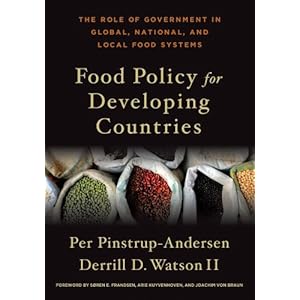
Food Policy for Developing Countries

I just got my advance copy of my textbook with Per Pinstrup-Andersen. Happy birthday to me! I am exceptionally excited to see this final, polished, beautiful book in my hands. I am also thrilled with the early praise:

"Food Policy for Developing Countries is a comprehensive and deeply insightful guide that will be of great practical value to policymakers, analysts, and students of food policy. It is a worthy capstone contribution that reflects the wealth of knowledge built up over the senior author's long and eminent career, and it should serve as the seminal work on this topic for years to come." -- Benjamin Senauer, University of Minnesota, coauthor of Ending Hunger in Our Lifetime: Food Security and Globalization


"Per Pinstrup-Andersen and Derrill D. Watson II serve up a rich multidisciplinary diet of insights into the incidence, causes, and cures for hunger in developing countries. The exceptional insights dished out by these authors known for their long practical and scholarly experience needs to be savored and digested by every student of food policy for the poor." -- Luther Tweeten, Emeritus Chaired Professor, The Ohio State University

"Per Pinstrup-Andersen and Derrill D. Watson II give us a comprehensive road map for understanding how governments and markets are shaping food outcomes in the developing world. The book provides food policy analysts with a sound political-economy foundation, international data on everything from sustainable farming to consumer food safety, and a complete set of recent and vivid stakeholder-based case studies. I have used the case studies to great advantage in my own classroom. At a moment when interest in global food policy is peaking, this is the book to read." -- Robert Paarlberg, Harvard Kennedy School of Government

Amazon tells me the book is scheduled for release there by Nov 24. Copies will be in the Cornell Bookstore well before that for this semester, though. I know that Cornell University Press is also trying to get interested faculty at other institutions textbooks as quickly as possible.

Monday, June 27, 2011

Hiatus and slow down

I appear to have been on hiatus. First it was allergies that turned into a sinus infection that needed antibiotics. Then that turned into (or was compounded by a new infection of) strep that needed different antibiotics. And then our new baby came: Econolass. She is happy and healthy.

Econolad is a very happy and attentive older brother. The Lovely and Gracious is doing very well.

So I don't expect to be doing much blogging for the next week either while I enjoy my new daughter and try to finish getting rid of this terrible cough.

Friday, June 17, 2011

Seeing Market Power

One of the things that separates the economist from the political scientist or the sociologist is power. No, I don't mean that we have more power in political discourse than they, however true that probably is. I mean how we talk and think about power.

To an economist, the exercise of market power is a real possibility in today's world of very large firms with largely unprecedented concentration ratios. But our basic assumption is one of free markets. We assume markets are free and fair, and you have to prove to us that market power exists and that it is being used. We have sophisticated tests to identify if market power is being exercised and entire literatures devoted just to various questions about market power.

To a political scientist or a sociologist, this is naive at best and a complete waste of time at worst. In many ways, they represent the scientific study of power in human relationships. Power is everywhere. It is assumed to exist from the get go. You have to somehow prove (and I do not know if they have tests for this) that power does not exist.

This makes conversations between the two camps a bit strained at times.

Most of the time, I am quite contented with the power of market forces as an instrument of regulating firms. Most of the time, you have to prove a power relationship exists.

The one time when I'm willing to crack is at a doctor's office. Since this happened recently, watch as my calm economist demeanor breaks down completely:

Thursday, June 16, 2011

Aid effectiveness on a bad day

But all three books make the case that the ineffectiveness of much philanthropy is actually the fault of the philanthropist. They applaud the motives for giving, but all make the point that people too often let their philanthropy be guided by their hearts alone. “Deciding what you will do to make change happen is a choice that requires both your head and your heart”, write Messrs Fleishman and Tierney in the best chapter in “Give Smart”, entitled “What Am I Accountable For?” The biggest problem for philanthropists, they argue, may be that “they are essentially accountable to no one but themselves.”
Some of the problems:

1 - There’s the overall lack of evaluations being done, and even when we do them we can’t simply aggregate the results and call it done, as Blattman points out:
We’re selective in which programs we evaluate, and ten[d] towards the decentralized, uncoordinated, and less sensitive programs. I call it the “non-random impact of random impacts
2 - Then there's the question of who receives the aid. Do we give to "bad governments"? On the one side, giving aid supports a corrupt regime. On the other, removing aid is likely to harm the poorest instead of the targets. Admittedly, there is a lot of disagreement about the model here: aid is hurting when it goes in and when it goes out. One of the ethical underpinnings, though may just be "strongly determined by how much you discount future suffering versus suffering today," writes Aid Thoughts.

Note: in the case being discussed at Aid Thoughts (Malawi and the British) I do not intend to imply that the Malawi government is “bad” on the basis of their insulting an ambassador. A little more care should be given, in my view, to differentiating between “behavior we don’t like” and actual villainy. If someone wants to argue that the government is villainous, then the debate should be about whether aid should be cut for that reason, rather than because a diplomat was expelled. Although, from an economist's perspective, I guess it reveals the true British preferences.
3 - And then Tales from the Hood tells us it may be time for aid -- all international aid -- to leave Haiti. His argument is that Haiti has been constantly interfered with without ever being given the chance to govern itself.

Tucker argues that this may not be the best thing, that the root cause of Haitian poverty is lack of capital, and the root cause of lack of capital is incredibly bad governance. He concludes unusually, however:
Now, to be sure, there are plenty of Americans who are firmly convinced that we would all be better off if we grew our own food, bought only locally, kept firms small, eschewed modern conveniences like home appliances, went back to using only natural products, expropriated wealthy savers, harassed the capitalistic class until it felt itself unwelcome and vanished. This paradise has a name, and it is Haiti.
Where Tucker gets the idea that Haiti only eats the food it produces is a little beyond me. Starvation is high, but so are food imports. The standard story (which Erica Philips and I debate in a forthcoming case study) is that massive US rice imports have harmed local agriculture significantly.

Monday, June 13, 2011

Amazing sentences: Calculus

I'm reading a paper that attempts to identify the best intermediate microeconomics textbook in terms of student outcomes at a Canadian university. Since I just learned I will be teaching intermediate micro next semester, I thought this was an important question. Among the variables they look at are the grades of prerequisite courses: intro micro, intro macro, and intro calculus. If a student took a prerequisite multiple times, they sensibly use the most recent course since that probably best reflects the student's current knowledge. Okay, fine. Then there's this line:
"Some students attempted introductory microeconomics and introductory macroeconomics up to four times and Calculus I seven times."
Four times in intro economics? Four? Clearly, someone never learned about decreasing marginal utility and comparative advantage (and hence needed to retake the course) or else they would have decided their comparative advantage led elsewhere.

Thursday, June 2, 2011

The proof is in the publisher

The final proofs of the food policy textbook are off to the publisher. Huzzah!

Tuesday, May 24, 2011

AUN


I am pleased to announce that I have accepted a position at the American University of Nigeria, where I will be teaching starting in August. A satellite campus of the American University in Yola, it was founded about 6 years ago. I visited there last week to get a feeling for the campus and witness their third commencement exercises.

I've seen a sketch of what AUN is going to look like, and it's pretty nice: 20 main campus buildings, bunch of dorms and other facilities. Some people look at it and think it's already there. When they get there, they ask, "Where's the rest of it?"

Above is the building with most of the teachers and classrooms. I'll be on the second floor.


Across the way from it is what I'll call the administration building. The library takes up the left half of the bottom floor and there are other admin offices throughout it, but the President's office is in the other building. HR, finance, and other offices are across the street mingled with the international school.

That's about it so far.


There are dorms to house the ~1300 students. There's a cafeteria and a vehicle maintenance shop for the fleet of AUN shuttles to take me to work.


They are building a new library. From one day to the next I could see progress being made on it. I think the next one they are building after this is the real admin building. Each of these will then free up more space in the building I've called the admin building for teachers and classrooms. According to the sketch, both the buildings that are currently up are for classrooms.


Speaking of classrooms, here is one. The current department chair was teaching a review session during the 5/6 week summer term. I was surprised how relieved I am to discover just how casual their business casual is. Here I've been ramping up my wardrobe, getting more suit coats and preparing to wear a tie to work everyday and now ... I can wear my Hawaiian shirts to work!

One last look at my future office on the way out. There's this really long driveway to get the gate, another indication of the big plans the Founder (former Nigerian vice-president) and American University have for the campus they hope will become the greatest university in Sub-Saharan Africa.

I am very excited to begin working at AUN. My wife and I will be starting up a new blog about family life there because there are relatively few resources to help expats know how to integrate there. Some of those posts will also be posted here. Among the things you can expect is that this blog will have a good deal more news about and from Nigeria as a result.

Wednesday, February 2, 2011

2011 -- Year of the ...

The promises of a tranquil Year of the Rabbit are nice, but unlikely in our household. The Lovely and Gracious and I learned yesterday that it will be a little girl that we will be welcoming this summer. In the spirit of celebrating the Chinese New Year, we recite to ourselves the marriage advice from the Chinese Zodiac that you marry someone 4 years younger or older than yourself, but never someone 6 years apart. (We happen to be 6 years apart and very happy together.)

But 2011 is not only the year of the rabbit. FAO has declared 2011 the Year of the Forest. The UN has also inaugurated the Year of Chemistry and the Year of Youth. Combining them would suggest we are celebrating the use of chemical fire retardant to fight youthful arsonists. Or maybe we're using homeopathic chemistry to make ourselves look younger.

Conservation groups declared last year the year of the shark. This time we get the Year of the Bat under the banner "Together with bats."

CNN has called for Latin America to celebrate the Year of the Female Politician with Brazil's first female President and several other notable state leaders from Costa Rica to Peru and beyond.

The Center for Consumer Freedom opines we may see The Year of the Nanny. "(Qualities: irritating, finger-wagging, spiteful, incapable of having a good time. Partners best with regulators. Incompatible with freedom and common sense.)" Then again, nearly every year is the year of the nanny to freedom-lovers because some dimension of freedom is constantly on the defensive. This year the theme seems to be food and obesity-related nannying.

The year 2011 will see the "M1C problem," similar to the Y2K bug, but only in Taiwan which dates this as year 100. The Australian of the Year for 2011 is a social entrepreneur who encourages philanthropy for international development.

All of this is assuming that 2011 is not, in fact, the Year of the Zombie Apocalypse. My favorite post on Zombie Politics.

Friday, December 31, 2010

Natural Resources and Poverty: Win-Wins Possible

Pinstrup-Andersen recently presented some work at the International Conference of Development of Dryrlands that he and I did on links between agriculture and climate change. The paper is available here and is based on earlier work we presented at the Global Development Network.

We argue that while most of the debate is about trade-offs between development/economic growth/poverty reduction and reducing harm to the environment, there are areas where it is possible to do both. Reducing poverty or the threat of extreme negative shocks can reduce the extremely poor's need to draw down their natural capital in the form of soil nutrient mining or deforestation. On the other hand, promoting better soil health and forestry practices can provide additional or improved sources of income, helping smallholders emerge from poverty and strengthen food security.

Monday, November 15, 2010

The African Food System


The African Food System and Its Interaction with Human Health and Nutrition is a collaborative, multi-disciplinary research effort between researchers at Cornell University, United Nations University, and other eminent scholars and policymakers worldwide under the direction of Per Pinstrup-Andersen. It is the first in a series discussing the gaps in knowledge that prevent governments in Sub-Saharan Africa from accomplishing the Millennium Development Goals. The research is targeted at a broad audience and does not assume specific technical knowledge to make use of the insights from the chapters.

Topics include: economics; nutrition; politics; poverty traps; malaria; AIDS; livestock; environment; food aid; population; gender studies


I am very happy to see the book come out as it is my first publication (I am the lead author on chapter 2 on nutrition). There will be a book launching event November 23 at Cornell University G10 Biotech Building from 4:30-6:30pm. There will be short presentations by those authors who can make it followed by a reception and book signing.


The chapters are as follows:

Saturday, November 6, 2010

My dear Watson in Boston

Directly across from the boycotted Hyatt in Boston where APPAM is meeting is the following noteworthy marker:
Bell's journal, now at the Library of Congress, contains the following entry for March 10, 1876:
I then shouted into M [the mouthpiece] the following sentence: "Mr. Watson, come here -- I want to see you." To my delight he came and declared that he had heard and understood what I said. ... 
Watson's journal, however, says the famous quote was: "Mr. Watson come here I want you."  Read More 
Not much of a difference. From a job market perspective, what a difference between a school that merely wants to see me and one that wants me!

Wednesday, September 15, 2010

Revealed Food Preference: A Tangled Web

Update: I originally posted this in March after participating in the experiment. I asked the authors for comments and they requested that I not publish until they were done running the experiment. Fair enough. I just attended the workshop on the basis of their results, so this can go back up.

Most of my concerns are not relevant for what they were trying to do but are still relevant for what we as economists claim to be able to do. (But what they *are* doing introduces a new set of issues I'll blog about after I read the paper and the methodology paper on which it's based.)
------------------
Time for me to demonstrate why they call it a degree in the PHilosophy of economics. In part, this is an esoteric problem that very few people should care about. In part, it's fundamental to what we as economists can say about the world based on the data we have available. Last week I learned that the relationship between what I buy at the store, what I would say on a survey are my food preferences, what I would tell a bunch of Econ101 students about my food demand, and what shows up in experimental data as my food preferences all give very different answers to my food preferences. Even if we are careful about definitions, it's a terrible mess.

For Euclidean geometry, three definitions are sacred and inviolable: point, line, and plane. Define those and a world of other proofs and theorems come from them. Change their definitions and you get a totally different geometry.

For economists, the fundamental element is preferences. A "rational" person can tell you between any two bundles which he or she prefers and the preferences over those bundles follow the property of transitivity. That is, if I prefer a pound of bananas to a pound of potatoes and I also prefer a pound of potatoes to a pound of tomatoes, then by golly, I really ought to prefer a pound of bananas to a pound of tomatoes. If not, I'm not rational.

It's very easy to be rational. Insane people can be rational. My professors have drilled into me that it takes a lot of hard work to not be rational. Appearances of irrationality can be deceiving. Even if you think you have a counter-example, we are very sophist-icated at demonstrating otherwise.

Last week I sat down in the experimental lab as a participant and by the end I realized the poor experimenters are going to be questioning my rationality.

They presented me and 21 other participants one pound of eight different fruits and vegetables in sequence. They did not show them all to us at once. We were to 'bid' for them by stating our "maximum willingness to pay" (WTP) for each food. Four of those 'auctions' would be binding in the sense that the person in the room with the highest WTP would actually buy that food. There is an important experimental economics question if that is a sufficiently binding rule to ensure truthful revelation - a question which we should seriously doubt depending on what data they care about from the 22 of us [they do]. But since I don't know which questions they were studying, I don't know. I only hope their results aren't sensitive to the folks in the lower range who know they have no chance of winning [they are; see future post].

Let's start at the beginning of my chain of reasoning as I go through this experiment.

1 - If they presented me with all 8 foods up front and asked me to rank order them according to how much I like eating each one, I could do that with no difficulty: Bananas > potatoes > grapes > carrots > red peppers > tomatoes > Empire apples > CA oranges. If they had presented me with Red Delicious apples instead of Empire apples, I would know how to rearrange the order, ranking the RD apples #3. My preferences are complete and transitive. I am rational. Oh good, I think, and breath a sigh of relief.

1.5 - They asked me this question, more or less, in the survey section. On a scale of 1-5 (hate to love), how much do you like each food? I can figure that one out too and translate my rank order into hate, dislike, indifferent, like, love. A slight permutation, but largely the same thing. It wouldn't have been more difficult to ask for a ranking of 8 than a ranking of 5, so why didn't they?  [Answer: They weren't thinking of it as a ranking, just a rating. It's a control variable that they aren't making much use of.]

2 - If they had asked me to envision my very own demand function for each of those foods, I could see in my mind's eye a possibly-kinked curve that intersects both the price and quantity axes for each food and is everywhere downward sloping. If they then asked me to follow those graphical representations of demand functions and find the maximum price for which I would be willing to purchase one pound of each food, I could do that too. I can readily imagine in such a world spending $6 (the maximum allowed bid) for a pound of bananas. They are second only to pizza in my food preferences, with chocolate and peanut butter a close 3rd. I might not do so very often, but I would buy that. My maximum WTP for a pound of bananas is at least $6.00

But they didn't ask me that. [They think they did.]

3 - You see, I and at least one other young man carried a reference or anchor price into the experiment with us. "I can go to Tops and pay $0.59 for a pound of bananas. Why on earth should I pay more than $0.60 for a pound of bananas?" He and I said that to each other after the experiment was over. My maximum WTP in that experiment was $0.60. The real world outside the experiment provides a ceiling: my maximum revealed WTP will be no higher than the store price, but could be lower if I don't buy any of that food.

Now, is my maximum WTP $6.00 or $0.60? Ouch, my brain hurts! I sat there philosophically debating this point with myself over and over again. If I told them $6.00, there was a 50/50 chance I would go home with a pound of bananas I would regret buying because I could have used the same money to get 10 pounds of bananas. I told them $0.60.

In fact, someone there actually paid $6.00 for a pound of grapes she could have bought at Tops for $2.00 - $2.50. Maybe she forgot her lunch and the convenience value of having a pound of grapes right then (the experiment was at lunch time) was at least $3.50. The guy I talked with could not believe her actions, which led to our conversation, but we did not expose her to our incredulous stares and whispers. I think it clear (but not necessarily certain) from her revealed preferences that she and we had a different understanding of the instructions and what a maximum WTP is. [Note: They claim no one paid more than $4 for anything. I could have overheard incorrectly.]

But it gets worse.

Thursday, September 2, 2010

Schools, Music, and Development: United by Statistics

I went to a small high school. It was sufficiently small* that there was regular debate about whether or not to shut it down. It was the size of my incoming cohort that led them to keep it open.

We had a regular rival in the large school across the freeway. I once tried to convince one of them that our school was much better than theirs because my graduating class had produced SIX National Merit Scholars from our smaller graduating class while they only produced one. Clearly our small school was superior.

Not necessarily, says Tabarrok:
The problem is that because small school don't have a lot of students, scores are much more variable.  If for random reasons a few geniuses happen to enroll one year in a small school scores jump up and if a few extra dullards enroll the next year scores fall.   
Thus, for purely random reasons we would expect small schools to be among the best performing schools in any given year.  Of course we would also expect small schools to be among the worst performing schools in any given year!  And in fact, once we look at all the data this is exactly what we see.

Reversion to the mean. It bites in music and development as well, as Easterly and I have recently discussed.

The first answer many people will reach for is that we need longitudinal/panel data rather than cross-sectional to solve this. Panel data is just as prone to this bias as well. The issue is what you're clustering. In Tabarrok's example, we are clustering students within a school. Panel data adds another dimension, but does not remove by itself that fact, nor that by adding another dimension we have another way to cause the same problem! If we have thirty years' data for one school and five years' for another, randomness will affect the results in the exact same way. In development, if we have 70 years' data for one country and only 10 for another, the same problem happens.

A second answer is that we need to grab RCTs. This again is not an automatic answer. Suppose you roll out a new program and test it in a few villages first while collecting national data. The villages are selected randomly, and let's assume that everything runs perfectly with the study and there is absolutely no cause for concern about cross-contamination or behavioral effects or anything. The results from villages with smaller populations will depend more on randomness than the results from larger villages, and the results from a few villages will vary more than the results from many villages. You can't rule out completely that it wasn't luck that helped those particular villages do better than the national average, so you need to adjust your standard errors to reflect the cluster size differences.

The right answer is that we need to account for the effects of sample size in generating our statistics. If we forget to do that, we can come to incorrect conclusions.


* - This is how you know economists are bad at telling jokes. Anyone else would have typed "It was SO small ..." and ended with something mildly witty, like "the valedictorian and the cheerleader captain were the same person" or "I would tell my teachers I couldn't finish my paper because someone had already checked out the book from the library." But the economist types "sufficiently small." Pfft.

Tuesday, August 31, 2010

Milk or Chocolate Milk?

A month or two ago, Econolad almost stopped drinking white milk altogether in his love of black milk, aka chocolate milk. While it's not my first choice, I get precious few of my first choices when it comes to Econolad's food preferences. Third and fourth-best is my life and there is no end in sight.

Then I read about the debates about whether schools should serve chocolate milk at all in school cafeterias:
Chocolate milk certainly does come packed with sweetness. The stuff contains more than twice the amount of sugar of regular milk (which is naturally sweet from lactose). In some cases, one little carton of chocolate milk holds more than five teaspoons of sugar.
But milk — regardless of whether it's sweetened or not — also comes loaded with important nutrients like calcium, protein, and vitamin D. According to the NYT, studies indicate that about 75 percent of teenagers and adults suffer from a lack of vitamin D. And sure, folks can get vitamin D, calcium, and protein from other foods, but giving kids a carton of milk is an easy way to pump them full of three beneficial nutrients.
And that's where something like a chocolate milk ban could be detrimental to kids' health.
The point is: it depends on the kids; it depends on parental values. If you're going to make only one decisions for all families, you are going to make the wrong choice for at least some of them. Among the pertinent variables: do you want the same regulation for primary school children as for high schoolers? How are parental preferences being integrated? What are the real costs (and to whom) for the obesity and the lack of nutrients? If you ban chocolate milk, what other things will they drink (not what will be offered, but what will they choose)? If they switch to more sugared sodas, it's a nutrition loss.

Meanwhile, Econolad discovered a new drink, "juice milk." He asked me for chocolate milk the other day and I obligingly started pouring milk into his cup. Little did I realize he already had diluted apple juice in it. He lapped it up happily without the chocolate syrup, though, and has been asking for "juice milk" nightly since. It was only after several nights of this that I recalled a certain undergraduate studying economics who enjoyed mixing a little orange juice into his milk on occasion..... I haven't done that in a long time. If you get the percentages right, it's really not that bad.

Friday, August 13, 2010

Banning Harry Potter to Reduce Obesity

A proposed San Francisco law (done in other CA cities) wants to outlaw giving away a toy (like Harry Potter figures) with food that has too many calories, fat, salt, or sugar. In other words, take the happy out of the happy meal because it may condition children to unhealthy eating.
The proposed law not only bans restaurants from including toys with unhealthy meals, it stipulates that entrees must come with fruits and vegetables in order to offer a toy. Junk food purveyors use kid-friendly characters for evil, but there's no reason these same characters can't incentivize healthy eating. In many cases, youngsters want Chicken McNuggets and an order of fries because that meal comes with a shiny, new Hot Wheels car. If that same car came with, say, a grilled chicken sandwich, apple slices, and sauteed asparagus, kids could have their toy and eat healthy meals, too.
1 - Grilled chicken, probably. Apple slices, definitely. Asparagus? Who are you trying to fool?

2 - A less invasive law would stipulate that, if you choose to give a toy with a meal, you need to give it with healthy foods as well. That preserves greater freedom of choice and still accomplishes most of whatever minuscule, secondary effect this has on obesity.

3 - Is there any way to separate kids' choices from parents' choices in this discussion? If any other options are available, you don't go to fast food in order to get something healthy (though I appreciate and order less-bad-for-me alternatives), and it's the parents who choose to go to MickeyDs or whoever. ... On the other hand, I do recall whiningly encouraging my parents to Pleeeeeeeeeeeeease stop at Arby's to try to complete my collection of silly characters they had.

My general rule of thumb professionally is to answer the secondary question: Assuming we go ahead with something like this, is there a better way to do it? This is what points 2 and 3 discuss. There is though the broader question of if this is really a public good we're talking about and if the government should be involved at all. My kneejerk reaction says this will have almost no effect and shouldn't be done on those grounds alone. My two other hands (or knees?) point out that (1) the freedom being infringed on - the freedom to sell or buy a cheap toy with less nutrition food - is really quite minor compared to the culture of infringement we have so that those opposed have bigger breaded fish to deep fry; and (2) this is a local matter and locals and states are given very wide latitudes in our Constitution. Part of it being a local matter is trusting that San Fransiscans can decide for themselves what policies they want without some Cornell post doc trying to butt in. ...

And that's why I developed my rule of thumb! Okay, so you want to do this, how could you get equivalent results better? Allow more substitutions so parents can enforce healthier choices than children are liable to make. Kids won't ask for the salad, but parents may. It preserves more choice.