Showing posts with label Labor. Show all posts

Thursday, January 26, 2017

Lit in Review: Social insurance programs

From the AER meeting in 2015:
"Despite the consensus that higher unemployment benefits lead to longer durations of unemployment, the precise magnitude of the effect is uncertain."

Card et al. "The effect of unemployment benefits on the duration of unemployment insurance receipt: new evidence from a regression kink design in Missouri, 2003-2013"
They find an elasticity of 0.35 pre-recession and between 0.65-0.9 during and after. [Translation: increase unemployment benefits by 1% and people stay unemployment 0.35% longer before the recession.] Why the difference? Could be jobs are harder to come by, so you're less likely to turn one down if your benefits aren't that generous. Could be that unemployment benefits lasted so much longer during the recession.

Coile, Duggan, and Guo. "Veterans' Labor Force Participation: What role does the VA's disability compensation program play?"
They find that increases over time in the generosity of disability compensation closely coincides with the decrease in veterans' labor force participation and that veterans have become increasingly sensitive to economic shocks. Back of the envelope calculations suggest no more than 55% of DC recipients who would not have been eligible before it became easier to get disability would be working without it.

Nekoei and Weber. "Recall expectations and Duration Dependence" in Austria
They survey a bunch of unemployed people and break them into two groups: those who expect to be hired back to their old job (temporary unemployment) and those who don't (permanent). Interestingly, 42% of separations are planned to be temporary, but only 58% of temporary layoffs actually are, while 19% of permanent layoffs are recalled. "On average, jobs ending in temporary layoffs lasted a shorter period but paid higher wages." They find that temporarily laid-off workers are less likely to look for a job (51% don't even try) and, even if they do, don't look as hard for one (use fewer search methods).

Monday, July 28, 2014

Big bag of blogs

Adam Smith put forward the basic idea of the stationary bandit vs. roaming bandit applied to India. Basically the Britishers overseeing India who expected to leave again were there primarily to take as much they could get their hands on, while those who had a more permanent interest wanted to invest in the country and make it more prosperous. Trying to get the incentives of the temporaries to align was difficult, in part because of the more permanent leaders didn't understand their own interest perfectly either.

People who lived in East Germany were more likely to cheat than people who lived in West Germany.

Cass Sunstein's (and Sumner's) defense of utilitarianism. The most interesting line for me is this argument:
the enterprise of doing philosophy by reference to such dilemmas is inadvertently replicating the early work of Kahneman and Tversky, by uncovering unfamiliar situations in which our intuitions, normally quite sensible, turn out to misfire. The irony is that where Kahneman and Tversky meant to devise problems that would demonstrate the misfiring, some philosophers have developed their cases with the conviction that the intuitions are entitled to a great deal of weight, and should inform our judgments about what morality requires. A legitimate question is whether an appreciation of the work of Kahneman, Tversky, and their successors might lead people to reconsider their intuitions, even in the moral domain.
Large retail chains give higher wages, mostly because there are a lot more middle-management and support positions.

A description of how people lived in Britain 100 years ago. It makes for a fascinating comparison to show how much living standards have improved.

Why you should probably self-publish.

Monday, July 21, 2014

Jobs in Africa

The African Economic Outlook (here) came out this month. It predicts continued 5% growth overall, with about 7% in the west and only 3-4% in the north and south. For Nigeria, and my former students should pay attention, it points out that most of that growth is NOT in the oil sectors: agriculture, trade, and ICT growing fastest. It also advises countries to invest more in the value added industries. Given that the vast majority of my intro economics students and even the people on the street in Nigeria not only could but did tell me the same thing on multiple occasions, I'm less impressed. It's a right answer, of course, but more needs to be done to identify why it isn't happening when everyone already knows it's the right answer and to take the political economy more seriously.

Oh, and as an aside, take a look at this graph from the AEO:
I could be wrong, but I don't think that's how gears work. The bottom two would turn just fine, but the Human Rights gear is pushing the Unequal Access gear counter-clockwise while the Exclusion gear is pushing it clockwise. From a graph standpoint, this undermines the presumed point that each of them exacerbates the others. It suggests maybe that a poor human rights record makes unequal access not as bad, or that unequal access improves human rights...

Teal argues that the increase in education supply in Africa is a good thing, but only provisionally. The question is: why is more education good? It's good from a human rights/development perspective, clearly. But whether increased education will bring people out of poverty depends in part on whether or not there are jobs available that demand the increased skills.
"Without the factories the dramatic increase in the primary educated work force will indeed see little economic gain from their education. The recent increases in the demand for education beyond the primary level certainly suggests that both students, and their parents, are aware that low levels of education have little value in the job market place. Focusing on meeting that demand rather than focusing on why that demand has arisen may well be to miss the critical problem facing educational policy in Africa."
One of the informal jobs I saw often in Nigeria is that of the porter. People, usually boys, wandered the Jimeta market with wheelbarrows, offering to carry my purchases. The Sudanese government, however, has decided that it is in the public's interest to create a monopoly on wheelbarrows in Khartoum. Porters are not allowed to own their own wheelbarrow, but must rent them at high fees, ruining what little income they were getting from a pretty thankless job.

El Alaoui, Aicha, Elhadj Ezzahid, and Jallal Eladnani (2013). "Estimating NAIRU: The Moroccan Case", MPRA Paper No 56815.
In intermediate macro we are introduced to the Non-Accelerating Inflation Rate of Unemployment (NAIRU). The idea is that if the level of unemployment is lower than NAIRU, you can expect inflation to increase, and to decrease if unemployment is higher. They estimate that the NAIRU has decreased from around 13% in 1998 to about 9% today. There is no explanation for why this happened and the policy conclusion - Morocco needs looser monetary policy based on the fact that the unemployment rate was consistently higher than NAIRU - does not capitalize on the fact that inflation has been remarkably low and sometimes negative since late 2009 or discuss the bank's mandate, goals, or governance.

Saturday, April 13, 2013

The Economist: a menace?

The Economist this week posted a study from Evolv, showing certain correlations between unusual worker choices and their talent. Among other factoids, it was argued that workers who had switched from their default browser (Internet Explorer or Safari) to another (Firefox or Chrome) were more likely to stay with the company and perform well - 15% more in fact. The browser is assumed to be a pure signal of initiative, rather than actually raising employee performance.

So far so good. However, the article concludes by encouraging all wannabe workers to change their browsers. This may be a good thing for some, but the advice will also definitely make some people worse off and will probably make society as a whole worse off. Let's take a look at who and how.

Friday, August 31, 2012

Lit in Review: Child Undernutrition and Labor

Harttgen, Klasen, and Vollmer, "Economic Growth and Child Undernutrition in Africa," GlobalFood Discussion Paper.

They add to the short but slowly growing literature on the impact of economic growth on child undernutrition that I based my dissertation work on. They add Klasen (08), Friedman and Schady (09), and Subramanyam et al (11) to the ones I knew about.

They identify a micro-macro paradox: increasing household income reduces undernutrition significantly but increasing average incomes doesn't make nearly the same difference. It is rather disturbing to me to see for how many SSA countries there has been significant improvement in GDP/capita, but a worsening of child hunger. Among the things they find that matter more than GDP/capita, household asset rank matters, suggesting that inequality may be an important part of the story.

Bhagowalia, Menon, Quisumbing, and Soundararajan, "What Dimensions of Women's Empowerment  Matter Most for Child Nutrition?' IFPRI Discussion Paper 01192

Women's empowerment can be a fairly vague (their preferred word: complex) term, so it is nice to see the authors breaking various dimensions of it down to see which are correlated with better outcomes. From the abstract: "Results from logit models indicate that both a greater degree of women’s empowerment and greater maternal endowments [read: height and education] are associated with better long-term nutritional status of children [in Bangladesh]. Attitudes toward domestic violence have an effect on child stunting and mobility; participation in decisionmaking is an important influence on dietary diversity. Consistent with previous studies, maternal height and maternal schooling decrease the probability of stunting, and maternal schooling is positively associated with dietary diversity. While these are not immediate measures of empowerment, they are positively associated with child nutritional outcomes and reflect prior investments in women and girls." However, they have almost no control variables in the regressions, so it is uncertain how much is due to these factors directly, and how much is the fact they signal correlation with socio-economic status or other factors.

De Paoli and Mendola, "Does International Migration Increase Child Labor?" Centro Studi Luca d'Agliano Development Studies Working Paper 339.

An interesting data combination allows them to look out how out-migration of workers from different skills impact local labor markets, and how those impacts affect some 200,000 children studied in 38 different countries. They find that allowing low-skilled workers to emigrate increases local wages for the parents, reducing child labor. It might have also been the case that it raised the wage for child labor, which would increase child labor, but this does not seem to be a significant factor. They also see that female emigration reduces child labor by more than male emigration. "According to our estimates, a 10% increase in the migration rate decreases the probability of child labor by 1.2 percentage points (p.p.) and the total time of weekly work by 7.3 hours." I count 209 reported regressions and, at first glance at least, the vast majority tell the same overall story.

Tuesday, January 24, 2012

Create value. Make stuff if necessary

I'm often confused why we celebrate manufacturing as much as we do. The goal is to "create value" for other people as I blogged about yesterday - to serve in meaningful ways. Some services are more urgent than others, some more luxurious, some more faddish, and some of them involve turning one thing into another thing someone wants more than what it used to be. I turn ingredients into restaurant meals, I'm classified as a service worker. I turn metal into injectors, I'm classified as a manufacturing worker. The point is still the same - create value for fellow human beings. Why do we love manufacturing?

An Atlantic article on manufacturing in America has some very intelligent discussion, some of which tries to help me answer this. From the 1940s to 1970s, manufacturing was a pathway forwards and that got embedded into the psyche:
All came to work unskilled, at first, and then slowly learned things, on the job, that made them more valuable. Especially in the mid-20th century, as manufacturing employment was rocketing toward its zenith, mistakes and disadvantages in childhood and adolescence did not foreclose adult opportunity.
But now a hefty part of the growing inequality in the US is from opposing forces:

Monday, January 23, 2012

Create Value, Not Jobs? How about AND?

Gurri makes a very good point (HT: Cafe Hayek), but one that wouldn't be immediately embraced by people the way it is regularly framed. (It's also not the only good point to be made on the subject, either, but that's another day's lecture.) The issue not "Create value. Not jobs." It is to create jobs of value. It is to enable people to create value and jobs will follow, sustainably. Partly this is semantics, but I think the semantics are important in terms of effecting policy.

It's easy enough to create make-work jobs. Keynes opted for digging holes and filling them up again. Germany (and many others) have expensive humans repave roads poorly that machines could do much better, much faster, and less expensively. While I do believe in the principal of having someone work for what they gain to avoid idleness and the evils of a dole, it ought to be work that makes at least one other person's life better off.

Slightly more tricky is creating make-work jobs that produce something more. India has a number of good programs that create jobs that also produce something of value, for instance.

Sunday, November 6, 2011

LDS Diversity and religious differences

CNN visits an LDS congregation in Washington DC and finds a very mingled, multicultural group:
On this Sunday, the Sacrament - what Mormons call the remembrance of the Last Supper and what other Christians call Communion - is said in French, a nod to the area's burgeoning West African population.
It is not a special multicultural celebration Sunday. For this growing Mormon congregation in northeast Washington, it's just another weekend.
“It’s 30% Caucasian, 30% African-American, and the rest is a combination of first-generation immigrants from around the world,” says Bishop Robert Nelson, the lay leader of this congregation. ...
“We’re in most of the free world right now,” Allen says. "We have a presence in Russia and Ukraine and the Baltic countries. We have a growing presence in Africa ... Nigeria, Kenya … then we have, Japan, Korea, Taiwan. There are small congregations in India, and the church is growing in those places.”
The church's membership has doubled since 1988, to 14.1 million Mormons worldwide.  Six million Mormons live in the United States. ... But like many other churches, there has been explosive growth in the LDS Church in Latin America. There are more than a million Mormons in both Mexico and Brazil. There are nearly a million Mormons in Asia and 300,000 in Africa, according to church statistics.
This was a lovely article describing the Church's growth in India an the faith of the members there [some of them, pictured right.]
Yglesias reports on a paper analyzing differences between Protestant and Catholic Swiss cantons, though he is also somewhat skeptical. "“Our empirical results suggest that ceteris paribus in a Reformed Protestant electorate support for increasing leisure time will be about 13 percentage points lower than in a Catholic electorate, and that support for government intervention will be about 11 percentage points lower."
Another study finds that LDS and Protestant youth who are active in their religions are much more likely (over 90%) to marry someone from their faith than are active Catholic or Jewish youth (60-70%). There is also a sizeable difference between less-active LDS and Protestants (60%) and less-active Catholic and Jewish youth (45%). Active LDS youth tend to marry earlier and are much less likely both to have multiple sexual partners or to cohabit before marriage than other youth and less likely to divorce or separate.
"We have this really unusual thing that is happening in America now," Brother Busby said. "The majority of the people don't marry until they are in their later 20s. Many of these churches have strong values and opinions about abstinence, but then couples feel like they can't get married until they are almost 30, causing more and more to eventually cave in and become sexual. Eventually they are worn down, something happens, and they don't stay together and then an individual begins to have multiple sexual partners."

Wednesday, October 12, 2011

Interesting Incentives: Pirates, bounty hunters, protesters, and more

For those of you in my Principles of Microeconomics class, you might find these links interesting for your second paper:

The incentives of Somali pirates. As a hint: they run their businesses by relying heavily on local credit. That means the non-pirates in town have an incentive in making the pirates productive so they get their investment back.

The incentives of cellphone bounty hunters in South Korea.

Hiring Africans to do your protest for you.

The incentive to write fewer laws so that the regulators enforce the laws you have already written.

Some simple game theory on whether you should bet big or small on Final Jeopardy.

Detroit's city government doesn't know what land it owns so people can't buy it up and develop it. How can we improve these incentives?

Migration incentives: As Mexico's economy improves and the US economy recedes, immigration not only goes down, there are estimates of 10 million Americans moving to Mexico to enjoy the warmer climate. Those of you who don't want to let them move here, should they similarly not let us in?

Monday, September 12, 2011

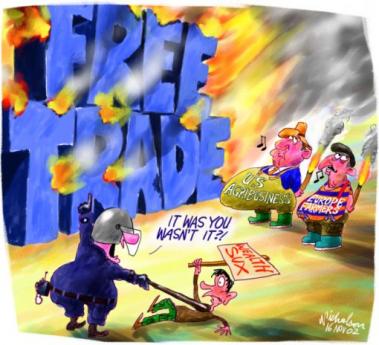
How can anyone not support free trade?

My cousin asked me that today, by happy coincidence the very day I prepare to lay the foundation so my micro principles students can understand why the vast majority of economists do support free trade. I responded to him, in part (and from a US-centric standpoint): 


But you ask me why other people don't think the way we do, so this is my attempt to give them a fair shake. I actually had to write a paper once on why some people don't support free trade. The short answers are:

  • They don't understand free trade. (#1 reason)
  • If they understand free trade is good in general, they may not understand what is really meant by "strong" and "weak" currencies or where trade deficits come from. Those we aren't going to cover in micro principles, but they are important parts of understanding free trade.
  • They understand that free trade maximizes total utility, but they are concerned about the distribution of the gains and losses. The ethics behind free trade says that the winners could compensate the losers of a change to free trade, but in general they don't - no more than the winners of protection compensate the losers. If you think most of the losses will hit poor people, there is a reasonable ethical ground for wanting to discourage some trade. Now, we could do things better by still allowing trade and doing something else for poor people, but I can understand the argument anyway. This analysis also usually forgets the much poorer people in another country who gain a job that allows them to survive.
  • As a rich country, the US can afford little luxuries like high labor and environmental standards that other countries may not. If you are categorically opposed to child labor in sweatshops or unsustainable fishing and air pollution, you might be concerned about more production moving to areas that don't regulate those items as much. There are arguments that go the other way, but again I can understand why someone who places a high value on the environment might not want production to move away from where we can regulate it.
  • If there are any externalities (like air pollution) you can also make the argument that the market price does not reflect the true costs and benefits, so markets will oversupply goods. Moving to somewhere that has a larger disparity between private and social costs (either because the firm will be more polluting there and increase the social costs, or different regulations lower private costs, or whatnot) will tend to exacerbate that problem.
  • It's a colonialist/egalitarian thing. If the rules of free trade agreements favor countries that are already wealthy (and they do), it is possible for a government to harm its citizens by opening to freer trade. The rules of accession to the WTO, for instance, allow current members to exact concessions from new members that either nullify WTO rules (WTO-) or require higher standards for entry (WTO+) so that the "rules-based" system becomes a power-based system. For egalitarian reasons, someone might not like that arrangement even if they like free trade per se. 
Now these aren't actually the arguments most people make. But if they had more sophisticated economic reasoning, these are the types of arguments they would make and they are the points brought up by the 2% of economists who don't care as much for free trade (e.g. Stiglitz). This is also ignoring the infant industries argument (favored by Rodrik), the national defence argument, or most arguments that point out that we may have more goals than efficiency and freedom (like food self-sufficiency). I'm also missing the anti-corporatist element and the more blatant self-serving protectionist arguments [made in particular by the corporatist element, right].

Tuesday, September 6, 2011

Happy Labor-tarian Day

Have solidarity with the working class and get the government off their backs. Many of the poorest pay over 100% marginal tax rates as benefits phase out in strange and unpredictable ways. It sets up strong counter-incentives to work. Employer payroll taxes reduce demand for labor across the board.
From Cafe Hayek:
taxes on corporations are taxes on people:

I remember that in addressing the issue in the 1980s, the late Herb Stein said that it’s as if people think that if the government imposed a tax on cows, the tax would be paid by the cows.

Labor and environmental regulations are actually preventing the government from producing Obama's sought-after clean tech jobs (HT: Newman).
Catalan at Mises discusses the moral and pragmatic consequences of Libertarianism for the poor:
As a “quasi”-consequentialist I tend to judge libertarianism by the outcomes of certain policies (or, better said, lack of policies). I honestly believe that the free market could better provide for the “less fortunate” than an interventionist economy, and that an interventionist economy will lead to the further impoverishment of the “less fortunate” over the long run. [My father] disagreed and I gave the example of the food industry. In more capitalistic countries, where regulation on food production and distribution is relatively minor, food is plentiful — there is a surplus that can be exported. There are some who are “malnourished”, but malnourishment in the United States is not the same as malnourishment in Sudan, for the most part. Yet, in countries where food is rationed there is widespread malnourishment and famine.
While I tend to favor his overall sentiment when applied to the US, the malnourishment of Sudan is scarcely caused by too much government today. You can make the case that the problem is too much of really bad government in the past, but if even 15 years of no central government have not turned things around in a significant way, maybe there needs to be something more. A good part of the reason our markets function well includes significant amounts of public goods provided by our government. Could they also be supplied by the market? Perhaps. Experience around the world shows that where government does not provide them, markets have provided in insufficient quantities to get their market system where it could be.

On the bright side, at least one sector is hiring: the downward-pointing arrows manufacturers.

Tuesday, May 24, 2011

The Faces of Development

Development in Mexico, according to its census (HT: MR via Andrew Sullivan):
In 1990, one in five dwellings had a bare-earth floor. Now only 6% do. … More interesting still is what Mexicans put in those homes. More houses have televisions (93%) than fridges (82%) or showers (65%).
In part that is because of the impressive Mexican work ethic: “Mexicans work an average of ten hours a day, paid and unpaid labor, even though the country is far from the world’s poorest.  Belgians work the least number of hours a day, at seven."

I was quite surprised, though, when searching through Google Images for a good shot of a bare-earth floor. There were more pictures of Westerners deliberately installing earth floors than there were of people too poor to get a proper floor. Searching for "dirt floor" scored somewhat better. So here's another development paradigm for you: Westerners use earthen floors, everyone else uses dirt floors.
Development in Zimbabwe over the last two years of national unity government and dollarization
The economy grew at nine percent in 2010, following on six percent in 2009. Government revenues climbed to 29 percent GDP in 2010; they were just three percent of GDP in 2008. … This good performance starts from a low base; the economy had contracted by more than 45 percent from 1999-2008. Furthermore, world prices of commodities, such as platinum, tobacco and gold, which are Zimbabwe’s main exports, have been on the rise. Weather has been good in the past two years. But the point is that Zimbabwe was able to make good use of these conditions. There was a supply response to high prices in agriculture and mining, and manufacturing showed signs of life.
Development in Africa: “The African Development Bank says that one out of three Africans are considered to be middle class” – that is to say, earns $2-20/day. Of the 313 million in that range, 180 million are between $2-4/day. “Tunisia, Morocco and Egypt had proportionately the biggest middle classes in Africa, while Liberia, Burundi and Rwanda had the smallest.”

Development through sweatshops, consensual market transaction edition: “Field interviews reveal that subjects perceive their alternatives, including agricultural work and street vending, as less desirable when compared to sweatshop labor. Non-monetary benefits are an important part of this appraisal.” Yglesias puts a different spin on it, based on Duflo and Banerjee’s new book on poverty that surveyed poor people and asked what they aspired to. Mostly what they want for their children is a government job, not entrepreneurship: “What the very poor want, overwhelmingly, is a job where you show up, do as you’re told, and get a guaranteed paycheck at the end. Given the fact that the prospects for government employment are always limited, I assume this explains a lot of the appeal of super low wage sweatshop work when it becomes available in poor countries. “

Friday, May 20, 2011

The opportunity costs of cheap food

Our food costs more than the price at the grocery store. In addition to the environmental costs, M. Nestle worries about food safety costs that would be much cheaper to prevent than cure. While the argument made by companies and Nestle is that prevention shows up in consumer costs while clean up doesn’t, I would argue that private clean up does show up in consumer costs. It’s only when government and public health systems bear the costs that they don’t show up directly in food costs. She worries also about human costs, including obesity caused in part by cheap, subsidized calories and expensive, unsubsidized vegetables, and:
I was reminded of externalized food costs when reading about the remarkable efforts of a Salinas teacher to educate children of itinerant farmworkers. The kids are trying to learn under disrupted, impoverished, crowded living conditions. If their parents were paid and housed better, we would pay more for food. …
The CEO of a large U.S. meat company told me that if he raised wages by $3, he could hire locals and not have to deal with immigrant labor. But then he would have to raise the price of his meat by 3 cents per pound (I’m not kidding). That amount, he claimed, would price him out of competitiveness. …
Speaking of which, Florida tomato pickers (mostly immigrants) have recently been awarded a much better contract, including higher wages, being informed about their legal labor rights, and many are cheering that the industry is really beginning to turn around. Expect some of the hidden costs of tomatoes to be less hidden.

In support of this notion of the unseen costs of our food system, Batz and colleagues at the University of Florida’s Emerging Pathogens Institute identify the 10 pathogen-food combinations that cost us the most in terms of public health (medical care, lost productivity, chronic disabilities including permanent physical and mental damage to infants, etc.):
Campylobacter in poultry — costs $1.3 billion a year [sickens more than 600,000 Americans annually]
Toxoplasma in pork — costs $1.2 billion a year
Listeria in deli meats — costs $1.1 billion a year
Salmonella in poultry — costs $700 million a year
Listeria in dairy products — costs $700 million a year
Salmonella in complex foods — costs $600 million a year
Norovirus in complex foods — costs $900 million a year
Salmonella in produce — costs $500 million a year
Toxoplasma in beef — costs $700 million a year
Salmonella in eggs — costs $400 million a year
Another source Nestle misses is the taxes needed to pay for government food policies in the form of taxation.

An example of unusual environmental costs of a food system comes from Zimbabwe, whose justice department has decided to solve undernutrition in overcrowded prisons by adding elephant meat to the menu. The government’s position is that there are three times as many elephants as conservation groups think, so they have “an elephant overpopulation crisis.”

Thursday, May 5, 2011

US Demographic and Labor Changes

Interesting factoids from the Census with a lot of great maps and charts (HT: Newmark): Where has US population growth been above average? Mostly the mountains and deserts of the West, metropoloitan Texas, all of Florida, and the DC-NYC corridor.

Detroit is now smaller than it was in 1920.

Not adjusting for inflation, the greatest per capita income growth happened in DC, Louisiana (!), Wyoming, North Dakota, and Montana, growing by 50% between 2000 and 2010. The states that were unable to keep up with the 27% inflation over the decade: Navada, Michigan, Georgia, and Colorado, with Ohio and Indiana just keeping up.

(HT: Economist) “… Whites still constitute a slender majority, 54%, of those under 18” but with minorities accounting for 92% of the population growth of the last decade, fewer than half of the children my sons age or younger are white. So even though population growth has been in traditionally Republican-leaning states, if the growth is largely in Democrat-leaning population, there could be some real political shifts in the long run.

Combine all this with declining male employment, particularly for the less-educated and the picture looks a lot grimmer. The Economist’s article on US employment policies makes for interesting reading.
French complains that government regulation is making it more costly to hire and fire people. He argues this leads firms to hire seniors rather than teens and that this does a real disservice to the future of the country. The one difficulty is that the regulations he cites do not discriminate between the young and the elderly. His primary argument applies just as surely without any government interference at all:
Mr. Jones with a 40-year track record of showing up on time and really needing to supplement his Social Security check is a surer, safer bet than Danny Jones, who, while seeming bright and enthusiastic,  has never held a job and has classes and band to schedule around.  Who knows if Danny Boy will stick around?

Monday, April 25, 2011

Unusual Political Economic Explanations

A good question from Cowen: “What is the political economy of a world where so few people work?” That deals with labor force participation rates rather than unemployment rates per se, but I would hazard that it makes the US look much more like Europe. Cowen believes that it will be more likely to lead to a change in ethical principles (moving from “protecting all the old people against major health care catastrophes” to guaranteeing everyone a particular annual income) which will involve a change in policy instruments from Medicare to welfare checks.
The political economy of energy: If we had no nuclear power, the world would produce an additional 2 billion tons of CO2, roughly the total emissions of Germany and Japan combined, much of it from gas plants. Of course, that number doesn’t count for the demand-depressing effects of higher energy prices. Japan, however, seems less concerned with nuclear power itself than with the political economy of how it is run, with senior bureaucrats who regulated the nuclear power industry being invited to “cushy jobs” in it. “An energy portfolio, like any other, is a basket of risks: of security of supply, cost and environmental damage. Fear and uncertainty, which nuclear fission produces as unavoidably as it does iodine-131, distort people’s perceptions of those risks.”
Yglesias was debating the political economy of why our tax code is convoluted and an unnecessary headache for millions of filers. I filled in one answer just before he gave it, but his other answer I think is quite doubtful:
Under the circumstances, the sensible thing would be for the IRS to send everyone a sheet of paper that says “based on the income that’s been reported to us and your family status from last year, your taxes owed (or refund owed to you) is $X with standard deductions. If something’s changed, or if that income number is wrong, or if you want to itemize deductions, you should fill out forms blah blah blah. Otherwise, just send a check.” A lot of us would still need to wrestle with the forms and nobody likes to give up money, but this would be much more convenient for millions of people. We don’t do it because H&R Block and TurboTax don’t want to lose customers and, crucially, because the conservative movement wants taxes for ordinary people to be as annoying as possible. Rich people don’t care about this kind of simplification because they itemize their deductions and hire accountants. But they benefit from middle class people resenting the tax process because it helps them build the case for low tax rates.
I would be interested to know just how much H&R Block and Turbo Tax are giving in campaign contributions to specific members of the relevant committees to fight against tax simplification. I am doubtful that it is anywhere near as significant as, say, the contributions for the Farm Bill or any hint of regulation of meat processors.

Saturday, March 26, 2011

Big Bag of Libya

The Economist: “WE APOLOGISE for the unplanned hiatus in bombing of the Middle East. Normal service has now been resumed.” … “This president has never been the peacenik America’s doves craved; his scorn for the “dumb” war in Iraq was always balanced by support for the “necessary” one in Afghanistan.”

How much is your non-violence worth?

Potayto, potahto; Tomayto, tomahto; mercenary, military contractor…:
You don't have to be a down-on-your-luck autocrat like Qaddafi or Gbagbo to hire private armies in the modern era, however. The largest customer for the services of private warriors is, without a doubt, the United States, which now employs more military contractors than troops in Iraq and Afghanistan.

Libya’s agricultural sector hires a large number of foreign workers from the neighboring countries. Those migrant workers have been heading home recently to avoid the violence, increasing food and poverty pressures in those countries as well.

“a rebel government, recognized by France, now has an oil company and a central bank.” HT: Blattman. Cowen quips that all they need now is an NGDP futures market.

Seven very good lessons on helping countries leaving autocracy on the road to democracy. In short, institutional reforms and getting the military out of power should happen quickly, followed by building into elections. International forces should largely stand by and focus on institutions and preventing conflict rather than picking winners.

Not appearing on your TV screens: relatively successful, quite peaceful elections in Africa. Given people’s stereotypes of the region, you would think peaceful elections would be newsworthy…

The Daily Show introduces the “Freedom Package” below the fold. Oh dear. HT: Wronging Rights.

Friday, March 18, 2011

Catching Up: Our Riots

I think one of the points of difference on the arguments over public sector workers is who you imagine first when you read that phrase. If you imagine teachers, police, firefighters, and so forth, you're liable to be strongly in favor of anything they ask. If you imagine "soulless" bureaucrats, men at "work", and other quotation-mark-laden drones whose job is to live off the public trough, you'll love sticking it to "the man." Is there some way to separate them? And, of course, avoiding the political economy theater brilliantly portrayed more than 25 years ago by Yes, Prime Minister (part 1, 2, 3).

“Government-employee unions have vastly more power than do private-sector unions because the entities they work for are typically monopolies.”

Why the Wisconsin demonstrations are like the Tea Party (HT Sumner):
The advent of the labor movement is at the heart of the left’s sacred creation myth. The sense on the left that unions are under siege gives them something to fight for with a bracing sense of historically-rooted identity and moral authority. Similarly, the sense on the right that America’s foundational values are under siege gave the Tea Party something to fight for with a bracing sense of historically-rooted identity and moral authority. Of course, the Tea Party has about as much to do with the values of the American founding as John Adams has to do with Raytheon, and public-sector unionism has about as much to do with preventing worker exploitation as Eugene Debs has to do with unfireable $100,000 a year public-school teachers.
Different measures disagree on whether public sector or private sector employees are better compensated. Here are comparisons, depending on which you think is most comparable. (HT Marron)

What teachers make, version 1; version 2; version 3;

Thursday, March 17, 2011

How to recognize unfavorable labor laws

Labor laws in Brazil. One law bans paying an employee less one month than the previous month.
That many of the new jobs are formal (ie, legally registered) is despite, rather than because of, the labour laws. The trend to formalisation is largely a result of the greater availability of bank credit and equity capital on the one hand, and recent changes that make it easier to register micro-businesses on the other. …
Gustavo Gonzaga, an economist … notes that a remarkable one-third of Brazilian workers are made redundant each year, a fact he attributes in part to the labour laws themselves. These are extraordinarily rigid: they prevent bosses and workers from negotiating changes in terms and conditions, even if they are mutually agreeable. They also give workers powerful incentives to be sacked rather than resign. Generous and poorly designed severance payments cause conflict, Mr Gonzaga says, and encourage workers to move frequently. That churn affects productivity, as employers prefer not to spend on training only to see their investment walk away.
Private enterprise and capital laws in China: “behind China’s remarkable success has been an odd and often unappreciated experiment in laissez-faire capitalism.”
The right of China’s private companies to exist is by no means clear. Private companies with more than eight employees began to emerge only in 1981 and were not officially sanctioned until 1988 (the number was drawn from an essay by Karl Marx on an inflection point for the creation of a rentier class); …
No one knows quite how much private companies contribute to China’s fast-growing economy. Chinese firms fall into a bewildering variety of legal categories and their respective contributions to GDP are not reported in official statistics. …
Zhejiang’s scrappy entrepreneurs had already acquired, in the least auspicious circumstances, a culture of opportunity and a belief that anyone could become successful. The anecdotes are almost endless. … [They appear to include a healthy dose of microloans and pay day loans since the] sources [of Chinese capital] are a bit of a mystery: largely unofficial, even secretive … discerning, vibrant, and (depending on the authorities’ sentiment of the moment) even illegal. … The system is entirely informal. Records, he says, are minimal and all investments are in cash. A by-product is a proliferation of vast steel safes in homes and offices. … Although success brings praise, too much of it can invite envy and scrutiny.
And the increasingly antagonistic agricultural labor laws in the US:
This is how our relatively inexpensive food gets to us.   The costs, as the economists tell us, are externalized.  Here is one of those externalized costs–the potential of those kids to become functioning citizens in our democratic society.

Wednesday, March 16, 2011

Big Bag of Ethics: Soylent Green, Mandela, and Aid

Terrible ideas in ethics: run the country like a business, Soylent Green edition. “If you’re trying to look at America from a balance-sheet perspective the problem is very clear … it’s the existence of old people. … The optimal economic growth policy isn’t to slash Social Security and Medicare benefits, it’s to euthanize 70 year-olds and harvest their organs for auctions.”

Much better thoughts on ethics about Mandela’s transformation into the Mandela we (think we) know today: “It was not because he was removed from others, removed from evil, removed from the weaknesses of a frail humanity, that he prevailed. It was by plunging into what was negative in himself and the aching world around him that he was able to develop “whatever is good,” as he puts it in his book. How to do this? One word keeps cropping up, over and over: integrity.”

Beyond a desire to save the world:
Someone very smart once said to me that “the reasons why you stay married are usually different from the reasons why you got married.” And very much like marriage, humanitarian work is one of those things that has good days and not so good days.”
On the ethics of pop stars associating with autocrats.

Unusual thoughts: livestock

Free Derange
Grocery Store | Venice Beach, CA, USA
Me: “Hello, how can I help you?”
Customer: “Yes, what does free range chicken mean?”
Me: “That means our chickens are not raised in cages. They get to walk around outside, which is important to the quality of life for the animals.”
Customer: *with a horrified expression* “How do you make sure they don’t eat bugs and stuff while they’re outside?”
Me: “We make sure the farmers put up a sign ‘don’t eat bugs’ in chicken scratch so they can read it.”
Customer: “Oh, okay. I’ll take two breasts.”
“Immigrants to the United States, rights advocates say, are treated like cattle. Little do they know how wrong they are. Cattle are treated much better.”  A marvelous article describing how cattle have much freer, better quality migration than humans, free of discrimination and with instant access to welfare (subsidies)

FAO is providing North Korea help fighting foot and mouth disease.

Among the points that comes out of the Worldwatch Institute’s report on agricultural innovations is that we can double food production in areas that are currently low producing areas using agro-ecological methods. Change.org would like to spin that into saying that we could get by with only organic methods everywhere, which is not actually supported by the findings. Organic methods out-produce traditional agriculture. It also requires more time and monetary investments.