Showing posts with label Risk. Show all posts

Thursday, September 8, 2011

Lit in Review: Nigerian Agriculture 2

Birol and many coauthors presented a paper a year ago on the place of poultry in African livelihoods. More specifically, they are "Investigating the Role of Poultry in Livelihoods and the Impact of HPAI on Livelihoods Outcomes in Africa: Evidence from Ethiopia, Ghana, Kenya and Nigeria." That is, what would happen to Africans who raise chickens if their flocks were hit by a Highly Pathogenic bird flu?

Most policies that deal with bird flu focus on the supply side problem (replacing the value of lost birds). "According to the records of the World Bank-funded Avian Influenza Control Program, between February 2007 and January 2008, N623,077,880 (US$4,215,683) has been paid to compensate farmers whose birds were culled." They point that there is also a demand side: less demand for the remaining birds whether or not HPAI actually happens when people are afraid it might happen. Even households with no sick birds lost more than two-thirds of their poultry income from the first outbreak in 2006. 75% of poultry farmers either bought no new birds or left the industry,

HPAI is "endemic" in Nigeria, and with Ghana on the migratory route, it has also had three outbreaks. However, because they find that poor people in Nigeria use a variety of livelihoods strategies, even a bad outbreak of HPAI won't affect them much in their total portfolio. Among their policy recommendations is to help increase livelihood strategy diversity - give people more opportunities to earn money.

However, I would point out that one of the reasons they pursue diverse livelihoods strategies is because of the risk involved in trusting in any one activity. They are unable to access better (more productive, more efficient, more remunerative) production strategies because something like HPAI would wipe them out. This keeps average incomes lower and perpetuates poverty and low mobility. Steps to reduce the uncertainty of any activity they already use would make it more attractive and reduce their loss aversion.

I was surprised at the Jimeta modern market this Saturday. I went to the corner where the broiler chickens are and spoke to a poultry seller. I asked him for seven of his nine chickens so my family would be able to get some food storage together. He refused to sell me more than one. It took some time and discussion before he realized that I was not trying to buy his one broiler for only N700 ("No, I want 7") and for me to realize that he would only sell me one for N1120. This being the first time I had ventured out to buy my own chicken, I don't know how much of a pattern this is. Had my Hausa or his English been better, I might have made some headway in understanding what was going on.

Some statistics:

Tuesday, August 23, 2011

Condie - Risk and Uncertainty

tBelow the fold is an interview with Dr. Scott Condie, who traveled with me through BYU and then Cornell's economics programs. He discusses his behavioral models of financial risk and uncertainty. The question is what people do when their information is highly ambiguous: we know there's more than a 25% chance of a strange coin toss coming up heads, but it might be 33% or it might be 50% or it might be 60%, and we just don't know. And if some investors are more than risk averse, but loss averse or maximin-ers or something else, that adds more complications. In that world then, how do markets respond, how informative are prices, and what opportunities are there for people with inside information to rig the system?

Thursday, June 16, 2011

Lit in Review: Food Demand -- Ethiopia and Speculators

K. Tafere, Taffesse, and Tamiru, with N. Tefera and Paulos, (2010) “Food Demand Elasticities in Ethiopia: Estimates Using Household Income Consumption Expenditure (HICE) Survey Data), IFPRI and EDRI, ESSP2 Discsussion Paper 011.

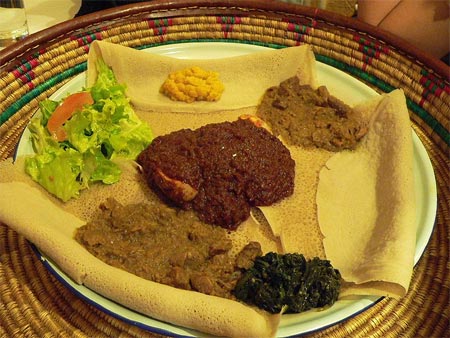
One of the difficulties of working with Ethiopian food data is that there are four staple cereals: wheat, maize, teff, and sorghum. Another difficulty is that this means there are a lot of zeroes in the data: 28 percent consume no sorghum, 22 percent no teff, 16 percent no maize, 9 percent no wheat, and 2 percent no animal products.

They come up with a fairly large group of significant own-price and expenditure elasticities (90% of the 230 possible price effects are significant). Most commodities are own-price unitary elastic, though maize (-.75) and sorghum (-.66) are the furthest from -1 and wheat closest (-.98) of the major cereals. Cross-price elasticities are relatively small, with complementarity between teff-sorghum and maize-sorghum, but substitution between teff and wheat. Own-price elasticities appear to be the same in urban and rural areas, but there are different cross-price effects.

Hailu and Weersink, “Commodity Price Volatility: The Impact of Commodity Index Traders,” CATPRN Trade Policy Brief 2011-04

While both sides agree that there is a correlation between CIT (commodity index trader) activity and commodity futures prices, the direct of causation is the point of contention. The empirical evidence is mixed with very limited support for the view that higher commodity prices draws in investment activity by index funds. … There is more empirical support for the claim that CITs are associated with greater market volatility. Khara in a Brookings report argues it is unpredictable price volatility that is the real problem for producers, consumers and governments, not the level of prices. … Thus, an increase in commodity market volatility may lead to greater costs for managing risk: more costly insurance premiums, higher options premiums, and greater margins for hedging. … The research conducted to-date suggests commodity index traders had little to do in driving prices upward but are one of the reasons for the significant increase in market volatility over the last several years, but are not the sole cause.

Tuesday, August 10, 2010

New financing options for SSA farmers

The proposed solution in South Africa: make more middlemen.

The bank gives loans to a contractor instead of directly to the farmer. The contractor then subcontracts the farmer to grow food or raise cattle. The contractor takes on the risks both of farming and of default.
"What we have essentially done is to remove the risk from the farmer and we carry the risk ourselves. We lease the land from the farmer and he is then contracted to us to grow crops according to our agreement and gets paid," he said. "They do not even worry about prices because we never enter into a scheme without hedging the prices as we are not in the business of speculating on prices."

Monday, May 17, 2010

Big Bag o Blog Links

Wall Street reform is more likely as the political winds shift. Then there's Cowen's excellent example of math voodoo in this regard.

How to spend $1 billion dollars the Yglesias way: buses. "It's rare that you have a policy issue that can be solved by throwing more money at the problem..." but he thinks buses will do the trick. As a development economist, my respect for him just lowered one tiny notch. However, he does make some excellent points about trying to tell the difference between hedging, betting, speculating, and risk management.

Ravi Kanbur offers that developmentalists ought to walk a mile in the poor's shoes, at least for a few days every 12-18 months. And, speaking of cast-off clothing, how about 1 million kittens for Africa?

The perils of laptops and the benefits of doodling in class and seminars. And, while most of the time bemoaning the lack of context in news reports of Africa, here is one reason why less is more in other areas.
The fatal turning-point in the modern development was when the great movement which can serve its original ends only by fighting all privilege, the labor movement, came under the influence of anti-competitive doctrines and became itself entangled in the strife for privilege. - F.A. Hayek, The Road to Serfdom, p. 207
The people in tragedies, according to Aristotle, are better than the rest of us, while the people in comedies are worse. In a certain kind of modern comic romance, though, the two primary stipulations are that the main characters be better-looking and duller than the audience, which produces a self-canceling wash of emotions. No cathartic tears or therapeutic laughter, but instead a mild, smiley stupefaction. --A. O. Scott, NYT, on the plight of the contemporary romantic comedy.

Dani Rodrik:
“the political trilemma of the world economy”: economic globalization, political democracy, and the nation-state are mutually irreconcilable. We can have at most two at one time. Democracy is compatible with national sovereignty only if we restrict globalization. If we push for globalization while retaining the nation-state, we must jettison democracy. And if we want democracy along with globalization, we must shove the nation-state aside and strive for greater international governance.

Thursday, May 13, 2010

WIDER Panel: Global Food Crisis and Response

Per Pinstrup-Andersen (yay!): The Political Economy of Food Price Policy (our next project)
The former and current heads of IFPRI largely agree on where the world is and is heading.
He references my work: almost all the increase in hungry people in Africa is from the Dem Rep of Congo
"I do not believe FAO's recent numbers."
Why? 1 - Price transmission from int'l to national is very low in countries with poor infrastructure and in China
US rice prices spiked highest for international Thai rice, 20% lower in Philippines and Egypt, 60% lower in India and China
But if prices didn't increase in China and India, the number of hungry people must have increased enormously in other countries based on FAO
Wheat prices went up more in Egypt than internationally. Maize prices went up in Kenya but didn't come down for national, not int'l reasons.
Global stock increase: 25% for rice and wheat
Terrible lack of commitment to putting plans into action. (more of my research behind that one)
Agrees with Fan's #1 Priorities. Priority #2: double public investment in ag to increase production sustainably: win-wins are possible
3 - incentives for private sector to invest in sustainable ag (saving and credit institutions for farmers, risk management, public goods)
Need to regulate land grabbing (and enforce them) and internalize environmental externalities (full-costing, PES, polluter pays)
Full costing will have to be international to be effective, and I'm not very optimistic if we can get the agreement.
He puts up our diagram of a modified environmental kuznets curve showing win-win-win: reducing poverty, hunger, and soil degradation at once.
"I'm probably the only one in the room who believes real food prices are going to continue down again. Please talk to me."

Alain de Janvry and Joachim von Braun below the fold

Monday, May 10, 2010

Off for Finland

Tomorrow I will be traveling to Helsinki, Finland for WIDER's 25th Birthday - a conference on the triple crisis (food, fuel, and finances). Those involved in our upcoming project on the political economy of food price crises will be meeting there to kick things off.

Thursday, April 1, 2010

Supporting developing private sectors: risk sharing

Under the banner that "innovation is a public good" [groan] Dan Altman proposes that investors could buy private high-risk, high-yield bonds and swap them for lower-risk, lower-yield bonds at participating governments. The theory is that governments have a longer time horizon than venture capitalists and if innovation is a public good they indirectly subsidize anyway, why not here too?

For instance, let's say a cashew producer in Senegal needs $5 million to build a new processing plant. The plant would have equal chances of delivering an annual return of 20 percent or going bust. If the plant is successful, though, it would also creates hundreds of jobs and be an anchor for the development of its community. So far, no one wants to invest. But a venture capital firm might be willing to put up the $5 million if, instead of the 50-50 chance of a 20 percent return after a few years, it received 7 percent per year starting now.

Who would make this swap? A foreign government interested in Senegal's development might. With a big, diversified portfolio full of investments just like this one, that government could expect a 10 percent annual return, on average, after a few years. That's not a very long time to wait, considering government's time horizon; what's a few years, when you're worried about funding Social Security until 2075?

Moreover, the investment would be a quadruple winner: the cashew producer would get its plant, Senegal would develop, the venture capitalist would get a good return, and taxpayers would get an even better one. The government would not be crowding private investors out of this market; rather, it would be facilitating a new market that otherwise would not exist, and then sharing in the gains from trade.

I'm glad someone is paying attention to the fact that donors aren't paying enough attention to the private sector. They aren't. But honestly, did we learn nothing from the current banking crisis? Oh wait, yes, we did. We learned that rich governments are willing to buy bad loans to subsidize hedge funds, banks, insurers, and venture capitalists. The idea could have some merit, but it's going to take more explanation why this isn't a disaster waiting to happen when systemic risk bites.

Other advantages: the government isn't picking winners (in theory). The private sector is picking which firms deserve money. Until governments put conditions on whose assets they will swap to meet certain criteria, anyway.

And can we please differentiate between public goods and merit goods where most of the benefits are captured privately, there are just some nice secondary effects, which incidentally are also privately captured?

Hat tip: Aid Thoughts

Thursday, February 18, 2010

Lit in Review: Livestock risks

From the last issues of the Review of Agricultural Economics (2009), Vol. 31, No. 3 and 4.

McCann (2009) "Transaction Costs of Environmental Policies and Returns to Scale: The Case of Comprehensive Nutrient Management Plans," No. 3, 561-573.
Livestock produce fertilizer. Put too much fertilizer on the land and the soil nutrients potentially end up in the drinking water. In the US, large livestock operations are required to have comprehensive nutrient management plans, made either by a government official or a private technical service provider. Recent studies have shown that farmers with plans put fewer nutrients on their land than those without, but still are putting too much on.

Eventually, the government hopes to expand this requirement to all livestock farms. Small and medium-sized farmers [I know what you're envisioning: munchkins raising guinea pigs. Let's not be silly.] face a number of transaction costs that larger farmers don't [it takes more steps to cover the same ground, for one. Stop that!] and extension services are not widespread enough to cover small farms as well. Farmer surveys (26 observations out of 1030 returned surveys out of over 3000 sent out to farmers in Iowa and Missouri. meh!) said the average monetary cost of preparing the CNMP was $460, with nothing significantly correlated, plus about 17 hours of work on the farmer's part [11 hours for the smallest farms, 24 for the largest] and 149 hours from government officials. The more animals you have, the lower the total cost per animal is.

Thus the conclusion is that extending the current set up to small and medium livestock farms would give large firms additional cost advantages. She argues that another method needs to be devised to keep the playing field level while still reducing the risk of environmental damage from livestock operations.

Elbakidze, Highfield, Ward, McCarl, and Norby (2009) "Economics Analysis of Mitigation Strategies for FMD Introduction in Highly Concentrated Animal Feeding Regions," No. 4, 931-950, ungated  An outbreak of Foot-and-Mouth Disease in Britain at the turn of the century caused damages of $720 to $2300 million, and larger losses in tourist income. Their simulation model has two components: an epidemiological model of disease risk and spread patterns and an economic model to examine losses. They include a fairly detailed table on the costs for appraisal, cleaning, vaccinations, etc by herd size and a rough estimate of the value of the livestock at different weight assumptions, including twelve classifications of cattle, six sheep, and six pigs.

Simulations indicate an outbreak of FMD in Texas would cost $1 billion in Texas cattle alone. Early detection efforts would save $150 million just for large feedlots and $3 mil for backyard production, so there's a fairly large margin to spend on the efforts. "Vaccine availability and enhanced surveillance were not economically effective ... compared to delayed vaccine availability and the default surveillance strategy." This is in part due to the assumption that vaccinated animals lose 50% of their value due to trade restrictions, though trade losses are not included in the model themselves.


Carlberg, Brewin, and Rude (2009) "Managing a Border Threat: BSE and COOL Effects on the Canadian Beef Industry"No. 4, 952-962
This teaching case describes cattle production and processing capacity in Alberta and Saskatchewan. Cattle processing used to be more spread out across Canada, but technological changes concentrated the processing in those two provinces. Farmers in the other provinces either trucked their animals across the country to have them processed or shipped them into the US. Just before the BSE [Mad Cow Disease] outbreak in 2003, 44% of Canada's cattle came into the US for processing. The BSE outbreak shut that down completely, glutting Canada's processors and wreaking havoc with cattle prices.

In response, the US has drafted mandatory Country of Origin Labeling (COOL) laws that came into effect March 2009. Some estimates indicated that processing costs could be as high as $50 million per plant to segregate the animals and their meat, a 2% per head increase. Since meatpacking is a low-margin business, this is economically important. Of course, you can avoid many of these costs if you don't use animals from other countries, so this has the potential to significantly decrease US plants' willingness to process Canadian livestock. There are plans to increase Canadian processing capacity to reduce reliance on US processors, just in case.

[Cow 1: Are you worried about becoming a raving lunatic because of BSE too?
Cow 2: Me? No. I'm a horse.]

Wednesday, December 23, 2009

Lit in Review: Three on Agricultural Risk

From the American Journal of Agricultural Economics, Vol 91, No 3 - August 2009

Di Falco and Chavas, "On Crop Biodiversity, Risk Exposure, and Food Security in the Highlands of Ethiopia," p. 599-611.
Facts: Ethiopia experienced droughts in 1965, 1974, 1983-4, 1987, 1990-91, 1999-2000, 2002. Ethiopia is a global center of genetic diversity for several crops, including barley. [A communal barley harvest in Ethiopia, right]
Method: Moment-based specification of the stochastic production function to identify how biodiversity affects the first three moments, unique farm survey, 1999-2000.
Findings: Most decision makers exhibit risk aversion and are DARA. Biodiversity increases farm productivity, even controlling for management practices and microclimate factors. Biodiversity increases skewness and variance, so higher upside and lower downside. The effects are larger on poorer soils (biodiversity and land quality are substitutes). Experience is not statistically significant.
Future research identified: This was a one year survey, so couldn't address the dynamics of management decisions.

Gramig, Horan, and Wolf, "Livestock Disease Indemnity Design When Moral Hazard is Followed by Adverse Selection," p. 624-641, ungated.
Discussion: The US Constitution requires governments to repay farmers when their livestock must be seized to prevent or treat infection. These indemnity payments are a form of implicit insurance and also, critically, disaster payment. Unconditional payments reduce the incentive for farmers to invest in biosecurity measures, particularly if they are paid the full market healthy price so that they suffer no loss at all.
Policy recommendation: Use two policies, one penalty for failure to disclose problem and one indemnity to incentivize proper levels of biosecurity investment. Belgium and the Netherlands give no payment for dead animals (so they want to report before the animal dies) and only partial payment for sick animals (so they want to invest in biosecurity). Private markets may be in conflict with the public policies.
Future research: This paper does not account of the externality and free rider problem: my optimal choice of biosecurity depends on my neighbors'.

Ito and Kurosaki, "Weather Risk, Wages in Kind, and the Off-Farm Labor Supply of Agricultural Households in a Developing Country," p. 697-710, ungated.
Method: multivariate two-limit tobit, Survey of Living Conditions, Uttar Pradesh and Bihar, 1997-98, with labor allocation in 31 (!) categories based on source of wage and whether in cash or in kind.
Facts: 41.4% of households (hhds) rely only on self-employment - largely they have more land and a higher reservation wage; 58.6% have at least one family member earnings wages, usually non-agriculture.
Findings: Education decreases the share of agricultural wage work. The more worker-age males and dependents in a hhd, the lower labor share on own-farm and more for off-farm wage work. The number of working-age females is not significant. Rainfall variance reduces own-farm labor, implying that risk makes people work off-farm. Rainfall variance increases agricultural work paid in kind and nonagricultural work, but is not statistically significant in determining agricultural work paid in cash.