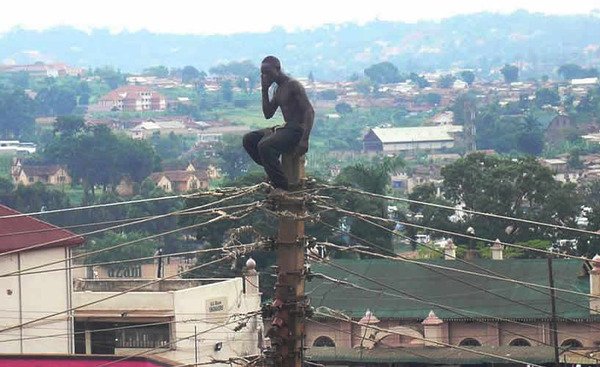
Showing posts with label Energy. Show all posts

Thursday, September 1, 2011

Gallup on energy: Nigeria's relative development

Source
Gallup surveyed 1,000 people in 20 African countries about where they get their primary source of power and their life satisfaction.
When asked to evaluate their lives using the Cantril Self-Anchoring Striving Scale, those who say their main source of lighting comes from power lines rate their present lives more than 0.5 points higher on a scale from 0 to 10 than those who rely on fuel lamps or other sources. These results still hold even after statistically controlling for household income. On-grid sub-Saharan Africans also rate their future lives a full point higher than those who mainly rely on fuel lamps and more than half a point higher than those who use other sources of home lighting. ...
Virtually everyone in Mauritius, an island nation in the Indian Ocean, says their main source of lighting is a power line. Majorities in Cameroon, Ghana, South Africa [what? really? wow /sarc], Nigeria, and Zimbabwe also report relying on power lines. At the other end of the spectrum, 10% or less in Mali, Central African Republic, Niger, Burkina Faso, Chad, and Liberia say the same.
Roughly 2/3 of Nigerians report relying on the power grid. In the median African country, less than one-fourth can even make that claim.
Gallup concludes:
The Gallup results suggest electricity access is a necessary pillar for the implementation of the Millennium Development Goals in the region. From improved food storage to better health, the benefits of power access are far reaching. As such, reliable and affordable power can give Africans opportunities to build prosperous economies, a key outcome of poverty alleviation across the subcontinent.
In light of my students' comments, I found this poll both timely and interesting.

Wednesday, August 31, 2011

What is Development? -- Students' answers

At the start of my course on development economics this semester, I asked my students to ponder a question. Suppose you woke up from a long sleep and were told that Nigeria is now a developed country. What would that mean to you? What would be different? What the same?

I should put forward at once that this not a random sampling by any stretch of the imagination. This in no way purports to be what "average Nigerians" (whatever that means) think -- these are economics majors at a private university, with all those facts imply. It was fascinating nevertheless and I will also be interested to see if their idea of development changes over the course of the semester.

Out of 12 students, 8 mentioned improved standard of living with a few using words like "economic growth" and one who even whipped out "GDP and GNP."

But how does that improved standard of living manifest itself? In order of mentions:
1 - Better infrastructure (sometimes as a catch-all term, sometimes with examples listed - roads and power being the top two)
2 - More job opportunities
2 - A stable and constant supply of electricity. During our discussion, with half the evening class spend without power, this got the widest noise of approval from the group. As Hans Rosling said, if you give people the right to vote, they will vote for the washing machine.
2 - Other public goods, which they mostly called "amenities," listing schools and hospitals most frequently.
5 - Lower poverty
6 - Lower corruption

Two students mentioned monetary factors: the Naira exchange rates would be more stable and would appreciate compared to other currencies. One mentioned food, but it was less clear whether food security, food safety, food quality, or food variety were implied. One voted for a high life expectancy, another for sport facilities, another for a balanced economy. Among other interesting comments were that Nigeria would then truly be independent, that former government leaders had all "died or were caught", and one person averred that nothing would change - "Nigeria is the same."

There was a general agreement that their culture would not be changed by development. I'm scarcely a sociologist, but coming from Cornell and a culture that fears Americanization, and right after a conversation with political scientist about how development changes a people's sense of priorities and timeliness, it was odd. It shouldn't have felt that way, though - America will always be America, right? I mean, sure, we've drifted a little from 19th century - or even 1950s - ideals over the course of our development, but that's all for the best, right??? /sarc

The other thing that would be the same? People who won't work continue to set up conditions that lead to  suffering.

Friday, June 3, 2011

Big Bag of Africa: Malawi politics, Rwandan agriculture, S. Sudan constitution

Malawi’s politics used to be highly geographic, with each third of the country focusing on one primary party. Between 2005 and 2009, that picture changed dramatically:


The DPP party gained an enormous following, enough that some people have started worrying about single-party democracy. Matt at Aid Thoughts postulates the primary reason for the great upswelling of unity is the national fertilizer subsidy. During the election, parties differentiated themselves mostly be claims of how they would apportion subsidy money. Since DPP had already shown how it (relatively) evenly distribute the money, they were a known entity. Now, is this vote buying, or demand-responsive democracy, or political entrepreneurship, or rampant socialism, or something else altogether?

One of my most-consistently-visited posts dealt with Rwandan agricultural growth prospects being potentially oversold. In the meantime, growth has been good and better than the regional average for five years. Hansl believes the way forward is to invest in irrigation, integrated fertilizer management, diversification of ag products, and most controversially get out of smallholder agriculture:
The relatively high level of land productivity reflects the favorable agro-climatic potential resulting in two harvest seasons, as well as the intensive nature of the predominant agricultural production systems. In contrast, labor productivity remains low compared to these countries, albeit increasing over the last decade. This is related to the fact that Rwanda has the highest proportion of rural population, most of them engaged in labor intensive agriculture. It appears that most opportunities for future productivity gains lie in the area of making agricultural production less labor intensive, in other words less subsistence based.
I commented earlier that the Rwandan hills will make mechanization somewhat difficult.

Comments on South Sudan’s temporary constitution. Primary concerns: it doesn’t say just how temporary, nor how the new process will be more transparent and participatory, nor if there will be term limits which the vice president had spoken in favor of. (HT: Roving Bandit)
Vaguely on the subject of African geopolitics, below the fold is a map of energy connections between African states:

Monday, April 25, 2011

Unusual Political Economic Explanations

A good question from Cowen: “What is the political economy of a world where so few people work?” That deals with labor force participation rates rather than unemployment rates per se, but I would hazard that it makes the US look much more like Europe. Cowen believes that it will be more likely to lead to a change in ethical principles (moving from “protecting all the old people against major health care catastrophes” to guaranteeing everyone a particular annual income) which will involve a change in policy instruments from Medicare to welfare checks.
The political economy of energy: If we had no nuclear power, the world would produce an additional 2 billion tons of CO2, roughly the total emissions of Germany and Japan combined, much of it from gas plants. Of course, that number doesn’t count for the demand-depressing effects of higher energy prices. Japan, however, seems less concerned with nuclear power itself than with the political economy of how it is run, with senior bureaucrats who regulated the nuclear power industry being invited to “cushy jobs” in it. “An energy portfolio, like any other, is a basket of risks: of security of supply, cost and environmental damage. Fear and uncertainty, which nuclear fission produces as unavoidably as it does iodine-131, distort people’s perceptions of those risks.”
Yglesias was debating the political economy of why our tax code is convoluted and an unnecessary headache for millions of filers. I filled in one answer just before he gave it, but his other answer I think is quite doubtful:
Under the circumstances, the sensible thing would be for the IRS to send everyone a sheet of paper that says “based on the income that’s been reported to us and your family status from last year, your taxes owed (or refund owed to you) is $X with standard deductions. If something’s changed, or if that income number is wrong, or if you want to itemize deductions, you should fill out forms blah blah blah. Otherwise, just send a check.” A lot of us would still need to wrestle with the forms and nobody likes to give up money, but this would be much more convenient for millions of people. We don’t do it because H&R Block and TurboTax don’t want to lose customers and, crucially, because the conservative movement wants taxes for ordinary people to be as annoying as possible. Rich people don’t care about this kind of simplification because they itemize their deductions and hire accountants. But they benefit from middle class people resenting the tax process because it helps them build the case for low tax rates.
I would be interested to know just how much H&R Block and Turbo Tax are giving in campaign contributions to specific members of the relevant committees to fight against tax simplification. I am doubtful that it is anywhere near as significant as, say, the contributions for the Farm Bill or any hint of regulation of meat processors.

Thursday, April 7, 2011

Economists' Unusual Ethics

“If you think government should get off our backs and encourage self-reliance – for moral reasons of course – you probably think cutting it will be good for the economy too.
If you think the government should help people more, you probably also think with uncanny conformity that this would be good for economic growth.
Whatever our morality, it’s efficient. Funny that.
Speaking of economists’ unusual morality, here are the number of deaths per terawatt of energy. If nuclear still scores as well next month, the suggestion (to economists) will be that we aren’t killing enough people via nuclear and killing far too many by coal. Of course, we also aren’t killing enough people with wind and water power .

On the economics and ethics of red light cameras (they give you a ticket if you drive through a red light). The economic incentive for the companies running them is to have a shorter yellow signal so they catch more people. That also leads to more accidents and fatalities, even though the cameras are designed to reduce accidents by getting more people to not speed through.

Those stories are about economics as moral philosophy. Are we scientists? One of the arguments against us being a “hard” science is that we’re not very good at forecasting. Sumner retorts, “Are physicists very good at predict earthquakes, tornadoes, heat waves, etc?  Obviously not.  … Physicists claim that their models explain those phenomena, so we have just as much right to expect them to predict tsunamis as we have to ask economists to predict recessions.”d

Monday, August 23, 2010

The Lighter Side: Government Reform

Sometimes, the pessimist's glass is very full

But who will reform the reformers?

When we run out of theories, can we recycle the government?
Finally, one suggestion that would really change the system.

Monday, July 26, 2010

Energy independence meets comparative advantage

According to Don Boudreaux:
Achieving energy independence in the U.S. would require Americans to gain a comparative advantage at producing all forms of energy.  But as every ECON 101 student learns, to go from having a comparative disadvantage to having a comparative advantage in one industry means that a country goes from having a comparative advantage to having a comparative disadvantage in some other industry (or industries).  Looked at differently, energy independence would mean that resources now used in other American industries – for example, in agriculture, aviation, or biotech – would shift into American energy industries.
Americans would then become more dependent upon the likes of foreign food suppliers, airplane builders, and pharmaceutical companies.  And it’s not at all clear that such “dependence” would be any better (or worse) than dependence on foreign oil suppliers.
From various commenters:
1) Shifting resources from a reliance on stated enemies ... towards a reliance on agriculture from Canada or aircraft manufacture by the EU may provide benefits that counter the pure economic efficiencies of a totally free market.

2) Should New York City be self-sufficient in energy as a political entity? Manhattan by itself? If not, why not? And why wouldn't those sorts of reasons be just as valid for larger political entities like the US as a whole?

3) The U.S. gets most of its foreign oil from Canada, Saudi Arabia, Mexico, Nigeria, and Venezuela. The U.S. government didn't have to send troops to any of those nations in order for U.S. energy companies to obtain their oil.

Monday, May 10, 2010

Off for Finland

Tomorrow I will be traveling to Helsinki, Finland for WIDER's 25th Birthday - a conference on the triple crisis (food, fuel, and finances). Those involved in our upcoming project on the political economy of food price crises will be meeting there to kick things off.

Wednesday, November 11, 2009

Lit in Review: Livestock

One of the things I have looked forward to in starting a work blog was writing up brief summaries of some of the research others' have done with comments. In part I hope to provide a service for others, bringing you a summary of recent research. In part though it's a convenient place for me to keep my notes about research I've read so when I scratch my head trying to remember who said what, I've got my notes most readily available and searchable for my own benefit. Please feel free to debate particular papers or to bring more on a particular topic to my attention.

Review of Agricultural Economics Fall 2009: Livestock articles

"The Economics of Dairy Anaerobic Digestion with Coproduct Marketing" by Bishop and Shumway. Descriptive, single firm. One of the solutions to the pollution livestock produce is to install some machines to turn methane into electricity (anaerobic digestion technology). But is this economical? The authors find that the main private benefits in the first two years of operation for dairy farms in Washington state come from producing and selling electricity to public utilities and in receiving payments for turning other people's organic waste [salmon carcasses, cheese whey, inedible eggs] into electricity. Average profits for running these machines were $75k and $140k in year 1 and 2, but they cost $1.1mil to set up. The authors emphasize that location - proximity to coproduct markets - matters. Regulations would need to be changed to synch up the incentives of farm-energy-producers and public utilities. - Note for Chapter 8. (picture: CalPoly anaerobic lagoon, from Wiki)

"Agricultural Trade among NAFTA Countries: A Case Study of US Meat Exports" by Henneberry and Mutondo. Demand analysis, 1995-2005. US meat exports doubled to both Canada and Mexico since NAFTA [correlation is not causation] and account for 40% of beef, 35% of pork, and 17% of US poultry exports 2002-05. This is despite the 2003 BSE outbreak and increased competition from other countries. Poultry and beef from your own country are substitutes if you don't account for country of origin and complements if you do (Yang and Koo, 1994), so the distinction matters in demand analysis. Canadian meat buyers are not very price sensitive to US meat prices, so increasing meat prices likely means increasing revenues from Canada, but the opposite is true for Mexico. - Meatpacking book

"Costs of Adopting a [HACCP] system: Case Study of a Chinese Poultry Processing Firm" by Wang, Yuan, and Gale. Descriptive, single firm - Beijing Dafa. As part of its accession to the WTO, China has pushed to improve exported meat quality since Dec 2001. Setup cost the firm $4.2mil or 2% of gross income, with ongoing monthly costs of $0.3mil - half of that is sanitation. Benefits were characterized as long-term, strategic, and intangible [reduced inferior and adulterated products, improved reputation, consumer loyalty, and product consistency, and increased exports]. The authors are concerned that the costs may be very difficult for small, domestic producers to recoup, who would likely face higher costs and less ability to increase prices to make up for it. - Meatpacking book